PaleoJudaica discusses evidence of Syriac Christianity in China in the seventh and eighth centuries.
Year: 2006
Free! Free! Free!
Adrian Murdoch gives us the rundown on English translations of Paulinus of Nola’s Life of Ambrose — including a version that’s free on the Web. Adrian’s also giving away the introduction to his new book, The Last Roman: Romulus Augustulus and the Decline of the West.
O Clement, O Sweet
Today’s the feast of Pope St. Clement I, aka St. Clement of Rome, one of the Apostolic Fathers — often called “the first echo of the apostles.” He knew Peter and Paul and was converted through their preaching. Irenaeus and many others attest that he came to inherit Peter’s office. We know little about Clement, though, except for the long and beautiful letter he wrote to the Church of Corinth. In it he admonishes them to return to peace and true doctrine, and to stop bickering. Along the way, he also provides us precious glimpses of the first-century Church’s liturgy, hierarchy, influences, and moral concerns. You’ll find a fresh, new translation of Clement at Kevin Edgecomb’s Biblicalia blog. In 2007 we at the St. Paul Center for Biblical Theology will be publishing Msgr. Thomas J. Herron’s monograph arguing for an early dating of Clement’s epistle (with an introduction by Bishop Allen H. Vigneron of Oakland, California). Msgr. Herron — like John A.T. Robinson and Joseph Ratzinger — argued that the text was written before 70 A.D.
I’m talking about Clement on KVSS this morning, and the show should show up for download on their special Aquilina audio page.
If you’d like to walk in the footsteps of St. Clement — and visit his home! — consider joining me, The St. Paul Center, and the gang from KVSS radio as we make our pilgrimage in May 2007.
Pilgrims’ Regress
Happy Thanksgiving to one and all, even those of you who live in a land that doesn’t observe today as a holiday. The Greek word for “thanksgiving” will be familiar to anyone who has studied the Fathers. It’s there in the earliest documents — in the Didache and Clement and Ignatius — and it denotes the source and summit of Christian life. The Greek word for “thanksgiving” is “eucharistia” (the root of our “Eucharist”).
The word has deep roots. It appears in the Septuagint, the most common Greek translation of the Old Testament, in the Books of Wisdom, Sirach, and Second Maccabees. Another ancient Jewish translation, that of Aquila, uses the word “eucharistia” as the equivalent of the Hebrew “todah,” the thank-offering of bread and wine, so often alluded to in the Psalter, so often associated with the reign of King David. The rabbis of the Talmudic period predicted that, in the age of the Messiah, all sacrifice would cease — except the todah offering of bread and wine. (For more on the todah, see the extended discussions in Scott Hahn’s The Lamb’s Supper: The Mass as Heaven on Earth and Catholic for a Reason III: Scripture and the Mystery of the Mass.)
Philo of Alexandria used the term “eucharistia” in several and varied ways, all studied in depth by the French patrologist Jean LaPorte in his book Eucharistia in Philo. In later work, La Porte went on to connect Philo’s “eucharistic” writings with those of the later Alexandrian Christians.
So enjoy the day all the more. Make it a thank-offering. And make it to the Eucharist, if you can.
Serve It with Red Wine
My co-author Chris Bailey announces the arrival of our book, The Grail Code: Quest for the Real Presence, now translated into Italian as Codice Graal. In case you wanted to know the Italian phrase for “detective story,” Chris informs us (after reading the back jacket) that it’s “detective story.” Watch for that funny little detail when Chris and I write our roman a clef.
After you’ve read the book in English and Italian, start immediately on Portuguese and French. You should be finished just in time for the German edition’s appearance in 2007.
New Audio — Plus Visual Aid
Junior has posted new audio. You can stock up now, as Advent is just around the corner, and the season does have a certain penitential character.
The new files are on St. Leo the Great and on the 2007 Rome pilgrimage. Just scroll down to the bottom of my audio page.
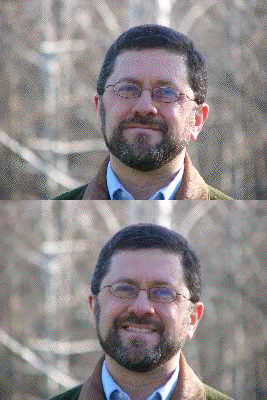
For those of you who listen regularly to my audio files, my son Michael has also posted a visual aid, which might enhance your listening pleasure.
Aging Gracefully
Son Michael wants you to know that he has upgraded the main image on my home page. (He’s the photographer.) Now it has gray hairs.
Passage to Carthage
For those of you patiently waiting, Maria Lectrix has posted the conclusion of Tertullian’s “Of Patience.” As always, her brief comments are lovely, well worth the trip to her blog.
Bishop 1, Emperor 0
Call it spine. St. Ambrose had a sturdy one, and he used it to stand up to emperors and face them down. In a post titled Ambrose the Bruiser, Adrian Murdoch looks at Our Man from Milan’s famous “just try it” letter to Valentinian II. (You’ll find the full text of the letter here.)
Don’t Sell Celibacy Short
The pope and curial officials met last week to discuss the surreal affairs of the globetrotting apostate Archbishop Milingo. At the conclusion of their meeting they reaffirmed the value of priestly celibacy. Milingo has said publicly that he thinks it wise to jettison the western tradition to alleviate the “dire … shortage of priests.” Blazing a trail in this direction, he himself married a member of Sun Myung Moon’s Unification Church. He then went on to ordain a few married men, including one guy who had already been consecrated by almost a half-dozen other bishops of questionable credentials.
My friends among the Lutheran and Episcopal clergy say that Milingo’s claim is absurd. In fact, their denominations — which permit clergy to marry — have experienced a similar decline in candidates over the last few decades. They’ve relaxed academic standards (so they tell me), bumped up the salaries and benefits, and doubled the potential pool of candidates by admitting women — but they’re still coming up short.
The Vatican’s right to remind us of the value of celibacy. We shouldn’t need the reminder, with all the scriptural passages that so clearly promote the celibate life (e.g., Matthew 19:10-12; 1 Corinthians 7; Revelation 14:4). (It’s a marvel to me that so-called “sola scriptura” Christians have never warmed to something taught so explicitly and emphatically in the New Testament.) And if we manage to miss the message in the Good Book, the Fathers are always around to remind us. I just finished re-reading Eusebius’s History of the Church, where celibates and consecrated virgins are everywhere celebrated. Last week I mentioned Aphrahat’s Demonstration 18, which complements the New Testament witness with an argument drawn from numerous Old Testament texts.
In both the east and the west, the Church has always prized celibacy. In the west, celibacy has almost always been obligatory for priests. In the east, parish priests have ordinarily been married, while bishops are celibate. As a result, the eastern churches usually draw their bishops from the ranks of the monks. In the age of the Fathers, married priests who were elevated to the episcopacy ordinarily lived with their wives “as brother and sister.”
Some years back, the Vatican posted an interesting study, by an easterner, on the Fathers and celibacy. I’m fond of two book-length treatments: Celibacy in the Early Church: The Beginnings of Obligatory Continence for Clerics in East and West by Stefan Heid and Apostolic Origins of Priestly Celibacy by Christian Cochini.
None of these authors claim that celibacy is essential to the priesthood. It’s certainly not. But it seems clear to me from Scripture and the Fathers that celibacy should be more revered — and more common — than it is in the Church today. I don’t think that celibacy is the great deterrent to priesthood that Archbishop Milingo thinks it is. I suspect that we in the west — addicted as we are to comfort and control — fear the cost of discipleship. And that fear will keep us out of the seminaries and convents, which are all about training disciples.
We’re weak. And until we recognize our weakness — and begin with God’s help to build up our strength — we’ll remain in this “dire” situation that Archbishop Milingo laments. But we’re never going to get stronger by indulging our weaknesses. If we demand little, we’ll get nothing. If we demand much, we just might see our way out of this man-made crisis.
I’ll wager that’s true not just for us Catholics, but for the Orthodox, Lutherans, and Episcopalians who are also wringing their hands over a “vocations shortage.”
The Golden Child
It looks like last-minute cramming to me. But Phil, the Candian patristic blogger, is expecting his initiation into parenting any day now. He posted on St. John Chrysostom and children.
Icon if I Want To
A little more on those ancient icons from St. Catherine’s in Sinai that are visiting California from now till next March. (Oops, now the link is fixed.)
Fourth-Century Image of Jesus Restored?
Discover the details at the Discovery Channel.
Ciao, Bella
KVSS radio has posted a long interview with Yours Truly, anticipating our big pilgrimage to Rome and Assisi in May 2007. The St. Paul Center has posted a day-by-day itinerary for the trip. Do consider joining me and my friends Scott and Kimberly Hahn. It’s a life-changing experience, spiritually transforming, to walk in the footsteps of the apostles and martyrs, the Fathers and the saints. It’s also a learning experience, to walk amid the monuments of millennia of western culture — to meditate, up close, on Michelangelo’s Sistine frescos; to celebrate the Eucharist in the Basilica of St. Clement, built from the home of a first-century pope, built over the ruins of a pagan Mithraeum. That’s our history, our ancestry, our life story. It’s our cultural genome mapped out before our eyes. Let’s see it together.
We’ve lined up great guides, devout and expert, to walk us through the sanctuaries and ruins. Scott and Kimberly and I will lead learning sessions in the mornings and evenings, and sometimes at the historic sites as well. Through the meanderings of the day, we’ll offer further observations. And we’ll all have our meals together. It’s a time to establish lasting friendships over good food. I’ve never, ever had a bad meal in Italy.
Some Good News and Some Bad News
Which do you want first: the good news or the bad news?
OK, but you’re just delaying the inevitable.
The wonderful news is that the great work of Aphrahat the Sage, his “Demonstrations,” is now available in its entirety in English. An Indian scholar, Kuriakose Valavanolickal, just published the second volume of his translation. To my knowledge, this is the first complete English translation of Aphrahat. In fact, till now it’s been impossible even to assemble all the Demonstrations from the various “selections” published in English since the late nineteenth century.
A little bit of backstory is in order.
The Catholic Encyclopedia (1911) places St. Aphrahat (sometimes rendered Aphraates) at the head of the long list of Syriac writers whose works have come down to us. We know little about his life. From his writings we learn that he was born of pagan parents during the second half of the third century, probably in the borderlands of the Persian empire. After his conversion to Christianity he embraced the monastic life, and was later called to be a bishop. One manuscript refers to him as “Bishop of the monastery of Mar Mattai,” whose ruins are near the modern Mosul in Iraq. His writings seem to have emerged between the years 337 and 345.
Aphrahat’s surviving works are his twenty-three “Demonstrations.” They’re homilies on morals and apologetics composed in the form of answers to an inquiring friend. They are a precious witness to the antiquity of many traditional Christian doctrines and practices — the value of celibacy, the perpetual virginity and Divine Maternity of Mary, sacramental confession, the Real Presence of Christ in the Eucharist, the foundation of the Church on St. Peter, and the existence of six of the seven sacraments. Aphrahat’s arguments are saturated with Scripture. In fact, because of his numerous quotations from the Bible, his writings are valuable for the history of the biblical canon and interpretation. Since he was in dialogue with some of the world’s most brilliant rabbis, he was always mindful to draw from the Old Testament as well as the New. His defense of celibacy — which, in my opinion, is the finest of all time — leans mostly on the Hebrew Scriptures.
The great modern scholar of Judaism Jacob Neusner finds St. Aphrahat to be a model — “remarkable and exemplary” — for Jewish-Christian dialogue. Aphrahat is, he adds, “an enduring voice of civility and rationality amid the cacaphony of mutual disesteem.”
Aphrahat’s writings have dribbled into English, beginning in the late nineteenth century. The Protestant Edinburgh edition of the Nicene and Post-Nicene Fathers (NPNF2) included “select” numbers from the Demonstrations: 1, 5, 6, 8, 10, 17, 21, and 22. (But don’t spend too much time searching there for material on the Blessed Virgin or on celibacy.) In the 1930s, the Journal of the Society of Oriental Research published two more, Demonstration 2 (on charity) and Demonstration 7 (on penance). Then, in 1971, Rabbi Neusner came through with a boatload, about eight and a half Demonstrations, which he published with his outstanding study Aphrahat and Judaism: The Christian-Jewish Argument in Fourth-Century Iran. Neusner’s book, which is indispensable, includes Demonstrations 11-13, 16-19, 21 and part of 23.
Those three sources add up to a lot; but even taken all together they still wouldn’t give you everything by Aphrahat. And everything is certainly what you want.
For that we had to wait for Kuriakose Valavanolickal, who published volume one of his translation with HIRS Publications in Kerala, India, in 1999. Volume two came out this year from the St. Ephrem Ecumenical Research Institute, also in Kerala. These books are almost impossible to obtain in the United States. The only vendor I found to carry them was Merging Currents.
Which brings me to the bad news — very bad news. I visited the Merging Currents site today and discovered that they will no longer be accepting book orders after November 30. If you haven’t visited the site before, please do. MC’s catalog is enormous, and it includes many rare primary patristic texts (especially the Syriac Fathers) and otherwise unavailable secondary literature (by the likes of Sebastian Brock, but also by many fine Indian scholars). As of this morning, Merging Currents was sold out of volume two of the Demonstrations, but volume one was still there. Grab it while you can.
Those of you who want to learn more about Aphrahat, but would rather spend less on a book, can, of course, buy the expanded edition of my bestseller, The Fathers of the Church. I have a chapter on the Persian Sage, with selections from his writings.
But until the books arrive … St. Aphrahat, pray for us — that we readers of the Fathers may find another passage to India.