In the London Times, Mary Beard shows us The Strangely Familiar World of Oxyrhynchus. Oxyrhynchus is the Egyptian town where hundreds of thousands of ancient manuscripts were discovered in the early twentieth century — including fragments of Christian apocrypha and the New Testament. It’s an entertaining essay that raises important questions about how and why we read history. The occasion is the publication of City of the Sharp-Nosed Fish by Peter Parsons.
Year: 2007
Cover Me
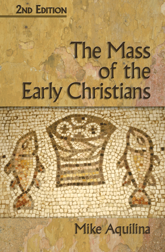
It looks like this is the new cover of the new edition of The Mass of the Early Christians. The new one’s not available on Amazon yet, but can be pre-ordered from the publisher, Our Sunday Visitor. To order the expanded edition, call toll-free 1-800-348-2440 and make sure to request T-419.
What’s on the cover? It’s a fifth-century mosaic depicting loaves and fishes, a favorite eucharistic symbol of the patristic era. This particular mosaic was found in the remains of a Byzantine church in Tabgha, Israel, the traditional site of Jesus’ feeding of the 5,000 (Mark 6:41).
Here are a few details on what’s new in this edition.
Mamas and the Papas
I mentioned last week that my wife Terri and I contributed a chapter titled “Milk and Mystery: On Breastfeeding and the Theology of the Body” to a new collection, Catholic for a Reason IV: Scripture and the Mystery of Marriage and Family Life. A commenter asked, somewhat incredulously, what the Fathers could have to do with such an exclusively maternal activity as breastfeeding. It’s a good question, and she put it to me with three question marks. So it merits at least a partial answer. (For a full answer, you’ll have to buy the book!)
My wife and I begin the essay by reviewing the ample biblical material on breastfeeding — the customs observed in Israel, the blessings and curses associated with the practice, the use of nursing as a metaphor, and instances where the inspired authors used breastfeeding as an essential part of a narrative plot.
The second section deals with the world of the Fathers, and again we discuss the cultural norms for breastfeeding mothers. And then we provide many examples of the Fathers’ use of breastfeeding imagery. A few examples:
Odes of Solomon: breastmilk is a metaphor for the Eucharist.
Odes of Solomon: the Holy Spirit is compared to a nursing mother.
Irenaeus of Lyons: speaks of Scripture as the breast of the Church.
Clement of Alexandria: Christ and the Eucharist are compared to milk; salvation is compared with lactation.
Ephrem of Syria: Christ is called “the breast of life.”
The Book of Steps: compares the Church to a nursing mother.
Augustine: speaks of Christians as nurslings, Christ as milk, the Bible’s two testaments as two breasts, and the Church as a nursing mother. He also uses the mother-child nursing relationship to illustrate how God creates us to be interdependent.
Again, that’s just a sampling. Both Clement and Augustine ponder the act of breastfeeding from physiological, moral, and theological angles. The full treatment is in our essay, “Milk and Mystery: On Breastfeeding and the Theology of the Body,” in Catholic for a Reason IV: Scripture and the Mystery of Marriage and Family Life.
I have another post on the subject of breastfeeding, here, with links to some great scholarship.
Origen’s Back
I don’t think Origen was waiting around anywhere for his rehabilitation. But if he was, it arrived yesterday.
In his Wednesday audience, Pope Benedict referred to the Man of Steel as “one of the most outstanding” of the “great figures of the ancient Church,” “a true teacher,” and concluded: “I invite you to welcome the teachings of this great teacher of the faith into your hearts.”
In our meditations on the great figures of the ancient Church, today we will get to know one of the most outstanding. Origen of Alexandria is one of the key people for the development of Christian thought. He draws on the teachings he inherited from Clement of Alexandria, whom we reflected upon last Wednesday, and brings them forward in a totally innovative way, creating an irreversible turn in Christian thought.
He was a true teacher; this is how his students nostalgically remembered him: not only as a brilliant theologian, but as an exemplary witness of the doctrine he taught. “He taught,” wrote Eusebius of Caesarea, his enthusiastic biographer, “that one’s conduct must correspond to the word, and it was for this reason above all that, helped by God’s grace, he led many to imitate him” (Hist. Eccl. 6,3,7).
His entire life was permeated by a desire for martyrdom. He was 17 years old when, in the 10th year of Septimius Severus’ reign, the persecution against Christians began in Alexandria.
Clement, his teacher, left the city, and Origen’s father, Leonides, was thrown into prison. His son ardently yearned for martyrdom, but he would not be able to fulfill this desire. Therefore, he wrote to his father, exhorting him to not renounce giving the supreme witness of the faith. And when Leonides was beheaded, young Origen felt he must follow the example of his father.
Forty years later, while he was preaching in Caesarea, he said: “I cannot rejoice in having had a father who was a martyr if I do not persevere in good conduct and I do not honor the nobility of my race, that is to the martyrdom of my father and the witness he gave in Christ” (Hom. Ez. 4,8).
In a later homily — when, thanks to the extreme tolerance of Emperor Philip the Arab, the possibility of ever becoming a martyr seemed to fade — Origen exclaimed: “If God would consent to let me be washed in my blood, receiving a second baptism by accepting death for Christ, I would surely go from this world. … But blessed are they who merit these things” (Hom. Lud. 7.12).
These words reveal Origen’s nostalgia for the baptism by blood. And finally, this irresistible desire was, in part, fulfilled. In 250, during the persecution by Decius, Origen was arrested and cruelly tortured. Severely weakened by the sufferings he endured, he died a few years later. He was not yet 70 years old.
We mentioned earlier the “irreversible turn” that Origen caused in the history of theology and Christian thought. But in what did this “turn” consist, this turning point so full of consequences?
In substance, he grounded theology in the explanations of the Scriptures; or we could also say that his theology is the perfect symbiosis between theology and exegesis. In truth, the characterizing mark of Origen’s doctrine seems to reside in his incessant invitation to pass from the letter to the spirit of the Scriptures, to progress in the knowledge of God.
And this “allegoristic” approach, wrote von Balthasar, coincides precisely “with the development of Christian dogma carried out by the teachings of the doctors of the Church,” who — in one way or another — accepted the “lesson” of Origen. In this way, Tradition and the magisterium, foundation and guarantee of theological research, reach the point of being “Scripture in act” (cf. “Origene: il mondo, Cristo e la Chiesa,” tr. it., Milano 1972, p. 43).
We can say, therefore, that the central nucleus of Origen’s immense literary works consists in his “three-pronged reading” of the Bible. But before talking about this “reading,” let us look at the literary production of the Alexandrian.
St. Jerome, in his Epistle 33, lists the titles of 320 books and 310 homilies by Origen. Unfortunately most of those works are now lost, but the few surviving works make him the most prolific author of the first three Christian centuries. His array of interests extended from exegesis to dogma, to philosophy, to apologetics, to asceticism and to mysticism. It is an important and global vision of Christian life.
The inspirational core of this work is, as we mentioned earlier, the “three-pronged reading” of the Scriptures developed by Origen during his life. With this expression we are alluding to the three most important ways — not in any order of importance — with which Origen dedicated himself to the study of Scripture.
He read the Bible with the intent to understand the text as best he could and to offer a trustworthy explanation. This, for example, is the first step: to know what is actually written and to know what this text wanted to say intentionally and initially. He carried out a great study with this in mind and created an edition of the Bible with six parallel columns, from right to left, with the Hebrew texts written in Hebrew — Origen had contact with rabbis to better understand the original Hebrew text of the Bible.
He then transliterated the Hebrew text into Greek and then did four different translations into Greek, which permitted him to compare the various possibilities for translation. This synopsis is called “Hexapla” (six columns). This is the first point: to know exactly what is written, the text in itself.
The second “reading” is Origen’s systematic reading of the Bible along with its most famous commentaries. They faithfully reproduce the explanations give by Origen to his students, in Alexandria and Caesarea. He proceeds almost verse by verse, probing amply and deeply, with philological and doctrinal notes. He works with great attention to exactness to better understand what the sacred authors wanted to say.
In conclusion, even before his ordination, Origen dedicated himself a great deal to the preaching of the Bible, adapting himself to varied audiences. In any case, as we see in his Homilies, the teacher, dedicated to systematic interpretation of verses, breaks them down into smaller verses.
Also in the Homilies, Origen takes every opportunity to mention the various senses of sacred Scripture that help or express a way of growth in faith: There is the “literal” sense, but this hides depths that are not apparent upon a first reading; the second dimension is the “moral” sense: what we must do as we live the Word; and in the end we have the “spiritual” sense, the unity of Scripture in its diversity.
This would be interesting to show. I tried somewhat, in my book “Jesus of Nazareth,” to show the multiple dimensions of the Word in today’s world, of sacred Scripture, that must first of all be respected in the historical sense. But this sense brings us toward Christ, in the light of the Holy Spirit, and shows us the way, how to live.
We find traces of this, for example in the ninth Homily on Numbers, where Origen compares the Scriptures to nuts: “The doctrine of the Law and of the Prophets in the school of Christ,” he affirms, “is bitter reading, like the peel, after which you come to the shell which is the moral doctrine, in the third place you will find the meaning of the mysteries, where the souls of the saints are fed in this life and in the next” (Hom. Num. 9,7).
Following along this path, Origen began promoting a “Christian reading” of the Old Testament, brilliantly overcoming the challenge of the heretics — above all the Gnostics and the Marcionites — who ended up rejecting the Old Testament.
The Alexandrian wrote about this in the same Homily on Numbers: “I do not call the Law an ‘Old Testament,’ if I understand it in the Spirit. The Law becomes an ‘Old Testament’ only for those that what to understand it in terms of the flesh,” that is to say, stopping at the mere reading of the text. But, “for us, we who understand it and apply it in the Spirit and in the sense of the Gospel, the Law is ever new, and the two Testaments are for us a new Testament, not because of a temporal date, but because of the newness of the meaning. … For the sinner on the other hand and those who do not respect the pact of charity, even the Gospels get old” (Hom. Num. 9,4).
I invite you to welcome the teachings of this great teacher of the faith into your hearts. He reminds us that in the prayerful reading of Scripture and in a coherent way of life, the Church is renewed and rejuvenated.
The Word of God, which never ages or has its meaning exhausted, is a privileged way of doing this. It is the Word of God, through the work of the Holy Spirit, which leads us always to the whole truth (cf. Benedict XVI, international congress for the 40th anniversary of the dogmatic constitution “Dei Verbum,” in Insegnamenti, vol. I, 2005, pp. 552-553).
Let us ask the Lord to enable us thinkers, theologians and exegetes of today to find this multidimensional nature, this permanent validity of sacred Scripture.
We pray that the Lord will help us to read the sacred Scriptures in a prayerful way, to really nourish ourselves on the true bread of life, his Word.
Origen played leading roles in my books The Fathers of the Church and The Mass of the Early Christians.
Court of Appeals
Yet another fascinating analysis of the condemnation of Origen.
Oh Happy Day
That Happy Catholic sure knows how to make a Catholic happy. She reviewed my most recent book, Love in the Little Things: Tales of Family Life.
Tom Finery
Capuchin Father Thomas Weinandy, the U.S. bishops’ chief doctrinal official, is in town to speak to catechetical leaders in our diocese. I had the great honor and pleasure of his company at dinner. Among Father Tom’s many great books is The Theology of St. Cyril of Alexandria: A Critical Appreciation. That’s my personal favorite. Much more affordable, though, is Jesus the Christ. For many years, he was at Oxford, directing great dissertations like this one. It’s good to have him back home in the States.
On Your Mark
It’s the feast of St. Mark. Celebrate with the Christians of Alexandria, the Church founded and ruled by St. Mark. The Egyptian liturgy, of course, was named after Mark, and the Patriarchs (Popes) of Alexandria consider themselves his successors. St. Jerome counts Mark among his Illustrious Men:
Mark the disciple and interpreter of Peter wrote a short gospel at the request of the brethren at Rome embodying what he had heard Peter tell. When Peter had heard this, he approved it and published it to the churches to be read by his authority, as Clement in the sixth book of his Hypotyposes and Papias, bishop of Hierapolis, record. Peter also mentions this Mark in his first epistle, figuratively indicating Rome under the name of Babylon: “She who is in Babylon elect together with you salutes you and so does Mark my son.” So, taking the gospel which he himself composed, he went to Egypt and first preaching Christ at Alexandria he formed a church so admirable in doctrine and continence of living that he constrained all followers of Christ to his example. Philo, most learned of the Jews, seeing the first church at Alexandria still Jewish in a degree, wrote a book on their manner of life as something creditable to his nation telling how, as Luke says, the believers had all things in common at Jerusalem, so he recorded that he saw was done at Alexandria, under the learned Mark. He died in the eighth year of Nero and was buried at Alexandria, Annianus succeeding him.
Big News!
Last year my publisher, Our Sunday Visitor, asked me to do an expanded version of yet another of my books — The Mass of the Early Christians. Earlier, OSV had released an expanded edition of The Fathers of the Church, and the response was great.
Well, we were all set to re-release The Mass of the Early Christians in late summer, just in time to be used as a college and high-school textbook for Fall semester. But we ran into a problem: sales surged for the first edition, and it’s almost sold out. So OSV is rushing the expanded edition into print in late May.
You can pre-order it now by calling OSV — toll-free at 1-800-348-2440 — and using item number T-419. For those of you who’d rather wait till it’s on Amazon: hang tight — I’ll let you know as soon as it’s up.
Here’s what reviewers said about the first edition:
“This is an excellent and exciting work. I wish that The Mass of the Early Christians was compulsory reading for all ordinands. Mike Aquilina is to be congratulated.”
— Robert Beaken, New Directions (U.K.)“All Christians from liturgical traditions can read this book with profit and find comfort in the firm historical basis of their own worship. Those who have shunned liturgical worship might after reading this book reconsider their position and wonder what they have been missing.”
— Christian Book Reviews“The Mass we know on Sunday—the Mass you encounter in this book—is where Tradition lives, where Church’s memory reigns ‘in the Spirit.’ Read this book, then, and remember.”
— Scott Hahn, professor, Franciscan University“Aquilina is to be congratulated for making these texts accessible to a new and wide-ranging audience allowing us to echo the cry voiced by the martyrs of North Africa in the third century: ‘we cannot live without the Mass!'”
— Fr. Joseph Linck, rector, St. John Fisher Seminary“Mike Aquilina has performed a needed service in making this heritage accessible to non-specialists.”
— Oswald Sobrino, Esq.“Aquilina has done us a great service in summarizing 300 years of church history in a 239-page book.”
— Richard J. Vincent, theocentric.com
What’s new in the expanded edition? Lots. The book’s a good deal bigger. There are at least six new chapters — on Clement of Rome, Cornelius, Firmilian, the Anaphora of St. Mark, Eusebius, and the Council of Nicea. I added several more apocryphal texts, and included a discussion of the recently discovered Gospel of Judas. I also added more texts by Cyprian, Origen, Clement of Alexandria, and others. Still other chapters were extensively rewritten based on more recent scholarship.
The publisher’s boasts make me blush, but I’ll share the promo copy with you anyway:
What did the first Christians believe about the Eucharist?
How did they follow Jesus’ command, “Do this in remembrance of me”?
How did they celebrate the Lord’s Day?
What would they recognize in today’s Mass?
The answers may surprise you.
In The Mass of the Early Christians, author Mike Aquilina reveals the Church’s most ancient Eucharistic beliefs and practices. Using the words of the early Christians themselves — from many documents and inscriptions — Aquilina traces the Mass’s history from Jesus’ lifetime through the fourth century. The Mass stood at the center of the Church’s life, evident in the Scriptures as well as the earliest Christian sermons, letters, artwork, tombstones, and architecture. Even the pagans bore witness to the Mass in the records of their persecutions.
In these legacies from the early Church, you’ll hear and “taste and see” the same worship Catholics know today: the altar, the priests, the chalice of wine, the bread, the Sign of the Cross … the “Lord, have mercy” … the “Holy, holy, holy” … and the Communion.
You’ll see vividly how Jesus followed through on his promise to be with us always, until the end of time.
Hope you’ll at least put it on your wish list! Thanks for celebrating with me. I do love this book.
More B16 on Augustine
The Gift of Tongues
Roger Pearse is working with some ancient texts in Old Nubian. I’ll let him explain:
The Nubian kingdom occupied the northern end of what is today the Sudan, and the blacks living there were a constant feature in the history of Ancient Egypt, even leading to two dynasties of black pharaohs, and a civilisation based at Meroe, complete with imitation pyramids. They were converted to Christianity at the end of Antiquity, and continued to be so down to the Middle Ages, and material in Old Nubian is the literature of that kingdom. The Nubian kingdom eventually broke up under incessant Moslem attacks, and had ceased to exist by the time the first European travellers reached the area. Today Christianity is only a memory in that unhappy land. Excavations at the ancient Egyptian fortress at Qasr Ibrim (now mainly submerged by the Aswan High Dam) revealed quantities of Old Nubian texts.
It’s an intriguing stack of books: “The Matyrdom of St. Menas,” a lectionary, books of both testaments of the Bible, and works by Chrysostom.
Roger’s also dabbling in Classical Armenian. If this guy weren’t so kind, he’d sure be intimidating.
B16 Goes to Gus
Pope Benedict paid his respects at the tomb of St. Augustine. CNS reports:
PAVIA, Italy (CNS) — Paying homage to one of the most important figures of the church, Pope Benedict XVI prayed at the tomb of St. Augustine and called him a “model of conversion” for Christians of all ages.
Although conditioned by the passions of youth and the habits of his time, St. Augustine sought the truth — and that led him inevitably to faith, the pope said at a Mass April 22 in the northern Italian city of Pavia.
The pope’s two-day visit to Pavia and Vigevano, south of Milan, was packed with events: outdoor Masses in both cities, brief encounters with young people, a visit to a hospital and medical center, a university address and a prayer service in the church where the relics of St. Augustine are preserved.
It was Pope Benedict’s most extensive pastoral visit in Italy, and tens of thousands jammed the streets in each of the small cities to catch their first in-person glimpse of the German pontiff.
For the pope, it was above all a personal pilgrimage to the final resting place of a theologian who inspired his own thinking. As a young priest in 1953, the pope wrote his doctoral thesis on St. Augustine’s teachings.
More recently, he has cited St. Augustine frequently in papal discourses and documents, and a key theme of his pontificate — the need to appreciate and return God’s love — reflects St. Augustine’s statement that Christ came “mainly so that man might learn how much God loves him.”
In a homily to some 15,000 people gathered at a riverside park in Pavia, the pope explained why he found the saint so inspiring and such a good example for modern people. Born in North Africa in the fourth century, St. Augustine for many years ignored the counsel of his Christian mother and led a hedonistic lifestyle before converting and being baptized in Milan at the age of 33.
The pope said St. Augustine’s spiritual awakening was not an overnight event but a continual process, which was ultimately successful because he never stopped trying to find out “where we come from, where we are going and how we can find the true life.”
The pope said a second stage of his conversion came when, after his ordination as a priest, St. Augustine was called upon to preach publicly — a development that required him to translate his “sublime thoughts” into the language of the simple people.
A third phase of the conversion came even later when, as a bishop, St. Augustine revised and corrected his previous works, a sign of his own humility, the pope said.
At an evening liturgy in the church of San Pietro in Ciel d’Oro in Pavia, the pope stood in prayer before a crystal urn that holds the 226 bone fragments of St. Augustine. Then he lit a new votive lamp for the tomb.
In a sermon, the pope said St. Augustine had his eyes opened by an awareness of God’s love, which is “the heart of the Gospel, the central nucleus of Christianity.” It was also the theme of his own encyclical, “Deus Caritas Est” (“God Is Love”), which owes much to the thought of St. Augustine, the pope said.
Serving Christ, the pope said, is essentially a question of returning God’s love through acts of charity, with special attention to the material and spiritual needs of others.
He said the church exists to educate people in love and bring them to spiritual maturity.
“The church is not a simple organization of collective events nor, on the contrary, the sum of individuals who live a private religiosity,” he said.
“The church is a community of people who believe in the God of Jesus Christ and who commit themselves to implement in the world the commandment of charity which he left them,” he said.
Pagels on Colbert
If you want to see Stephen Colbert adversus haereses, check it out. He plays Irenaeus to Elaine Pagels’ Valentinus. OK, that’s giving both of them more credit than they’ve earned. But they do wear the hats, whether or not the hats fit. Hat tip: Apocryphicity.
A Year of Holy Grails
Chris Bailey, with whom I co-authored The Grail Code: Quest for the Real Presence, is celebrating his blogiversary at GrailCode.com.
Conn. Men
I have some big news to report this week, but no time to pull it together right now. I’m just getting back to town after delivering the More-Fisher lecture at St. John Fisher Seminary of the Diocese of Bridgeport, Connecticut. What an impressive place! The rector is a priest I much admire. The sems are a young bunch, and they have many virtues, not least hospitality, refinement, and culture. As I arrived, they were just returning from a private tour of New York’s Metropolitan Museum of Art, and they gave me an impressive report over appropriately strong coffee at breakfast.
Friday night I had an Italian dinner — just like Mama’s — on Arthur Avenue in the Bronx. The food was outstanding, but the conversation was heavenly. I was joined by Judy DeFelice of the seminary staff and her husband, Felice DeFelice. “Phil” is one of the premiere liturgical artists in the United States. I’ve had the privilege of worshiping at several altars he carved — though I never knew they were his. Such is the work of such a man. His work is featured online by the Institute for Sacred Architecture and here, here, and here on the site of noted architect Henry Menzies. Beauty is making a strong comeback, thanks be to God — and thanks to artists like Phil.