Happy Catholic spreads much cheer hereabouts, as she reviews Praying the Psalms With the Early Christians: Ancient Songs for Modern Hearts, by Yours Truly and my good friend Chris Bailey. I love it when reviewers say that the book’s main problem was that the reviewer didn’t want it to end.
Year: 2009
Essene Essay
On the long flight from Newark to Tel Aviv, I occupied myself with Jesus and First-Century Christianity in Jerusalem, by Elizabeth McNamer and Bargil Pixner, OSB. I see that Dr. McNamer has posted an online essay based on that fascinating book.
For more of Father Pixner’s work, see here and here. He has since gone to his reward. Two of my fellow pilgrims went looking for his excavations and were shown the way by a Palestinian boy who remembered the priest and his digging.
Father Pixner and Dr. McNamer connect the first-century Christians genetically (literally and figuratively) with the Essenes.
One does not have to look far to see that many of these practices [Essene] were adopted by the early Christian community. They returned to that upper room after the death of Jesus. They were altogether there at Pentecost. They celebrated this according to the Essene calendar. (“Devout men “were present in Jerusalem.) They choose Matthias by lot (there is a house of Matthias mentioned in the copper scroll). Pentecost became the main feast for the early church. Baptism became the initiation rite of the new community; The Holy Spirit (not mentioned anywhere in the O.T.) is prominent in the Dead Sea Scrolls and in the literature of the early Jewish community. They celebrated a sacred meal. They practiced communal living. Both sects observed a community rule (Didache for Christians). There was a hierarchy of twelve for both. Times of prayer were the same. Healing was done by both groups. Could it all just be coincidence? We are told early on that a group of priests converted. They couldn’t have been Sadducees, who are shown as opposed to the Christian sect in the Acts. So who else? The only alternative was the Essenes.
Budz Light (Not Lite)
In today’s mail came J. Budziszewski’s new book, The Line Through the Heart: Natural Law as Fact, Theory, and Sign of Contradiction. I put it aside as interesting for future reading, but perhaps far afield for this blog. Then, tonight, while waiting for my wife to finish up on the computer, I opened to a random page and found the author defending the Fathers against charges of intolerance. “Nor do the patristic writers argue merely that God detests the persecution of Christians; they say that persecution as such is repugnant to faith and to the will of God. This argument is elaborated by diverse early Christian figures, just the sort of thinkers whom liberals assume to have been impossible before liberalism.” Then follows the abundant evidence, from Lactantius, Hilary, Isidore of Pelusium, Gregory Nazianzen, John Chrysostom, Athanasius, and Augustine. The quotes are generous. The argument covers many pages. As I glance through the index, I see many more familiar names from antiquity. Looks like I’ll be reading this sooner rather than later.
I’m a longtime fan of Budziszewski. I’ve used his Ask Me Anything: Provocative Answers for College Students and How to Stay Christian in College with my kids.
Meet the Fathers
Tiber River asked me to recommend a good course of introductory reading on the Fathers. Here’s my best shot.
Signs of the Times
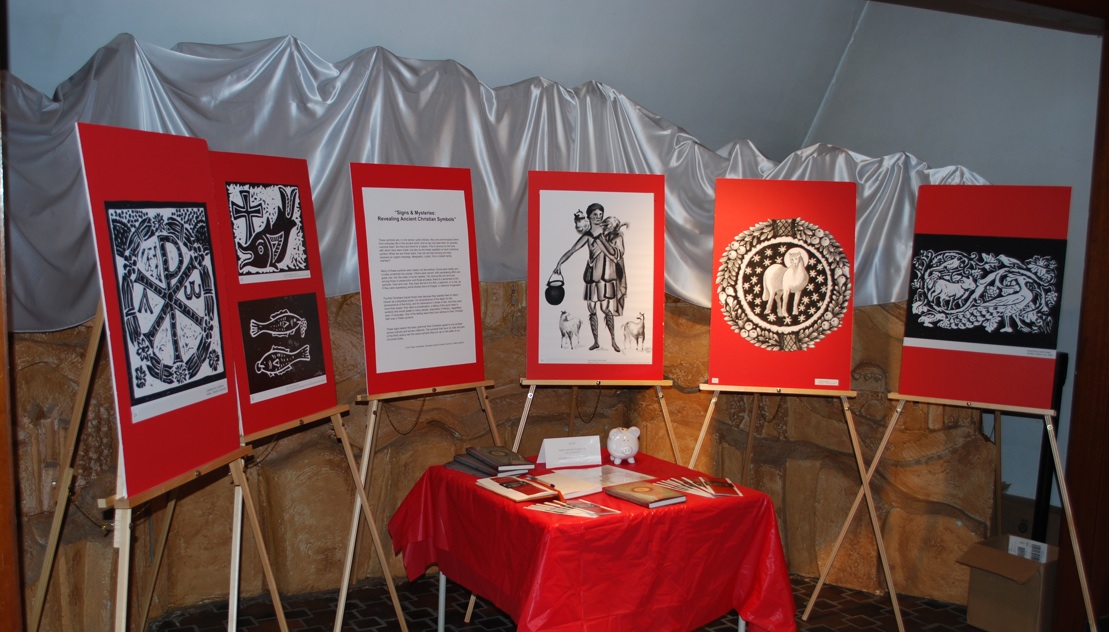
The Signs and Mysteries traveling road show is, briefly, at St. Sebastian Parish in Ross Township (a suburb of Pittsburgh). The intersection is McKnight and Siebert Roads. The book’s renowned illustrator, Lea Ravotti, sent along a photo of part of the exhibit, which is in the nave of the Church. Hurry if you plan to visit. It’s only there this week, June 7-15, 2009! Other parishes will follow. Stay tuned.
Casting a Paul
Texan Taylor Marshall — who teaches at the University of Dallas and whose blog I have linked for its reconsiderations of Christianity and neoplatonism — is now podcasting The Catholic Perspective on Paul. Listen up!
From the Ancestral Lands
A blogger-priest in Italy transcribed and translated a bit of my recent on-the-air conversation with The Great Al Kresta. It’s all about Angels.
Taking (Ancient) Initiative
Last week I had the great pleasure of coffee, conversation, and prayer with Timothy Becker, who’s finishing up his doctoral work in patristics at Union in New York. Tim and Matt Bell, a doctoral student at Durham, are living in Pittsburgh and launching a remarkable project called the Ancient Christian Faith Initiative.
Tim says: “Our goal with ACFI is to bless the Church by connecting Christians with the spiritual vision of the Fathers. This past spring we led a group of about nine, from Protestant, Catholic, and Orthodox backgrounds. We studied Sts. Irenaeus, Cyril of Alexandria, Hilary of Poitiers, and Jacob of Serug, covering, among other things, Rule of Faith, Christology, Eucharist, Baptism, and Mary. The response was dramatic. People were enthralled with the charismatic power of the Fathers and grew in their awe and wonder at the Christian faith.”
But of course. The good news is that they’re going to keep it going: “This summer we are offering a seminar that will cover Sts. John of Damascus and Symeon the New Theologian. In the fall, we’ll be offering two seminars: ‘Pillars of the Church’ (Sts. Ephrem, Gregory of Nazianzus, and Augustine) and ‘How to Read the Bible According to the Early Church.'”
Each session includes a discussion based on the reading — 20-40 pages per week. It all takes place Mondays, 7 p.m. to 9 p.m., June 8 to July 13 at St. George Antiochian Orthodox Cathedral (in Pittsburgh’s Oakland neighborhood), 3400 Dawson St. Cost is $90 for the seminar, approximately $15 for books.
Tim is also hosting a high-school boys seminar on St. Athanasius. Why? “Rebellions always need a beginning.” It starts next week.
I apologize for the lateness of this posting. I’m very excited about this project — but way too busy to act as quickly as it deserves! Mea maxima culpa.
I suspect the Ancient Christian Faith Initiative may be the real reason the London Economist just chose Pittsburgh as the United States’ most livable city.
Big Bible News III: The Software
As if on cue, in today’s mail came The Collegeville Catholic Reference Library: CD-ROM Edition, Version 2.0. It’s out from Logos, who also did the Early Church Fathers Catholic EditionEarly Church Fathers Catholic Edition many years ago. The Collegeville Catholic Reference Library includes:
- The New Dictionary of Sacramental Worship
- The New Dictionary of Catholic Spirituality
- The New Dictionary of Catholic Social Thought
- The New Dictionary of Theology
- Consecrated Phrases: A Latin Theological Dictionary
- Collegeville Bible Commentary (entire collection)
- New American Bible (Revised)
Other stuff can be activated for a fee: RB 1980: The Rule of St. Benedict in Latin and English; Benedict’s Rule: A Translation and Commentary, by Terrance Kardong; Early Monastic Rules with The Rules of the Fathers in Latin and English.
Logos has a page dedicated to its Catholic products. It’s well worth a look. I’ve yet to unwrap this software. I’ll let you know how it goes.
Angel Sightings
Chris Cash at Catholic Spotlight has podcasted our long conversation about my book Angels of God: The Bible, the Church and the Heavenly Hosts.
Also, dearest Maureen Wittmann has posted full text of David Mills’ review of the book.
Keys to Educational Success
Yesterday I had the singular honor of giving the high-school commencement address at Aquinas Academy in Pittsburgh, Pennsylvania. In case you didn’t know: Aquinas has the highest SAT average in its region and for four years in a row has been ranked one of the Top 50 Catholic High Schools in the United States. See what happens when a school incorporates my books (The Resilient Church and The Fathers of the Church) in its religion and history curricula?
I served on the board of Aquinas, way back at its founding (1996).
Holy Land Scrapbooking
It’s amazing that I’m still trying to catch up after my ten days in the Holy Land. If you track the activity of those days, though, you’ll understand why. My fellow pilgrim Piotr has posted narrative (in Polish and English!) plus photos plus video of the trip. I make cameos frequently, as Piotr and I were assigned to the same bus.
Big Bible News II: The Dictionary

My friend Scott Hahn’s Catholic Bible Dictionary is now in the warehouse and shipping from Amazon. Scott’s beaming. He says: “It weighs in with more than a thousand pages. It’s sturdily and beautifully bound. And it includes more than five thousand clear and accessible entries covering a wide range of people, places, and topics, from Genesis to Revelation. Best of all, perhaps, it comes at a very affordable price.”
He’s quite right.
Big Bible News I: The Concordance
Had lunch a couple days back with my good friend Mike Sullivan of Emmaus Road Publishing. At an opportune moment, he reached into his bag and pulled out a fresh copy of the massive Catholic Bible Concordance for the Revised Standard Version Catholic Edition — the first and only concordance for the RSV-CE. It includes more than 15,000 words and 300,000 entries. It was compiled by C.W. Lyons and has a foreword from my friend Scott Hahn. It’s quite lovely, and I can’t wait to own a copy. It’s on sale now!
A Gathering of Angels
Just got back from Jerusalem, and my little brain has not yet adjusted to the new time zone. I was very happy to return to new reviews of my book Angels of God: The Bible, the Church and the Heavenly Hosts.
Happy Catholic reviewed it, saying: “With his customary clarity and thoroughness, Mike Aquilina not only enlightens us about angels but actually makes us realize that our angelic brethren are just that … our brothers.” She says it’s “easy to understand without dumbing down” and “highly recommended.”
Meanwhile, Donna-Marie Cooper O’Boyle said, in the first installment of her review: “I am loving Mike Aquilina’s new book Angels of God: The Bible, the Church and the Heavenly Hosts … I especially love this author’s style of writing. He brings us so much enlightenment on his subjects in a wonderful conversational way. Mike helps us to discover the reality and the power of our Angel friends, escorting them seemingly ever closer to us. I really feel like I’m sitting down with Mike and chatting about the Angels over a cup of coffee every time I pick up this book to read more. I know you’ll love this book and learn much too, which is why I am highly recommending it. I’ll be posting a review of it soon. Stay tuned!”