Posted on

Saving the Monastery

While I was in Israel, Reuters reported on the happy resolution of a nasty situation I blogged on some time back.

Christian monastery in Turkey wins back land

ISTANBUL (Reuters) – One of the world’s oldest functioning Christian monasteries has won a legal battle to have land it had owned for centuries restored to it, after a Turkish court ruled on Friday it could not be claimed by the state.

The dispute over the boundaries of Mor Gabriel, a fifth-century Syriac Orthodox monastery in eastern Turkey, had raised concerns over freedom of religion and human rights for non-Muslim minorities in Turkey, a predominantly Muslim country and European Union aspirant.

In a statement, the Syriac Universal Alliance (SUA), a leading Syriac group based in Sweden, said a Turkish court in Midyat had reversed an initial decision by the land registry court to grant villages some 110 hectares (272 acres) of monastery land.

Posted on

A Little Vindication

BMCR reviews Alden A. Mosshammer’s The Easter Computus and the Origins of the Christian Era (in the Oxford Early Christian Studies series). What’s it all about? It’s about …

… Dionysius Exiguus, the sixth-century putative inventor of Anno Domini dating. Skeptics … noted that Dionysius’ dating of the nativity was quite likely wrong … The Venerable Bede had observed back in the early eighth century that Dionysius’ dating of Christ’s birth contradicted biblical, annalistic, and patristic evidence, which favored the years BC 2/3. Most modern scholars thus have assumed that Dionysius willfully broke with tradition, and calculated his own (incorrect) nativity date.

Mosshammer effectively undermines this accusation in a lengthy, highly technical, and meticulously-argued study … That he largely succeeds is a testament to his clearly extensive knowledge of antique calendrical traditions.

Posted on

The World’s Liturgist

Pope Benedict XVI has named an American, Dominican Father J. Augustine DiNoia, secretary of the Congregation for Divine Worship and the Sacraments. Father Gus (now Archbishop-designate Gus) has been with the Vatican Congregation for the Doctrine of the Faith since 2002, and before that he was the doctrine guy for the U.S. bishops. When I was doing newspaper work, he was the perfect source, peerless in clarity and brevity. When I’ve visited Rome with my friend Scott Hahn, Father Gus has always been a gracious and entertaining host. Catholic News Service tells the story of his well-deserved promotion and points us to sound files of his lectures.

Posted on

Happiness and Knowledge

My two oldest daughters are happy and they know it. Their puppet video is part of some contest. I think they get bonus points if you view their video, and they get thrilled if you comment. So make them happier still!

Eldest now tells me that the grand prize is a guitar. I wonder if it comes with headphones.

UPDATE: my daughters say an explanation is in order. Their video is actually a parody of the work of a “screamo” group. Screamo is a combination of “scream” and “emo” (from emotional, with teen connotations). This helps, I suppose. I had thought it to be an exploration in epistemology, perhaps Augustinian for its emphasis on happiness. How do we know we’re happy?

Posted on

All Lost in Wonder

Al Ahram posted a nice feature on the old lighthouse of Alexandria, one of the Seven Wonders of the World. The Pharos occupies a chapter in my book Signs and Mysteries: Revealing Ancient Christian Symbols, as it appears often in ancient Christian art and literature. Basil compared Athanasius to the towering wonder that cast brilliant light to guide wayfarers to safety. Athanasius, of course, was bishop of Alexandria.

There seems to be talk about assembling the lighthouse from the rubble.

Posted on

Naples Explodes with Delights

The New York Times, of all places, regales us with early-Christian archeological finds in Naples, Italy. Tolle, lege: Deep in the Heart of Historic Naples.

Another day, we took an English-language tour at the catacombs of San Gennaro, the patron saint of Naples, which began behind the Church of Madre del Buon Consiglio and just past a courtyard overlooking clotheslines, lemon trees and scooters. Down below we walked, first seeing small chapels, which held the bodies of wealthy families; in one “cubico,” a haunting fresco from the sixth-century A.D. memorialized a family with a young child. The bodies of humbler citizens were placed in wall niches that are now empty. We walked through ancient arches amid a silent mustiness, and learned that this catacomb’s earliest use was in the second century A.D. Here, too, is the site of three early churches, the oldest dating to the fourth century; two of them were built underground. We saw a painting of Adam and Eve from the third century A.D. and symbols of Greek goddesses. Near the exit was a fresco of a bishop from the ninth or 10th century, found about a year ago.

Later, in the Sanità district, we toured the Catacombs of San Gaudioso — named for an African bishop who arrived in Naples in 439 — and saw skulls set into wall niches with frescoes below them depicting the dress of their owners’ professions: a judge’s robes, a knight with a sword. In the women’s area, the frescoes showed only long dresses: “The women had no professions, of course,” our guide explained.

You’ll find more up-to-the-minute Neapolitan archeological news here.

Posted on

Patristics for the Kids

The animated feature The Story of Saint Perpetua is now available. It’s the first installment in the Catholic Heroes of the Faith series. I served as a consultant on this project, and I appear on camera in the soon-to-be-released companion documentary. Here’s the promo copy:

It is the year AD 203 in Carthage, North Africa. Perpetua, an affluent young mother, is charged with converting to Christianity and is sent to prison. But her freedom can be secured easily. All she has to do is offer one pinch of incense in honor to the Roman gods. With this simple act of devotion and loyalty to the Roman Empire she can regain her freedom and return to her son and a life of comfort. As her father pleads for Perpetua to consider the welfare of her child and the reputation of their family, she slowly makes her way to face the Roman proconsul and declare her final decision. What will it be? This inaugural episode of Catholic Heroes of the Faith presents one of the most influential, true stories of the Early Church.

Catholic Heroes of the Faith is a series of animated programs for youth ages eight and older, presenting the lives of true-life heroes of the Catholic Faith.

DVD Features:

– English and Spanish languages with optional English and Spanish subtitles

– Comprehensive leader’s guide in PDF with lesson plans, background information, and more

– Reproducible student handouts in PDF with discussion questions, puzzles, coloring pages, and more

Posted on

Essene Essay

On the long flight from Newark to Tel Aviv, I occupied myself with Jesus and First-Century Christianity in Jerusalem, by Elizabeth McNamer and Bargil Pixner, OSB. I see that Dr. McNamer has posted an online essay based on that fascinating book.

For more of Father Pixner’s work, see here and here. He has since gone to his reward. Two of my fellow pilgrims went looking for his excavations and were shown the way by a Palestinian boy who remembered the priest and his digging.

Father Pixner and Dr. McNamer connect the first-century Christians genetically (literally and figuratively) with the Essenes.

One does not have to look far to see that many of these practices [Essene] were adopted by the early Christian community. They returned to that upper room after the death of Jesus. They were altogether there at Pentecost. They celebrated this according to the Essene calendar. (“Devout men “were present in Jerusalem.) They choose Matthias by lot (there is a house of Matthias mentioned in the copper scroll). Pentecost became the main feast for the early church. Baptism became the initiation rite of the new community; The Holy Spirit (not mentioned anywhere in the O.T.) is prominent in the Dead Sea Scrolls and in the literature of the early Jewish community. They celebrated a sacred meal. They practiced communal living. Both sects observed a community rule (Didache for Christians). There was a hierarchy of twelve for both. Times of prayer were the same. Healing was done by both groups. Could it all just be coincidence? We are told early on that a group of priests converted. They couldn’t have been Sadducees, who are shown as opposed to the Christian sect in the Acts. So who else? The only alternative was the Essenes.

Posted on

Budz Light (Not Lite)

In today’s mail came J. Budziszewski’s new book, The Line Through the Heart: Natural Law as Fact, Theory, and Sign of Contradiction. I put it aside as interesting for future reading, but perhaps far afield for this blog. Then, tonight, while waiting for my wife to finish up on the computer, I opened to a random page and found the author defending the Fathers against charges of intolerance. “Nor do the patristic writers argue merely that God detests the persecution of Christians; they say that persecution as such is repugnant to faith and to the will of God. This argument is elaborated by diverse early Christian figures, just the sort of thinkers whom liberals assume to have been impossible before liberalism.” Then follows the abundant evidence, from Lactantius, Hilary, Isidore of Pelusium, Gregory Nazianzen, John Chrysostom, Athanasius, and Augustine. The quotes are generous. The argument covers many pages. As I glance through the index, I see many more familiar names from antiquity. Looks like I’ll be reading this sooner rather than later.

I’m a longtime fan of Budziszewski. I’ve used his Ask Me Anything: Provocative Answers for College Students and How to Stay Christian in College with my kids.

Posted on

Signs of the Times

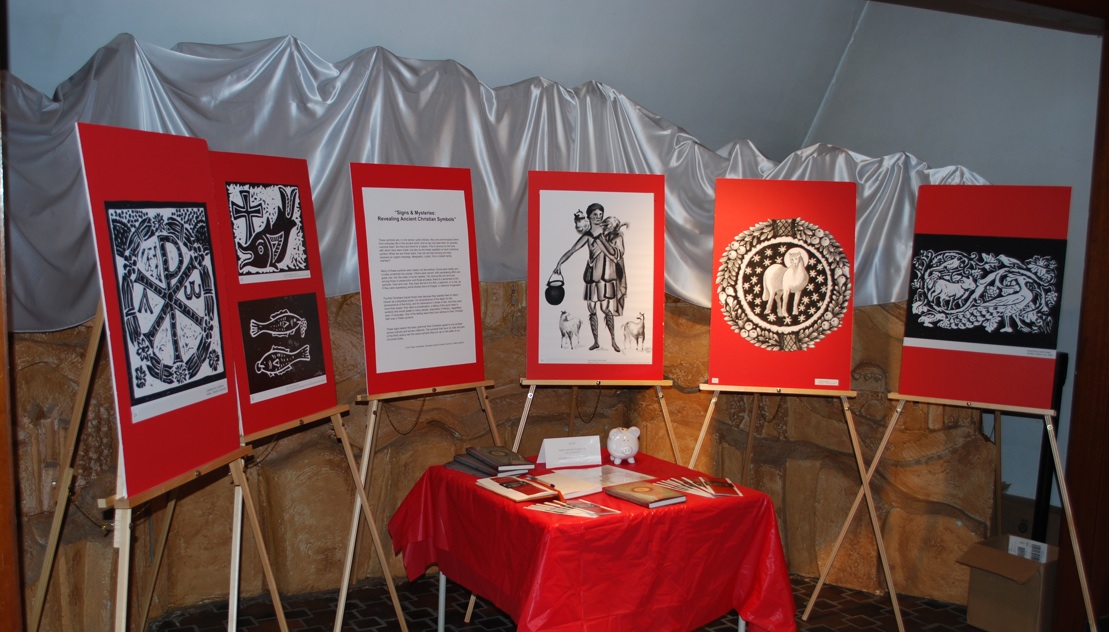
The Signs and Mysteries traveling road show is, briefly, at St. Sebastian Parish in Ross Township (a suburb of Pittsburgh). The intersection is McKnight and Siebert Roads. The book’s renowned illustrator, Lea Ravotti, sent along a photo of part of the exhibit, which is in the nave of the Church. Hurry if you plan to visit. It’s only there this week, June 7-15, 2009! Other parishes will follow. Stay tuned.

Posted on

Taking (Ancient) Initiative

Last week I had the great pleasure of coffee, conversation, and prayer with Timothy Becker, who’s finishing up his doctoral work in patristics at Union in New York. Tim and Matt Bell, a doctoral student at Durham, are living in Pittsburgh and launching a remarkable project called the Ancient Christian Faith Initiative.

Tim says: “Our goal with ACFI is to bless the Church by connecting Christians with the spiritual vision of the Fathers.  This past spring we led a group of about nine, from Protestant, Catholic, and Orthodox backgrounds.  We studied Sts. Irenaeus, Cyril of Alexandria, Hilary of Poitiers, and Jacob of Serug, covering, among other things, Rule of Faith, Christology, Eucharist, Baptism, and Mary.  The response was dramatic.  People were enthralled with the charismatic power of the Fathers and grew in their awe and wonder at the Christian faith.”

But of course. The good news is that they’re going to keep it going: “This summer we are offering a seminar that will cover Sts. John of Damascus and Symeon the New Theologian.  In the fall, we’ll be offering two seminars: ‘Pillars of the Church’ (Sts. Ephrem, Gregory of Nazianzus, and Augustine) and ‘How to Read the Bible According to the Early Church.'”

Each session includes a discussion based on the reading — 20-40 pages per week. It all takes place Mondays, 7 p.m. to 9 p.m., June 8 to July 13 at St. George Antiochian Orthodox Cathedral (in Pittsburgh’s Oakland neighborhood), 3400 Dawson St. Cost is $90 for the seminar, approximately $15 for books.

Tim is also hosting a high-school boys seminar on St. Athanasius. Why? “Rebellions always need a beginning.” It starts next week.

I apologize for the lateness of this posting. I’m very excited about this project — but way too busy to act as quickly as it deserves! Mea maxima culpa.

I suspect the Ancient Christian Faith Initiative may be the real reason the London Economist just chose Pittsburgh as the United States’ most livable city.