Christianity Today has posted a good roundup on the Vision of Gabriel inscription. Remember, though: you heard it here months before you read it in the New York Times.
Author: Mike Aquilina
Villa of the Papyri
When Vesuvius erupted August 24, A.D. 79, it left Pompeii and Herculaneum buried under 30 meters of volcanic mud. We’ve learned so much about Roman life from the excavated bakeries and cafes sealed forever in that long-ago moment, with petrified food still on the tables and petrified bread still in the ovens. Most intriguing to nerds is the haul taken out of the Villa of the Papyri. It’s a library of scrolls that were instantly turned to blocks of charcoal. We don’t know what most of them contain. A month or so ago, a few of us were dreaming about the possibilities. Now The Australian is doing the same. “Scholars today, using multi-spectral imaging technology, are able to decipher the otherwise inscrutable surface of black ink on black fabric of the papyrus scrolls. A multinational team has assembled to transcribe the collection.” There’s no news, as the process has been temporarily halted, but there’s plenty of speculation to fuel our fantasies.
Roger Dodger
Now you see him … at another blog. Patristiblogger Roger Pearse is now pondering in a new place.
Join Me in the Holy Land?
I’ll be there May 16-25, 2009, with Dr. Scott and Kimberly Hahn and Steve and Janet Ray.
We’ll be celebrating the Year of St. Paul and visiting the sites of Jesus: the Sea of Galilee, the Mount of Transfiguration, Capernaum, Peter’s House, the Church of the Visitation, the Holy Sepulchre, Bethlehem, the Church of the Dormition, the Church of the Nativity, the Upper Room, the Garden of Gethsemane, the Via Dolorosa … and many more unforgettable places. We’ll also have optional side trips to Qumran, Masada, Jericho, and the Dead Sea for swimming.
History Repeats Itself
There’s a new (very affordable) paperback English translation of Eusebius: The Church History. The translator has tried to make the ancient work accessible to a wider modern audience. You’ll find a review here.
Check These Out
* The Knights of Columbus have launched a new parenting site called Fathers for Good. It’s rumored that some Aquilina-authored material will soon appear there.
* Tom Craughwell at Antique Holy Cards is offering my visitors a special 2-for 1 offer. Buy any package of Christmas cards (6 pack or 12 pack) and get another package FREE! This offer is available until August 25. Tom will also be reproducing some newly discovered antique cards, too, so keep an eye on his website.
* Maureen is proposing patristic material that’s ready-made for modern tee-shirts.
Ancient Germanic Übersource
Templar titan Paul Crawford tells us that the Monumenta Germaniae Historica is now available free online.
Time Travel Agency
Via Catholic News Service: Syrian monastery gives visitors taste of ancient spiritual life…
AL-NEBEK, Syria (CNS) — A sixth-century monastery in the desert of western Syria is giving today’s visitors the experience of ancient spiritual life.
Named after St. Moses, an Ethiopian monk, the Mar Musa monastery is about 20 miles from the nearest town, Al-Nebek. The monastery and its church are staffed with Catholic and Orthodox nuns and priests, and the compound has become a center for Muslim-Christian interfaith dialogue. With its vegetable garden and goat herd, the desert monastery is a model of sustainability.
“I felt like I had a calling to come here, and I felt at home in Mar Musa even before I started living here,” said Father Michel Toma, a Syrian Catholic priest from Homs, Syria, who moved to the monastery several months ago after having visited the remote spiritual oasis several times over the last 10 years. “I love nature. It’s a relaxing and calm place.”
Everyone who visits works to help keep the monastery running. Some tend to the goats and make cheese. Father Toma’s specialty is making candles, something he is teaching the other residents.
He is particularly proud of the monastery’s hospitality to all who visit regardless of race, religion or nationality.
“We welcome everyone,” Father Toma said. “It’s not important that someone prays the same way, but that we all live together. We eat and pray together. That’s the way we live.”
This is what Italian Jesuit Father Paolo Dall’Oglio envisioned when he founded the community about 20 years ago.
After celebrating an energetic Mass in Arabic, Father Dall’Oglio was quick to greet a tour group from Italy.
“Come and see the new church,” he said, leading the group across a bridge and up a cliff to a nearly completed stone church.
When Father Dall’Oglio stumbled upon Mar Musa’s ancient ruins in the early 1980s, the monastery was in severe decay. The site had been long forgotten, known only to a few local goat herders. The ancient monastery is reminiscent of an era when rocky landscapes provided shelters for self-sustaining religious communities.
With the help of volunteers, the Syrian government and international sponsors, the church roof has been rebuilt and medieval frescoes have been restored. More than 340 steps have been added almost seamlessly into the mountain, easing the climb to the monastery for visitors.
According to legend, the son of a wealthy Ethiopian king named Musa founded the monastery. Preferring the monastic life to the throne, he traveled to Egypt, then to the Holy Land, settling in Syria where he became a monk in Qara, southern Syria.
He lived as a hermit in the valley where the monastery is now situated until he died a martyr at the hands of a Byzantine soldier. As the story goes, the king’s family took his body but his right thumb was separated from his body and remains a relic in the Syrian church in Al-Nebek.
Mar Musa once belonged to the Syrian Antiochene rite. It was more than 500 years — in 1058 — before the church was built. The church’s frescoes, which date from the 11th and 12th centuries and depict biblical scenes, are the monastery’s pride.
Restoration work has revealed three layers of artwork: Two are from the 11th century and the other is from the end of the 12th century or the beginning of the 13th century, according to restorers.
The nave of the church is decorated with images of saints, with females on the arches and males on the pillars. A representation of the Last Judgment is depicted on the wall of the nave.
Each evening, there is about an hour of quiet time, followed by a prayer service. The liturgy usually is celebrated in Arabic, French or English.
Recently, the Jameel family made the eight-hour trip to Mur Masa from their home in northeastern Syria, near the Iraqi border, to have their 6-month-old daughter baptized.
During the baptism the priests sang and prayed while a group of about 50 people observed the ceremony. Once the child was dipped in the water, the priests immediately sang a joyful Arabic hymn to the beat of a large drum.
As the Jameel family and other visitors left, a group of French tourists who spent five days at Mar Musa took one last moment to rest under the tent on the monastery’s terrace before returning to Damascus.
Claire-Lise Henge of Alsace, France, said she was pleased with her visit.
“It’s not too strict, not what you’d think a monastery would be like,” she said. “It’s very open here. They joke around and people feel comfortable.”
She welcomed the mandatory participation in daily life, jokingly saying, “It means we’re not just squatters here.”
Carole Perez-Pinard, also from the French group, acknowledged that life at Mar Musa was somewhat of an acquired taste.
“Communal living was a big change for me,” she said. “The first day, I couldn’t imagine staying four nights.”
Like the French visitors, Jane Bornemeier, a tourist from New York, decided to visit Mar Musa out of curiosity.
“I didn’t know what it would be like. But it seemed adventurous, so we did it,” she said.
She admitted it was not what she expected.
“When we arrived, we were dropped off at the bottom of a cliff. When I saw how far up it was that we had to climb, I said, ‘No way.’ It’s much more remote and roughing it than I expected, much more like camping out than I thought it would be.”
But after one night of sleeping under the stars on the monastery’s roof, she quickly warmed to the surroundings.
“It’s an extraordinary place,” she said while helping with a meal for other visitors. “This modern version of an ancient tradition is really something.”
Holy Martyrs Fun Fair
There’s a town not far from me called Tarentum, and in Tarentum there’s a parish called Holy Martyrs, and every summer the parish hosts the “Holy Martyrs Fun Fair” — the signs for which always bring a smile to the face of my friend and sometime co-author Chris Bailey. He’s imagining, no doubt, Neronian spectacles. The reality is probably more like Bingo and pierogies.
But it seems that the Eternal City is planning its own Holy Martyrs fun fair on a grand scale: a Disney-style theme park. Not even Chris could make this up.
Pressing for Details
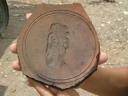
A few weeks ago we looked at the excavation of a Byzantine wine press near or at an ancient Egyptian monastery. Today let’s look at a Byzantine olive press just unearthed in Israel, also quite probably associated with a monastery. Among the artifacts found are two fragments of a marble chancel screen and what seems to be a plate bearing an image of the Madonna and Child.
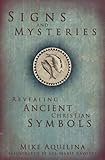
Olives for anointing … the fruit of the vine … the mother with her suckling infant … these images abound in my new book, Signs and Mysteries: Revealing Ancient Christian Symbols, which is lavishly illustrated by Lea Marie Ravotti. No less an authority than Adrian Murdoch has said that Signs and Mysteries is “an essential book to keep to hand when visiting early Christian sites” — even if you’re just visiting them as archeological sites on the Web!
UPDATE: The Jerusalem Post reports on the dig.
Pict Clean
The Independent reports on an ancient monastery found in the north of Scotland — that’s making folks regret all the nasty stuff they’ve said about the Picts.
Portrait Gallery
David Meadows leads us to a haunting YouTube slide show of ancient portraits, most of them from Egypt’s Roman period and discovered in the Fayoum. Many are painted on burial cloths. My favorite image from this style and period now hangs in the Louvre. It portrays the deceased, a beautiful young Christian woman, holding the traditional Coptic cross, the ankh. (I discuss this image in my new book, Signs and Mysteries: Revealing Ancient Christian Symbols.)
These are lovely images. You’ll see their influence later in Byzantine icons. Enjoy the show!
And may the souls of the faithful departed, through the mercy of God, rest in peace.
Happy About Signs and Mysteries
Happy Catholic has joined Adrian Murdoch in praising my new book, Signs and Mysteries: Revealing Ancient Christian Symbols. That means a lot to me, as HC knows the book very intimately. She’s the one who lovingly designed the pages, for perfect coordination of my words and the gorgeous lillustrations by Lea Maria Ravotti.
Question Authority
Some years back, my son contributed to a book project called No Question Left Behind, edited by Maureen Wittmann. The book got spiked just before press, for economic reasons. But now Maureen’s posting its contents, absolutely free, on a blog titled No Question Left Behind. Photos of the contributing authors make the page very appealing. Junior is wearing a red shirt and baseball cap, both of which he probably still wears. The braces, however, are long gone.
First Review!
“Mike Aquilina’s Signs and Mysteries provides a popular yet academically rigorous guide to symbols in the early church. The immediately accessible prose — which quotes thoughtfully from the church fathers, classical and Jewish sources — is complemented by generous illustrations. He has not only drawn on the obvious archaeological and epigraphic record, he has also delved into the fascinating world of Christian graffiti. An essential book to keep to hand when visiting early Christian sites.”
— Adrian Murdoch
Fellow, British Royal Historical Society
Author, The Last Pagan, Rome’s Greatest Defeat, and The Last Roman
The “generous illustrations,” numbering in the hundreds, are by the great Lea Marie Ravotti. The book is out any day now. Order yours today!