For a patristic look at the events the Chuch commemorates today, check my post from last year. For the patristic dispute on whether the events actually took place on Thursday or Tuesday, check this out.
Author: Mike Aquilina
Listen Here
I’ve fallen way behind in my postings. Those of you who like to listen should pump your Pod full of patristic audio from Maria Lectrix and Father Z. There’s tons of new stuff on their sites. And I’m on KVSS talking my way through the Triduum.
Which Church Father Are You?
I’m sure you were wondering when we’d get around just such a self-help test. By now you’ve figured out the color of your parachute and the season of your wardrobe. It’s time to figure out your place in the early Church. For each question, choose ONE answer that best describes your position.
Hip Gnosis
Elaine Pagels is at it again, hawking as silk purse that sow’s ear of the Gospel of Judas. My beloved godson David Mills slices and dices her recent interview with Salon.com: “This is really very dim. Remarkably dim. Dim beyond belief.” It’s a must-read.
Got a Date for Easter?
One of the great vexing questions of early Christianity concerned (believe it or not) when to celebrate Easter. N.S. Gill has done a nice job explaining the various positions. Wikipedia’s rundown is also pretty good.
But it’s best to engage the primary texts. So I hope Father Raniero Cantalamessa’s excellent Easter in the Early Church: An Anthology of Jewish and Early Christian Texts is atop your reading list for the season that begins next week.
Buddha: The Christian Fathers’ Response
Palms and Circumstance
Egeria, a nun from Gaul on pilgrimage in the Holy Land, left us a lively record of Holy Week celebrations in fourth-century Jerusalem. Here’s her play-by-play account of Palm Sunday:
On … the Lord’s Day that begins the Paschal week (which they call here the “Great Week”), when all the customary services from cockcrow until morning have taken place in the Church of the Resurrection and at the Cross, they customarily proceed … to the greater church, which is called the martyrium. It is called the martyrium because it is in Golgotha behind the Cross, where the Lord suffered. When all the customs have been observed in the great church, and before the dismissal is made, the archdeacon lifts his voice and says first: “Throughout the whole week, beginning from to-morrow, let us all assemble in the martyrium, that is, in the great church, at the ninth hour.” Then he lifts his voice again, saying: “Let us all be ready to-day in Eleona at the seventh hour.” So when the dismissal has been made in the great church, that is, the martyrium, the bishop is escorted with hymns to the Anastasis, and after all things that are customary on the Lord’s pay have been done there, after the dismissal from the martyrium, every one hastens home to eat, that all may be ready at the beginning of the seventh hour in the church in Eleona, on the Mount of Olives, where is the cave in which the Lord was wont to teach.
The Year in Review
Today marks one year since I started this blog. So it probably marks about fifteen years since my son started bugging me to start blogging. I’m very glad I finally took him up on it. I’ve met so many fascinating people through these pages. I thank you all for visiting, commenting, and sending me notes. I’ve learned much from the give and take that comes with this territory, which was very new to me (and still is). My unpleasant experiences I can count on one hand — and still have fingers left over.
Here’s some trivia from Junior the Webmaster. I have no idea what any of it means.
In its first year, this blog racked up 845,546 hits, 386,086 page views, 164,258 visits, and 74,376 unique visitors.
The most visited posts were:
Youth When the Church Was Young
Roman Cruelty, Christian Purity
My list of Top 20 books on the Fathers
The Time Capsule (on the Didache)
Another bit of trivia: This blog is one of Google’s top hits for several searches. But my absolute favorite is “Christian baby names.” I earned this by posting on some ancient Christians’ choice to name themselves “Stercorius” (literally, Crap). I hope I haven’t started a trend.
The top-selling books through the site are (in order):
The Fathers of the Church (by far!)
The Mass of the Early Christians
The Grail Code: Quest for the Real Presence
and Living the Mysteries: A Guide for Unfinished Christians
The most popular non-Aquilina books are (in order):
Through Their Own Eyes: Liturgy as the Byzantines Saw It by Robert Taft, S.J.
The Spirit of Early Christian Thought: Seeking the Face of God by Robert Louis Wilken
The Christian Catacombs of Rome: History, Decoration, Inscriptions by Fabrizio Bisconti et al.
Four Witnesses: The Early Church in Her Own Words by my friend Rod Bennett
In Procession Before the World: Martyrdom As Public Liturgy in Early Christianity by Robin Darling Young
If all I did in the course of the last year was sell these books I’ve loved by authors I admire, I’d count myself a great success at blogging. I hope you who bought them enjoyed the books half as much as I did. If so, you’re pretty happy campers in this KOA (Kampground of the Ancients).
I can’t thank all of you enough for encouraging me in this work. I address my gratitude to Junior first, but to all of you who have clicked here. When you do that, I know that a tree has fallen in the forest.
Party’s at Sardis
In addition to being Palm Sunday and April Fool’s Day, today’s the feast of St. Melito of Sardis, an oldie but goodie — and appropriate for the season. Huw at Doxos marks the day.
Unicorns — They’re Not Just for Girls Anymore
Ages before the first new-age fantasy, devout Christians told the allegory of the unicorn. In this story, the fabulous creature — like a horse but with a single horn on its head — finds its way into a nearby forest, and soon every hunter in the land desires the unicorn as his trophy. They send the fairest virgin into the meadow, where she sings a song to attract the unicorn. Charmed, the animal comes out to hear her song and rests its head upon her lap. And so it is caught. In the allegory, the unicorn stands for Jesus, the Word who came into the world from heaven. The singer, of course, is His Blessed Mother, Mary. The hunters represent mankind — we who desire the Savior, seek Him, and find Him with Mary’s help. The horn of the unicorn was considered the seat of his supernatural powers. St. John Chrysostom identified the unicorn with Jesus Christ, saying the Redeemer’s single horn of defense against His enemy is the cross. The Douay Bible proclaimed: “But my horn shall be exalted like that of the unicorn” (Ps 91:11).
What brings this to mind? While two of my kids were at their Bible study the other day, I did what comes naturally. I ducked into the nearest used-book store, and there I found (for practically nothing) The Lore of the Unicorn by Odell Shepard. He sneers a bit at religion in general and Christianity in particular, but seems fairly conscientious in tracking down his sources. He says that the legend of the unicorn got a spectacular launch from a second- or third-century bestiary called Physiologus, probably produced in Alexandria by Christians. Here’s the Catholic Encyclopedia‘s rundown on the Physiologus:
The book, originally written in Greek at Alexandria, perhaps for purposes of instruction, appeared probably in the second century, though some place its date at the end of the third or in the fourth century. In later centuries it was ascribed to various celebrated Fathers, especially St. Epiphanius, St. Basil, and St. Peter of Alexandria. Origen, however, had cited it under the title “Physiologus,” while Clement of Alexandria and perhaps even Justin Martyr seem to have known it.
The Physiologus picks up on the unicorn, probably from the Greek-language Old Testament’s mistranslation of the Hebrew word for “wild ox.”
Christians of late antiquity drew from the Physiologus and ascribed such authority to the text that Pope Gelasius in 496 found it necessary to condemn it outright as the work of heretics. Nonetheless, it cast a long shadow into the Middle Ages. Thus the tapestries you see in so many museums.
Shepard continues to trace the unicorn’s paper trail:
Probably the earliest narration of the tale in literature outside of the Physiologus itself is that in the Commentary on Saint Basil’s Hexaemeron, long attributed to Saint Eustathius of Antioch, who died about A.D. 330 [sic]. This curious work weaves about Basil’s poetic account of creation a tissue of popular legend which makes it good hunting-ground for the student of folklore. In most of its discussions of animals it drags a wide net through the sea of Levantine superstition, but the unicorn passage follows Physiologus in every detail, its only importance for our purpose consisting in the fact that here we see the virgin-capture story moving out into literature under its own sail, without assistance from allegory.
The legend of the unicorn is a beautiful example of the Alexandrian tendency to allegory. They applied the technique to biblical texts, literary works, and even their observation of nature. Even the beasts spoke to them of God’s grandeur. Even imaginary beasts!
It’s a good thing for me to remember — often. I have five daughters, and for years I’ve lived with posters and clothing and toys emblazoned with unicorns (usually in pink and pastels). If you don’t believe me, ask my son (the only boy in the bunch), who was moved to write and record a satirical girl-song titled “Love Unicorns.”
You see, if the marketers don’t drive you to prayer, they drive you crazy.
(If the ancient Christian bestiaries interest you, please check out The Bestiary of Christ. The author is keen on the Fathers. The book is amazing. A good medieval example, well translated by T.H. White, is The Book of Beasts.)
See for Yourself
Smithsonian has posted the article on Alexandria that sent me into a fury last week.
Mum’s the Word
It’s like being canonized all over again. About.com’s N.S. Gill has numbered St. Helena among the Top 6 Famous Roman Mothers. Constantine’s mum is, of course, a regular at this blog.
All this talk about Roman moms will probably have you thinking about the mothers you know and what to give them for Mother’s Day. I’ll make my suggestion: my new book, Love in the Little Things: Tales of Family Life.
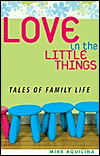
It’ll make moms smile with recognition, and maybe help them to pray. Bishop Thomas Tobin of Providence, Rhode Island, calls it “a domestic catechism for the domestic church … absolutely delightful and insightful.” You’ll find reviews by Scott Hahn, Curtis Martin, Russell Shaw, and others right here.
Who You Gonna Call? Gnost-Buster!
In his Wednesday audience, Pope Benedict continued his series on the Church Fathers. We’ve moved all the way to Irenaeus (second century). Benedict begins with the historical facts and then makes a beeline for the heart of the ancients’ wisdom.
Irenaeus was most probably born in Smyrna (today Izmir, in Turkey) between the years 135 and 140. There, while still a youth, he attended the school of Bishop Polycarp, for his part, a disciple of the apostle John. We do not know when he moved from Asia Minor to Gaul, but the move must have coincided with the first developments of the Christian community in Lyons: There, in 177, we find Irenaeus mentioned among the college of presbyters.
That year he was sent to Rome, bearer of a letter from the community of Lyons to Pope Eleutherius. The Roman mission took Irenaeus away from the persecution by Marcus Aurelius, in which at least 48 martyrs died, among them the bishop of Lyons himself, the 90-year-old Pothinus, who died of mistreatment in jail. Thus, on his return, Irenaeus was elected bishop of the city. The new pastor dedicated himself entirely to his episcopal ministry, which ended around 202-203, perhaps by martyrdom.
Irenaeus is above all a man of faith and a pastor. Like the Good Shepherd, he has prudence, a richness of doctrine, and missionary zeal. As a writer, he aims for a twofold objective: to defend true doctrine from the attacks of the heretics, and to clearly expound the truth of the faith. His two works still in existence correspond exactly to the fulfillment of these two objectives: the five books “Against Heresies,” and the “Demonstration of Apostolic Preaching” (which could be called the oldest “catechism of Christian doctrine”). Without a doubt, Irenaeus is the champion in the fight against heresies.
The Church of the second century was threatened by so-called gnosticism, a doctrine which claimed that the faith taught by the Church was nothing more than symbolism for the simpleminded, those unable to grasp more difficult things. Instead, the initiated, the intellectuals — they called themselves gnostics — could understand what was behind the symbolism, and thus would form an elite, intellectual Christianity.
There’s more, and you’ll find it here. (Thanks to Rich, who’s been nudging me awake as I try to recover from a week away!)
Irenaeus is available in English in the 19th-century Ante-Nicene Christian Library. Father Dominic Unger was working on a better English translation, and it’s at least partially published in the Ancient Christian Writers series. Top minds are continuing the work, I’m told. ACW also publishes Irenaeus’s Proof of the Apostolic Preaching, as does St. Vladimir Seminary’s Popular Patristics series.
Warner Fathers
My friend David Warner tells Zenit why Study of Church Fathers Is Not Just for Catholics. He’s taking his cue from Pope Benedict’s ongoing catechesis on the Apostolic Fathers. (Thanks to Rich for the lead.)
Linck’s Page
Asking your prayers for Father Joe Linck, esteemed patrologist and rector of St. John Fisher Seminary in Stamford, Connecticut. Father Joe underwent surgery for cancer last week and is facing a difficult recovery.
Those who joined us for the St. Paul Center‘s 2005 pilgrimage to Rome know Father Joe as an outstanding confessor and preacher. It was heavenly for a bunch of patristics nerds to be with him — in Rome! — for the feasts of Saints Irenaeus, Peter and Paul, Cyril of Alexandria, and the Roman Martyrs. Unforgettable.
His master’s thesis, by the way, is very cool: “The Trinitarian Dimension of Eucharistic Communion with God in the Adversus Haereses of Irenaeus of Lyons.” He is also the author of Fully Instructed and Vehemently Influenced: Catholic Preaching in Anglo-Colonial America. He contributed to He Spared Himself in Nothing: Essays on the Life and Thought of John Nepomucene Neumann and The New Catholic Encyclopedia, Second Edition (many, many articles). Father Joe is a senior fellow of the St. Paul Center. And one of the funniest people I’ve ever met.
Humor, brilliance, and goodness make a great combination.
Anyway, I love the man dearly, and I beg your intercession.