Posted on

Perpetua Light

Today’s the memorial of Saints Perpetua and Felicity. I’m on KVSS radio this morning, talking about their “Passion,” which is one of the most remarkable documents of the early Church. Composed by Perpetua herself, it is certainly the most detailed account of a woman’s experience of Christianity during those formative years (she died in North Africa in 203 A.D.). Perpetua’s narrative concerns itself with many experiences we don’t often find in the Fathers — childbirth and breastfeeding, for example. We also glimpse how a woman exercised spiritual leadership in the ancient Church. Perpetua’s Passion is an important early witness for the study of liturgy, sacramental theology, and the doctrine of purgatory. It is one of the key texts discussed in one of my favorite books, Robin Darling Young’s In Procession Before the World: Martyrdom As Public Liturgy in Early Christianity.

You can listen to my interview via the live feed at the station’s website, or pick up the program at the Aquilina page later on. Eventually, Junior will move it to my own audio page.

Posted on

No Ordinary Joe

The Feast of St. Joseph is less than two weeks away, and I’m prepping by reading Father Joseph Lienhard’s St. Joseph in Early Christianity: Devotion and Theology: A Study and an Anthology of Patristic Texts (a lovely book). More on patristic josephology as the day approaches. Meantime, I share a quote beautiful for its clear and simple summary of the Fathers’ method of interpreting Scripture:

In their study of the Bible, moreover, the Fathers accepted in faith three controlling truths: the Holy Spirit is one, and thus, in the whole Bible speaks with one voice and teaches one truth; the Holy Spirit is no fool, and nothing in the Bible is trivial or irrelevant; and the Holy Spirit speaks to me, so that everything the Bible says should, when understood rightly, foster my Christian faith and life.

If you don’t already own the book, you can probably order it today and have it in time for March 19. The Augustine material alone is worth the price of admission, and it’s joined by passages from Jerome, Origen, Justin, Epiphanius, Chrysostom, and others. Father Lienhard’s essay provides excellent analysis and synthesis. What a great way to celebrate a great day, a great life.

Posted on

News of Armageddon

The good thing about the media’s seasonal fevers of christophobia is that they bring some good alternative news sources to the fore. Thanks to Huw at Sarx, I found my way to Israel Today, an excellent source of information on real archeology in the Holy Land. Do you remember the pre-Constantinian church unearthed at Megiddo (the biblical Armageddon) a couple of years ago? It is probably the oldest church ever excavated, and its mosaic inscriptions are very well preserved. They highlight important doctrinal and sociological facts: the early Church’s strong belief in the divinity of Jesus; the prominence of women in the community; and so on. Israel Today offers an excellent, brief documentary video on the digs and the significance of the small details. The interviews with the archeologist are definitely worth your time. There’s also a small news story.

Posted on

Gus on the Go

Just laid hands on a nifty little book, St. Augustine LifeGuide: Words to Live By from the Great Christian Saint. It’s pocket-sized (or purse-sized) and fifty-two pages. Each page offers several choice quotes from Augustine, first in Latin and then in English translation. The editor included citations, too, so you can call up the content fairly easily, if you’re so moved. The two hundred quotations are arranged thematically. It’s a handy book to keep with you for help in meditative prayer. It’s also a great way to grow in appreciation for the beauty of the Latin language. Augustine was a master, and reading him in the original we can pick up a lot more of his virtuoso wordplay. His cadences are musical. His assonance, alliteration — and punning! — are explosive, but even the best translations rarely relay the big bang of the Latin. I love this little book, and I think you’ll love the price. Here are a couple of seasonal samples:

Magna est enim miseria superbus homo, sed maior misericordia humilis Deus.
The wretchedness of a proud man is great, but the mercy of a humble God is greater.

Locus eius tu eris si bonus, si confessus invocaveris eum.
You will be His dwelling place if you call upon Him after being cleansed in Confession.

Posted on

Just a Reminder

Loyola Press, publisher of my book The Grail Code: Quest for the Real Presence is offering a Lent-long 30% discount not only on my title, but on lots of other good stuff as well, including the Loyola Classics series, which I’ve often blogged upon, and two books by one of my favorite human beings, David Scott: The Catholic Passion: Rediscovering the Power and Beauty of the Faith and A Revolution of Love: The Meaning of Mother Teresa. Also check out the titles by Bob Lockwood, Liz Kelly and Matthew Lickona. Gosh, it’s all so good. Talk about temptation!

The discount is good for one-time use only and not valid on textbook or curriculum orders. The offer expires at the end of the Easter season, May 27, 2007.

TO GET THE DISCOUNT, make sure to enter the promotional code 2261.

Now … keep reading your way to the fullness of Easter.

Posted on

Hear and Now

Someone just alerted me to hours of free audio. EWTN has posted the sound from four of the television series I’ve done with Scott Hahn. Other folks are posting the entire archive of “The Roman Observer,” where I appear every now and then. In both places, you can find my stuff by typing my last name as a keyword: Aquilina.

Posted on

Herbal Cures of the Desert Fathers

The monks of St. Catherine’s in Sinai are in the news again. For a reclusive bunch, they sure do make a splash. A few months back, I was aching to see the exhibit of their patristic-era icons. Then they caught my eye with their efforts to record and restore ancient manuscripts.

Now they’re back in the spotlight for their project to catalog ancient medicines and conserve medicinal plants. It’s all to make the world a better place. It seems that pharmaceutical researchers have gained a new appreciation for old folk remedies. Several companies have tried unsuccessfully to patent turmeric — a key ingredient in curries — for fighting cancer and senility. I’m way ahead of them on this; just ask the proprietor of Taj Mahal Indian buffet (McKnight Road in Pittsburgh), the favorite haunt of Yours Truly and David Scott.

What are the monks of Sinai finding in those old manuscripts? “For example, acacia was used to treat coughs and eye complaints in ancient times and is still used for that to this day … Colic was treated with anti-spasmodics, such as hyoscymus, cumin and coriander, still vogue today.” But mostly what they’re dealing with is laxatives. There were apparently many, many brands to choose from.

As Jerome might have grumbled as he passed through Egypt: the more things change, the more they stay the same.

Posted on

Great Scot

Scotland’s own Adrian Murdoch has posted a PDF of an excellent, short article he wrote on Romulus Augustulus, the last Roman emperor. The article summarizes Adrian’s recent book, The Last Roman: Romulus Augustulus and the Decline of the West. It’s so good it will leave you wanting to read the book. And I hope you do act on the impulse, even if it is Lent. Romulus is the subject of a soon-to-be-released movie, “The Last Legion,” with Ben Kingsley, among others. I’m publishing a longish review of Adrian’s books in an upcoming edition of Touchstone magazine, where I review patristic titles almost every month. Adrian has also been posting much on St. John Chrysostom of late.

Posted on

Family Matters

Grace builds on nature. Anyone who’s read my book The Fathers of the Church knows that I trace my love for the Church Fathers back to my love for my dad. It’s the constant teaching of the Fathers that the home is a Church (ecclesia domestica) and the Church is a family (familia Dei).

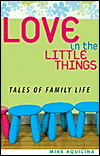
So, in the interest of full theological disclosure, I’ve written a book about the life of my family — my parents and sibs, my wife and my kids. It’s called Love in the Little Things: Tales of Family Life, and it’s been vetted by my wife and my four oldest children. I’m told it’s quite funny. (Patristic nerds will be happy to know that Ambrose, Augustine, and crew make cameo appearances.) If you dare to peek behind the pages of this blog, Love in the Little Things is your keyhole.

But don’t take my word for it — or my kids’ word for it. Here’s what the reviewers have to say:

“I wish I could have read this book when I was a young dad, but I was too busy learning all the lessons alongside Mike Aquilina. No matter what stage of the parenting game you’re at, don’t delay—start reading this book now!”
—Scott Hahn, author, Letter and Spirit: From Written Text to Living Word in the Liturgy

“…a domestic catechism for the domestic church…absolutely delightful and insightful”
Bishop Thomas J. Tobin, Providence, R.I.

“…a book that knows real life smells a little like incense, a little like pasta and a little like a used diaper. As someone who has experienced the gracious vivacity of the Aquilina home firsthand, I can promise that you have a sure and fine guide to finding the Blessed Trinity in the clutter and chaos of the glorious thing known as family.”
Mark P. Shea, author, By What Authority?

“This book is a delight—easy to read and pregnant with insight. It is amazing how little things will change your view about family, faith and life.”
Curtis Martin, president and founder, FOCUS

“Mix lots of laughter and a few tears, add generous helpings of faith and hope, bring it all to a boil with the flame of love—that’s Mike Aquilina’s recipe for a happy, holy family. Love in the Little Things stands out for its good humor and deeply Catholic good sense. A terrific read for married couples of any age and for couples preparing for marriage.”
—Russell Shaw, author, Catholic Laity in the Mission of the Church

“…a charming yet profound blueprint on how to be a devout Christian. People of all ages, of all religions, will delight to read this self-deprecating guide for pursuing holiness in a family milieu with all its humorous idiosyncrasies. Bravo!”
—Rev. T.G. Morrow, author, Christian Courtship in an Oversexed World