From Maureen: Some Brief Thoughts about Women and the Fathers.
Category: Patristics
Wow!
My eldest daughter and I are recovering from the St. Paul Center‘s 2008 Letter & Spirit Conference, which closed last night. The speakers were outstanding. You should buy all their books (hyperlinked here). Keynote was Dr. John Cavadini, head of theology at Notre Dame, who gave the Center’s annual lecture in honor of the great Father Ronald Lawler, O.F.M. Cap. Dr. Cavadini spoke brilliantly about St. Augustine and marriage. The heart of his lecture is posted here as a PDF. It may be the best thing you read this year. We had a record number of seminarians attending. One of them posted a photo.
Family Matters
Cappuccino’s Mom has reviewed my two books on family: Love in the Little Things: Tales of Family Life and Catholic for a Reason IV: Scripture and the Mystery of Marriage and Family Life. The latter includes the essay, “Milk and Mystery: Breastfeeding and the Theology of the Body,” a mostly patristic and biblical study co-authored by my brilliant and beautiful wife.
The Mother Church
PhDiva is displaying a series of posts full of gorgeous photos of Justinian’s Hagia Sophia, inside and out. (The link is to the first post. Make sure to look at the others, especially the doors, the doors.)
Dee-fense, Dee-fense
Yancy Smith posted the following on Roger Pearse’s blog:
I will be defending my dissertation “Hippolytus’ Commentary on the Song of Songs in Social and Critical Context” on Nov. 19. Drs. Carolyn Osiek, David L. Balch, and Jeffrey Childers (Syriac, Georgian expert) are my committee. Thanks of the input and for your prayers.
Please keep him in mind. He’s doing important work.
Psalms Sung Blue
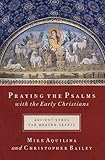
Amazon provides a sneak peak at the lovely cover of my upcoming book, co-authored with Chris Bailey (a reunion of The Grail Code team). The new one is Praying the Psalms with the Early Christians: Ancient Songs for Modern Hearts. You guessed it: it’s a collection of the Fathers’ reflections on the Psalter. It’s out in Spring, but of course it can be pre-ordered.
Reading the Signs
Here’s another blog review of Signs and Mysteries: Revealing Ancient Christian Symbols.
Virtual Rome
The London Times takes us, via Google Earth, to Rome as Constantine I knew it.
The glory that was Rome is to rise again. Visitors will once more be able to visit the Colosseum and the Forum of Rome as they were in 320 AD, this time on a computer screen in 3D.
The realisation of the ancient city in Google Earth lets viewers stand in the centre of the Colosseum, trace the footsteps of the gladiators in the Ludus Magnus and fly under the Arch of Constantine.
The computer model, a collection of more than 6,700 buildings, depicts Rome in the year 320 AD. Then, under the emperor Constantine I, the city boasted more than a million inhabitants –- making it the largest metropolis in the world. It was not until Victorian London that another city surpassed it.
The project has been developed by Google in collaboration with the Rome Reborn Project and Past Perfect Productions. The computer graphics are based on a physical model – the Plastico di Roma Antica, which was created by archaeologists and model-makers between 1933 and 1974 and is housed in the Museum of Roman Civilisation in Rome. There are only 300 original ruins still standing today.
I still think Evelyn Waugh did a better job of taking us back to Constantine’s Rome, in his novel Helena. In the most recent issue of First Things, George Weigel argues that Helena was the first postmodern novel. I don’t know about that. I do know it’s side-splittingly funny. And it was Waugh’s own favorite among his works. If you haven’t read Helena, you owe it to yourself. It’ll take your mind off the stock market and any number of elections.
From the ‘Art
Karen Edmisten has reviewed my book Signs and Mysteries: Revealing Ancient Christian Symbols. She calls it “a great read … a great reference book” and “an exquisite piece of art.”
The Apostate and Immigration Reform
Archbishop Jose Gomez of San Antonio recently gave the keynote address at the Missouri Catholic Conference Annual Assembly. He spoke on the Catholic contribution to immigration reform. And he told his listeners the story of Julian the Apostate.
I want to go back in history a little bit. To the short reign of the Emperor Julian, who ruled the Roman Empire from 361 to 363 A.D.
You remember your history, I’m sure. After centuries of persecution, Christianity became first a “tolerated” religion, and then the official state religion under the Roman Emperor Constantine, beginning in the early fourth century. Well, Julian was the son of Constantine’s half-brother, Julius Constantius, and he came to power after a series of bloody struggles.
Julian came to be known for all time as “Julian the Apostate.” He got that notorious label because, although he had been baptized and raised a Christian, he abandoned his faith immediately upon becoming emperor. Julian then used his “bully pulpit” as emperor to scorn the Church and Christianity and to promote devotion to the pagan gods and goddesses of ancient Greece and Rome—Zeus, Apollo, Aphrodite, and the rest.
Julian called the Christians “Galileans.” It was a kind of ethnic and class slur. And he wrote a big book against the Church. He said his aim was to strip that “new-fangled Galilean god” of “the divinity falsely ascribed to him” (Wilken, The Christians as the Romans Saw Them, 177).
But there was something that Julian couldn’t shake about the Christians. Something he couldn’t get out of his mind. And that was the Christians’ virtue. Their charity. And especially their hospitality to those they didn’t even know. In fact, Julian once issued an order to try to get pagan believers to start imitating the Christians in what he called their “benevolence toward strangers.”
Here’s a quote from a letter he wrote, and you can tell he’s not very happy. He complains that Christians’ care for strangers and their holiness is contributing to the spread of “atheism.” (He called Christians “atheists” because they didn’t believe in the pagan gods.)
Here’s what Julian wrote: “Why do we not observe that it is their benevolence to strangers … and the pretended holiness of their lives that have done the most to increase atheism. … It is disgraceful that when … the impious Galileans support not only their own poor but ours as well, all men should see how our people lack aid from us.” (Macmullen and Lane, Paganism and Christianity, 100–425 C.E.: A Sourcebook, 271–272).
You see he’s embarrassed. Ashamed. The Christians are so generous that they’re helping the poor Romans and that exposes how the Romans themselves don’t take care of their poor.
My friends, my point in this little history lesson is this: From the beginning there was something very different about Christians. Something even their enemies, like Julian, couldn’t help but notice—and admire, no matter how reluctantly.
It’s true there was a tradition of welcoming the stranger in other cultures and religions. Philosophers like Plato wrote about the importance of hospitality. But for the first Christians it became an original and central element of their religious identity. To be a Christian was to practice hospitality to the stranger.
Julian the Apostate is worth getting to know. See here. Or cut to the chase and buy Adrian Murdoch’s The Last Pagan: Julian the Apostate and the Death of the Ancient World.
Archbishop Gomez is always worth reading. See his collected works here.
Suh-wheat
The St. Louis Review has posted a feature on Father Michael Giesler’s novel Grain of Wheat, which is set in second-century Rome. Here’s a money quote from the newspaper story: “I did that thinking of our society, because in many ways people have said, and I think it’s true, that there are some real similarities today with the Roman empire.”
A Not-Lukewarm Review
Notlukewarm has posted a review of my book Signs and Mysteries: Revealing Ancient Christian Symbols.
The Catholic company has posted several reviews.
The Audacity of Pope
Now that the United States has elected its first African-American president, Archbishop Wilton Gregory and others have wondered aloud whether we might some day see an African pope. I find future-pope speculation distasteful — like wondering aloud whom Mom might marry should Dad ever get around to kicking off. But I’m grateful to the London Times‘ Richard Owen for noting that
three early Popes came from North Africa, at a time when it formed part of the Roman Empire: Pope Victor, who reigned from 189-198; Pope Melchiades, or Militiades (311-314); and Pope Gelasius (492-496). All three are saints.
Pope Victor was born in Africa and served as pontiff during the reign of the Emperors Commodus and Septimus Severus (who was also an African), persuading them to release persecuted Christians, including a future pope, Calistus I.
Pope Militiades was the first Pope to benefit from greater tolerance of Christianity under the Emperor Maxentius, regaining confiscated holy properties. He was given the first official papal residence, later to become the Lateran Palace. Pope Gelasius, born in Rome to African parents, revised the rules for the clergy, permitting the use of wine at the Holy Communion.
He covered the issue in greater detail three years ago, in Africans Led Church During Roman Empire.
Mar-mar-mar Marmaris
Here’s an update on a major underwater recovery, the first Byzantine port of Constantinople, on the Sea of Marmaris.
So far, 32 wooden ships, Stone Age skeletons, coins, amphorae and even a basket full of ancient cherries have been uncovered … Dating from the time of the Roman emperor Theodosius I, in the fourth century AD, the finds are an unprecedented glimpse into the ancient trade and maritime life of one of the world’s longest-inhabited cities…
They include a woman’s shoe with an ancient Greek inscription: “Use it in health, lady, be in beauty and happiness and wear it.”
I can’t help but think of the Empress Eudoxia. Perhaps it was a gift from St. John Chrysostom? If so, we can be sure it’s a sensible shoe.
The site also bears relics of continued Byzantine presence after the harbour had been filled in. A Byzantine tannery and charnel house were discovered at the western end of the excavation, as well as human skulls – perhaps those of executed criminals – thrown into a well.
Lots of candidates for those. Too many to list.
Make Haste to Help Him
Roger Pearse is having trouble translating a curious passage in Eusebius. If you’ve got the Greek, stop by and help.