Posted on

Herod-Raising Adventure

There’s no resting place for the wicked. It seems that archeologists have found the tomb of King Herod “the Great.” Here’s the initial report from Reuters via ABC News:

An Israeli university has announced the discovery of the grave and tomb of Herod the Great, the Roman empire’s “king of the Jews”, in ancient Judea.

The Hebrew University of Jerusalem said in a brief statement the discovery was made at Herodium, where Herod’s hilltop fortress palace once stood, some 12 kilometres from the holy city where he had rebuilt and expanded the Jewish Temple.

The university said it would give further details at a news conference later today.

The Gospel of Matthew says Herod ordered the ‘Massacre of the Innocents’, the killing of all young male children in Jesus’s birthplace of Bethlehem, out of fear he would lose his throne to a new “king of the Jews”, whose birth had been related to him by the Magi.

According to Matthew, Joseph and Mary fled with baby Jesus to Egypt to escape the slaughter.

The Roman Senate appointed Herod “king of the Jews” in approximately 40 BC.

According to the ancient Jewish historian Falavius Josephus, Herod died in 4 BC.

Israel’s Haaretz newspaper says on its website that Herod’s tomb was discovered by Hebrew University professor Ehud Netzer, who has conducted archaeological digs at Herodium since 1972.

Don’t be scandalized by the claim that Herod may have died four years B.C. That doesn’t mean he wasn’t really around to harrass the Holy Family. The calculation of years B.C. and A.D. comes to us as the best guess of a fifth-century monk, Dennis the Little.

It will be interesting to see if, in a few years, Herod’s decorations can make the grand tour, as did those of Caiphas and Pilate last year. I wonder if he ever dreamed he could spend 2011 in Cleveland.

When the Fathers pondered Herod, they pondered the mystery of iniquity. Consider St. Peter Chrysologus:

What does this mean, that it was in the time of a very malevolent king that God descended to earth, divinity entered into flesh, a heavenly union occurred with an earthly body? What does this mean? How could it happen that a tyrant could then be driven out by one who was not a king, who would free his people, renew the face of the earth and restore freedom? Herod, an apostate, had wrongly invaded the kingdom of the Jews, taken away their liberty, profaned their holy places, disrupted the established order, abolished whatever there was of discipline and religious worship. It was fitting therefore that God’s own aid would come to succor that holy race without any human help. Rightly did God emancipate the race that no human hand could free. In just this way will Christ come again, to undo the antichrist, free the world, restore the original land of paradise.

I’ll try to keep up on news of the tomb. This one’s more interesting to me than the tomb of the alleged Christ family. As I find more news, I’ll find more Herodian moments from the Fathers.

Posted on

How to Succeed in Antiquity Without Really Trying

Adrian Murdoch leads us to some interesting links on the hermit life in late antiquity.

Adrian also draws some very funny management lessons from the Battle of Thermopylae. This article’s a fine follow-up to his earlier business lessons from the barbarian tribes.

Why didn’t my employers bring in consultants like this guy when I was working in corporate America?

You still have about a week to subscribe to Touchstone magazine in time for my review essay on two of Adrian’s books.

Posted on

Keeping Tabs

Tony Chartrand-Burke has posted a fun page of real tabloid treatments of the Christian apocrypha. He includes images of some priceless front pages: “Found! Christ’s Lost Scrolls,” “Christ’s Passion…in Mary Magdalene’s Own Words,” “Lost Gospel Claims Da Vinci Code is for Real,” “NASA Decodes Lost Gospels.”

It makes “Dewey Defeats Truman” look so lame.

Posted on

The Point of Origen (Part 2)

Here’s the full text (Zenit translation) of the pope’s second address on Origen:

Dear Brothers and Sisters,

Last Wednesday’s catechesis was dedicated to the important figure of Origen, the Alexandrian doctor of the second and third century. In that catechesis we looked at the life and literary works of the Alexandrian master, focusing on his “three-pronged reading” of the Bible, which is the animating center of all of his work.

I left out two aspects of Origen’s doctrine, which I consider among the most important and timely, so that I could speak about them today. I am referring to his teachings on prayer and the Church.

In truth, Origen — author of an important and ever relevant treatment “On Prayer” — constantly mixes his exegetic and theological works with experiences and suggestions relating to prayer. Despite the theological wealth found in his thought, his is never a purely academic treatment; it is always founded on the experience of prayer, on contact with God.

In his view, understanding Scripture requires more than mere study. It requires an intimacy with Christ and prayer. He is convinced that the privileged path to knowing God is love and that one cannot give an authentic “scientia Christi” without falling in love with him.

In his “Letter to Gregory” he writes: “Dedicate yourself to the ‘lectio’ of the divine Scriptures; apply yourself to this with perseverance. Practice ‘lectio’ with the intention of believing and being pleasing to God.

“If during the ‘lectio’ you find yourself in front of a closed door, knock and the guardian will open it for you, the guardian of whom Jesus said: ‘The advocate will teach you everything.’ Apply yourself in this way to ‘lectio divina’ — search, with unshakable faith in God, the sense of the divine Scriptures, which is amply revealed.

“You must not be satisfied with only knocking and searching: To understand the things of God, ‘oratio’ is absolutely necessary. To encourage us to do this, the Savior did not only say: ‘Seek and you shall find,’ and ‘Knock and it shall be opened unto you,’ but he also added: ‘Ask and you shall receive'” (Ep. Gr. 4).

One can see clearly the “primordial role” that Origen played in the history of “lectio divina.” Bishop Ambrose of Milan — who would learn to read the Scritpures from Origen’s works — introduced it in the West, to hand it on to Augustine and the successive monastic tradition.

As we mentioned earlier, the highest level of knowing God, according to Origen, comes from loving him. It is the same with human relationships: One only really knows the other if there is love, if they open their hearts. To show this he illustrates the significance given at that time to the verb in Hebrew “to know,” used to show the act of human love: “Adam knew Eve, his wife and she conceived” (Genesis 4:1).

This suggests that union in love procures the most authentic knowledge. As man and woman are “two that become one flesh,” in the same way, God and the believer become “two that become one in the spirit.”

In this way, the prayer of the Alexandrian reaches the highest mystical levels, as is shown by his “Homilies on the Song of Songs.”

In one passage of the first homily, Origen confesses: “Often — God is a witness to this — I felt that the Bridegroom drew very near to me; afterward he would leave suddenly, and I could not find that which I searched for. Again I have the desire for his presence, and he returns, and when he appears, when I hold him in my hands, he leaves again and once he is gone I begin again to search for him” (Hom. Cant. 1:7).

I recall what my venerable predecessor wrote, as a true witness, in “Novo Millennio Ineunte,” where he showed the faithful “how prayer can progress, as a genuine dialogue of love, to the point of rendering the person wholly possessed by the divine Beloved, vibrating at the Spirit’s touch, resting filially within the Father’s heart … becoming,” John Paul II continued, “a journey totally sustained by grace, which nonetheless demands an intense spiritual commitment and is no stranger to painful purifications. But it leads, in various possible ways, to the ineffable joy experienced by the mystics as ‘nuptial union'” (No. 33).

We come to Origen’s teaching on the Church, and precisely — within it — on the priesthood of the laity. As the Alexandrian affirms in his ninth Homily on Leviticus, “this discourse is important for all of us” (Hom. Lev. 9:1).

In the same homily Origen — referring to Aaron’s prohibition, after the death of his two children, to enter the Holy of Holies “at any time” (Leviticus 16:2) — he admonishes the faithful: “From this we can see that if one enters the sanctuary, without the proper preparation, not dressed in priestly dress, without having prepared the prescribed offerings and having offered them to God, he will die. …This discourse is meant for everyone. It guarantees that we know how to approach God’s altar.

“Or do you not know that the priesthood was given to God’s Church and to all believers? Listen to how Peter speaks to the faithful: ‘Elect race,’ he says, ‘royal priesthood, holy nation, a people bought by God.’ You have priesthood because you are a ‘priestly people,’ and therefore you must offer sacrifice to God. … But so that you may offer it worthily, you need pure vestments, distinct from the common vestments of other men, and you need the divine fire” (ibid.).

On one hand the “girded loins” and the “priestly vestments,” which represent purity and honest living, and on the other the “perpetually lit lamp,” which represents the faith and science of the Scriptures — these become the necessary conditions for the exercise of the priestly ministry. These conditions — right conduct, but above all, the welcoming and study of the Word — establish a genuine “hierarchy of holiness” in the common priesthood of all Christians.

Origen places martyrdom at the top of this path of perfection. In the ninth Homily on Leviticus he alludes to the “fire for the sacrifice,” that is, the faith and knowledge of Scripture, which must never be extinguished on the altar of he who exercises the priesthood.

He then adds: “Each one of us has within us” not only fire, but “also the sacrifice, and from his sacrifice he lights the altar, so that it will burn forever. If I renounce everything I possess and take up the cross and follow Christ, I offer my sacrifice on God’s altar; and if I give my body over to be burned, having charity, and meriting the glory of martyrdom, I offer my sacrifice on God’s altar” (Hom. Lev. 9:9).

This path of perfection “is for everyone,” so that “the eyes of our heart” will contemplate wisdom and truth, which is Jesus Christ. Preaching on the discourse of Jesus of Nazareth — when “the eyes of all in the synagogue were upon him” (Luke 4:16-30) — Origen seems to be speaking to us: “Even today, if you want, in this gathering, your eyes can gaze upon the Savior.

“When you turn your heart’s gaze to contemplate wisdom and truth and the only Son of God, your eyes will see God. O happy gathering, that of whom Scripture speaks as having their eyes fixed on him! How I would like that this gathering receive a similar witness, that the eyes of all, of the unbaptized and of the faithful, of women and men and young children, not the eyes of the body, but those of the soul, look at Jesus! … Impressed upon us is the light of your face, O Lord, to whom belongs glory and power forever and ever. Amen!” (Hom. Lc. 32:6).

As if on cue, Ignatius Press has re-released Henri de Lubac’s History and Spirit: The Understanding of Scripture According to Origen.

Posted on

Origen, Continued

Pope Benedict XVI once again made Origen the subject of his Wednesday audience. Here’s the Vatican’s English-language summary.

Last week we looked at the life and writings of Origen of Alexandria. Today, I would like to consider two significant themes in his work. Origen’s teaching on scripture greatly influenced the Church’s rich tradition of lectio divina. Through the prayerful and faith-filled reading of the scriptures, we are drawn in love to mystical union with God. Just as a man and a woman become “one flesh” in marriage, so—in prayer—the Church and each of her members become one in the Spirit with the divine Bridegroom. Regarding the Church, Origen teaches us the importance of the priesthood of all the faithful. As a member of this common priesthood, every believer is called to put on “priestly attire” by living a pure and virtuous life. Loving intimacy with God through prayer and the offering of an upright and moral life—these are two of Origen’s most important lessons for us; these are the ways we keep the “gaze of our hearts” fixed on the “Wisdom and Truth who is Jesus Christ.” God bless you all!

Zenit should have a full translation up shortly. Asia News gives it more extensive news coverage (thanks to Amy for the lead).

Posted on

Athanasius Audible

Today’s the feast of St. Athanasius, the Father of Orthodoxy, the man who stared the world down when it awoke to find itself Arian. A great way to celebrate is by listening to St. Athanasius and the Divinity of the Holy Spirit, an engaging lecture by Capuchin Father Thomas Weinandy. (Scroll down to the bottom of the page, look for the little audio symbol, and follow the instructions.) Father Tom delivered that paper at the St. Paul Center‘s Letter and Spirit Conference in 2006. It was the second annual Father Ronald Lawler Memorial Lecture.

You’ll find more Athanasian text and audio right here. My KVSS Radio interview on the man is about halfway down my audio page.

UPDATE: More good stuff from Jeff Ziegler’s A-List:

— Noteworthy among Athanasius’ works are “Life of Antony” (Vita Antonii), “On the Incarnation” (De Incarnatione), and Discourses against the Arians (Contra Arianos).
— The Ven. John Henry Newman’s translation of some of the saint’s works.

Posted on

Hungary? Czech It Out!

While our backs were turned, somebody went and translated The Grail Code into Czech and Hungarian.

Hungarian, my co-author Chris Bailey points out, is our first language outside the Indo-European family. I think that’s cause for celebration. And what better way to celebrate than by reminding you that the English edition is still on sale when you buy direct from the publisher?

Those of you who don’t speak Czech, Hungarian, or English can still order the book in the following languages:

German

Italian

Brazilian Portuguese

Canadian French

Soon to come are French French and Portuguese Portuguese, not to mention Croatian.

And some of these covers are stunning. The Grail seems to bring out the best in all of us.

Posted on

All You Need Is Louvre

The people of Armenia heard the Gospel rather early in history, and their land was the site of much activity during the patristic era. Armenian Christians knew persecution back then — and often again through the centuries since then. The International Herald Tribune can’t help but tell the story as it covers “Armenia Sacra,” an exhibit at the Louvre until May 21.

What mostly survives is the art of religion, the hard-core to which the persecuted cling and carry away if portable. Otherwise it is fragments collected from ruins. Hence the title … “Armenia Sacra” …

Armenia had a very long past when King Tiridate made it the first country where Christianity was declared the state religion around 313, when Byzantium only made its worship permissible…

[The influences of both eastern and western cultures are apparent in] the first art spawned by the advent of Christianity of which the earliest surviving fragments do not predate the 5th century A.D. However disparate these look stylistically, they mostly share a monumental quality and an austere gravity maintained even when startling irony creeps in. Figural art, sometimes rough, invariably explodes with vigor. On one capital of starkly geometrical shape from Dvin, a Virgin and Child carved in low relief stare hypnotically at the viewer. It has a Romanesque feel to it but is not later than the 5th or 6th century A.D.

The stem of a stone cross also from Dvin is topped by the head of Jesus in a style strangely reminiscent of the human masks found in early 1st millennium B.C. bronzes from Luristan, in western Iran.

This aesthetic diversity was maintained into the 7th century A.D. if the datings suggested by art historians are right.

Read on at IHT.

And see the little page at the Louvre’s site: “For the first time, the Louvre will present an exhibition devoted to Armenian Christian art, dating from Saint Gregory the Illuminator’s conversion of the country in the early 4th century to the dawn of the 19th century.”

“Gregory the Illuminator” — the name would have been perfect, really, for a character played by Arnold Schwarzenegger twenty years ago, in a movie with lots of special effects.

Posted on

Cover Me

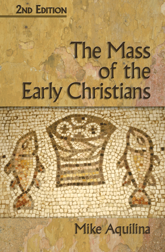
t419_cover_rgb.jpg

It looks like this is the new cover of the new edition of The Mass of the Early Christians. The new one’s not available on Amazon yet, but can be pre-ordered from the publisher, Our Sunday Visitor. To order the expanded edition, call toll-free 1-800-348-2440 and make sure to request T-419.

What’s on the cover? It’s a fifth-century mosaic depicting loaves and fishes, a favorite eucharistic symbol of the patristic era. This particular mosaic was found in the remains of a Byzantine church in Tabgha, Israel, the traditional site of Jesus’ feeding of the 5,000 (Mark 6:41).

Here are a few details on what’s new in this edition.

Posted on

Mamas and the Papas

I mentioned last week that my wife Terri and I contributed a chapter titled “Milk and Mystery: On Breastfeeding and the Theology of the Body” to a new collection, Catholic for a Reason IV: Scripture and the Mystery of Marriage and Family Life. A commenter asked, somewhat incredulously, what the Fathers could have to do with such an exclusively maternal activity as breastfeeding. It’s a good question, and she put it to me with three question marks. So it merits at least a partial answer. (For a full answer, you’ll have to buy the book!)

My wife and I begin the essay by reviewing the ample biblical material on breastfeeding — the customs observed in Israel, the blessings and curses associated with the practice, the use of nursing as a metaphor, and instances where the inspired authors used breastfeeding as an essential part of a narrative plot.

The second section deals with the world of the Fathers, and again we discuss the cultural norms for breastfeeding mothers. And then we provide many examples of the Fathers’ use of breastfeeding imagery. A few examples:

Odes of Solomon: breastmilk is a metaphor for the Eucharist.
Odes of Solomon: the Holy Spirit is compared to a nursing mother.
Irenaeus of Lyons: speaks of Scripture as the breast of the Church.
Clement of Alexandria: Christ and the Eucharist are compared to milk; salvation is compared with lactation.
Ephrem of Syria: Christ is called “the breast of life.”
The Book of Steps: compares the Church to a nursing mother.
Augustine: speaks of Christians as nurslings, Christ as milk, the Bible’s two testaments as two breasts, and the Church as a nursing mother. He also uses the mother-child nursing relationship to illustrate how God creates us to be interdependent.

Again, that’s just a sampling. Both Clement and Augustine ponder the act of breastfeeding from physiological, moral, and theological angles. The full treatment is in our essay, “Milk and Mystery: On Breastfeeding and the Theology of the Body,” in Catholic for a Reason IV: Scripture and the Mystery of Marriage and Family Life.

I have another post on the subject of breastfeeding, here, with links to some great scholarship.

Posted on

Origen’s Back

I don’t think Origen was waiting around anywhere for his rehabilitation. But if he was, it arrived yesterday.

In his Wednesday audience, Pope Benedict referred to the Man of Steel as “one of the most outstanding” of the “great figures of the ancient Church,” “a true teacher,” and concluded: “I invite you to welcome the teachings of this great teacher of the faith into your hearts.”

In our meditations on the great figures of the ancient Church, today we will get to know one of the most outstanding. Origen of Alexandria is one of the key people for the development of Christian thought. He draws on the teachings he inherited from Clement of Alexandria, whom we reflected upon last Wednesday, and brings them forward in a totally innovative way, creating an irreversible turn in Christian thought.

He was a true teacher; this is how his students nostalgically remembered him: not only as a brilliant theologian, but as an exemplary witness of the doctrine he taught. “He taught,” wrote Eusebius of Caesarea, his enthusiastic biographer, “that one’s conduct must correspond to the word, and it was for this reason above all that, helped by God’s grace, he led many to imitate him” (Hist. Eccl. 6,3,7).

His entire life was permeated by a desire for martyrdom. He was 17 years old when, in the 10th year of Septimius Severus’ reign, the persecution against Christians began in Alexandria.

Clement, his teacher, left the city, and Origen’s father, Leonides, was thrown into prison. His son ardently yearned for martyrdom, but he would not be able to fulfill this desire. Therefore, he wrote to his father, exhorting him to not renounce giving the supreme witness of the faith. And when Leonides was beheaded, young Origen felt he must follow the example of his father.

Forty years later, while he was preaching in Caesarea, he said: “I cannot rejoice in having had a father who was a martyr if I do not persevere in good conduct and I do not honor the nobility of my race, that is to the martyrdom of my father and the witness he gave in Christ” (Hom. Ez. 4,8).

In a later homily — when, thanks to the extreme tolerance of Emperor Philip the Arab, the possibility of ever becoming a martyr seemed to fade — Origen exclaimed: “If God would consent to let me be washed in my blood, receiving a second baptism by accepting death for Christ, I would surely go from this world. … But blessed are they who merit these things” (Hom. Lud. 7.12).

These words reveal Origen’s nostalgia for the baptism by blood. And finally, this irresistible desire was, in part, fulfilled. In 250, during the persecution by Decius, Origen was arrested and cruelly tortured. Severely weakened by the sufferings he endured, he died a few years later. He was not yet 70 years old.

We mentioned earlier the “irreversible turn” that Origen caused in the history of theology and Christian thought. But in what did this “turn” consist, this turning point so full of consequences?

In substance, he grounded theology in the explanations of the Scriptures; or we could also say that his theology is the perfect symbiosis between theology and exegesis. In truth, the characterizing mark of Origen’s doctrine seems to reside in his incessant invitation to pass from the letter to the spirit of the Scriptures, to progress in the knowledge of God.

And this “allegoristic” approach, wrote von Balthasar, coincides precisely “with the development of Christian dogma carried out by the teachings of the doctors of the Church,” who — in one way or another — accepted the “lesson” of Origen. In this way, Tradition and the magisterium, foundation and guarantee of theological research, reach the point of being “Scripture in act” (cf. “Origene: il mondo, Cristo e la Chiesa,” tr. it., Milano 1972, p. 43).

We can say, therefore, that the central nucleus of Origen’s immense literary works consists in his “three-pronged reading” of the Bible. But before talking about this “reading,” let us look at the literary production of the Alexandrian.

St. Jerome, in his Epistle 33, lists the titles of 320 books and 310 homilies by Origen. Unfortunately most of those works are now lost, but the few surviving works make him the most prolific author of the first three Christian centuries. His array of interests extended from exegesis to dogma, to philosophy, to apologetics, to asceticism and to mysticism. It is an important and global vision of Christian life.

The inspirational core of this work is, as we mentioned earlier, the “three-pronged reading” of the Scriptures developed by Origen during his life. With this expression we are alluding to the three most important ways — not in any order of importance — with which Origen dedicated himself to the study of Scripture.

He read the Bible with the intent to understand the text as best he could and to offer a trustworthy explanation. This, for example, is the first step: to know what is actually written and to know what this text wanted to say intentionally and initially. He carried out a great study with this in mind and created an edition of the Bible with six parallel columns, from right to left, with the Hebrew texts written in Hebrew — Origen had contact with rabbis to better understand the original Hebrew text of the Bible.

He then transliterated the Hebrew text into Greek and then did four different translations into Greek, which permitted him to compare the various possibilities for translation. This synopsis is called “Hexapla” (six columns). This is the first point: to know exactly what is written, the text in itself.

The second “reading” is Origen’s systematic reading of the Bible along with its most famous commentaries. They faithfully reproduce the explanations give by Origen to his students, in Alexandria and Caesarea. He proceeds almost verse by verse, probing amply and deeply, with philological and doctrinal notes. He works with great attention to exactness to better understand what the sacred authors wanted to say.

In conclusion, even before his ordination, Origen dedicated himself a great deal to the preaching of the Bible, adapting himself to varied audiences. In any case, as we see in his Homilies, the teacher, dedicated to systematic interpretation of verses, breaks them down into smaller verses.

Also in the Homilies, Origen takes every opportunity to mention the various senses of sacred Scripture that help or express a way of growth in faith: There is the “literal” sense, but this hides depths that are not apparent upon a first reading; the second dimension is the “moral” sense: what we must do as we live the Word; and in the end we have the “spiritual” sense, the unity of Scripture in its diversity.

This would be interesting to show. I tried somewhat, in my book “Jesus of Nazareth,” to show the multiple dimensions of the Word in today’s world, of sacred Scripture, that must first of all be respected in the historical sense. But this sense brings us toward Christ, in the light of the Holy Spirit, and shows us the way, how to live.

We find traces of this, for example in the ninth Homily on Numbers, where Origen compares the Scriptures to nuts: “The doctrine of the Law and of the Prophets in the school of Christ,” he affirms, “is bitter reading, like the peel, after which you come to the shell which is the moral doctrine, in the third place you will find the meaning of the mysteries, where the souls of the saints are fed in this life and in the next” (Hom. Num. 9,7).

Following along this path, Origen began promoting a “Christian reading” of the Old Testament, brilliantly overcoming the challenge of the heretics — above all the Gnostics and the Marcionites — who ended up rejecting the Old Testament.

The Alexandrian wrote about this in the same Homily on Numbers: “I do not call the Law an ‘Old Testament,’ if I understand it in the Spirit. The Law becomes an ‘Old Testament’ only for those that what to understand it in terms of the flesh,” that is to say, stopping at the mere reading of the text. But, “for us, we who understand it and apply it in the Spirit and in the sense of the Gospel, the Law is ever new, and the two Testaments are for us a new Testament, not because of a temporal date, but because of the newness of the meaning. … For the sinner on the other hand and those who do not respect the pact of charity, even the Gospels get old” (Hom. Num. 9,4).

I invite you to welcome the teachings of this great teacher of the faith into your hearts. He reminds us that in the prayerful reading of Scripture and in a coherent way of life, the Church is renewed and rejuvenated.

The Word of God, which never ages or has its meaning exhausted, is a privileged way of doing this. It is the Word of God, through the work of the Holy Spirit, which leads us always to the whole truth (cf. Benedict XVI, international congress for the 40th anniversary of the dogmatic constitution “Dei Verbum,” in Insegnamenti, vol. I, 2005, pp. 552-553).

Let us ask the Lord to enable us thinkers, theologians and exegetes of today to find this multidimensional nature, this permanent validity of sacred Scripture.

We pray that the Lord will help us to read the sacred Scriptures in a prayerful way, to really nourish ourselves on the true bread of life, his Word.
Origen played leading roles in my books The Fathers of the Church and The Mass of the Early Christians.

Posted on

Tom Finery

Capuchin Father Thomas Weinandy, the U.S. bishops’ chief doctrinal official, is in town to speak to catechetical leaders in our diocese. I had the great honor and pleasure of his company at dinner. Among Father Tom’s many great books is The Theology of St. Cyril of Alexandria: A Critical Appreciation. That’s my personal favorite. Much more affordable, though, is Jesus the Christ. For many years, he was at Oxford, directing great dissertations like this one. It’s good to have him back home in the States.

Posted on

On Your Mark

It’s the feast of St. Mark. Celebrate with the Christians of Alexandria, the Church founded and ruled by St. Mark. The Egyptian liturgy, of course, was named after Mark, and the Patriarchs (Popes) of Alexandria consider themselves his successors. St. Jerome counts Mark among his Illustrious Men:

Mark the disciple and interpreter of Peter wrote a short gospel at the request of the brethren at Rome embodying what he had heard Peter tell. When Peter had heard this, he approved it and published it to the churches to be read by his authority, as Clement in the sixth book of his Hypotyposes and Papias, bishop of Hierapolis, record. Peter also mentions this Mark in his first epistle, figuratively indicating Rome under the name of Babylon: “She who is in Babylon elect together with you salutes you and so does Mark my son.” So, taking the gospel which he himself composed, he went to Egypt and first preaching Christ at Alexandria he formed a church so admirable in doctrine and continence of living that he constrained all followers of Christ to his example. Philo, most learned of the Jews, seeing the first church at Alexandria still Jewish in a degree, wrote a book on their manner of life as something creditable to his nation telling how, as Luke says, the believers had all things in common at Jerusalem, so he recorded that he saw was done at Alexandria, under the learned Mark. He died in the eighth year of Nero and was buried at Alexandria, Annianus succeeding him.