Read your way around Smyrna — modern Izmir, Turkey — the city of Polycarp.
Category: Patristics
Ankara’s Aweigh
Well, the Pope is all over the news treading the tarmac in Turkey’s capital, Ankara, and visiting tombs there. So the Buckeye Banshee Maureen coaxed me out of my cave to give a brief tour of the city known to readers of the Fathers as Ancyra.
The pope knows as well as Maureen that he is walking on holy ground, sanctified by the blood of martyrs, sacred to the memory of the Fathers. Ancyra was the site of three important gathering of bishops. The old Catholic Encyclopedia summarizes them briefly and well. The first Synod of Ancyra came in 314 A.D., just after the most severe and thoroughgoing persecution of the early Church, the persecution of Diocletian. The bishops gathered to settle a number of disciplinary questions, perhaps most importantly the question of the readmission of the “lapsi,” those who had renounced faith under torture or threat of death. That council produced twenty-five canons. Nine deal with conditions for the penance and reconciliation of the lapsi. All in all, an important meeting of leaders proven by fire, resulting in good guidance for the Church, and a monument of the early Church’s administration of the sacrament of penance.
The synod of 358 was not so good. It was a Semi-Arian gathering, and while the bishops there condemned the grosser Arian blasphemies, they set forth a poor remedy — a compromise proposition that the Son was similar to the Father, but not identical in substance. Homoousios meant “same in substance” (or “one in being,” as we recite in the Sunday Mass translation of the creed). Homoiousios — the word the semi-Arians promoted — meant “similar in substance.” This comporomise caused no end of difficulty for the good guys, like St. Athanasius. Homoousios, homoiousios: it was just one iota’s difference. But that was all the difference in the world, and good men were willing to die for the sake of the difference.
In 375, Arian bishops met at Ancyra and deposed several bishops, among them the brilliant St. Gregory of Nyssa. He was an incompetent administrator. We know this from his own admissions and from the exasperation of his brother St. Basil the Great. But he was an effective teacher, and this was surely the cause of his deposition.
One of Ancyra’s most famous sons was the fourth-century bishop Basil, a member of the homoiousian party — in fact, he was the very man who presided over the semi-Arian synod in 358. (Basil of Ancyra is not to be confused with Basil the Great, who was an early associate of his.) This lesser Basil opposed the hardline Arians, but opposed Athanasius too, and he ardently promoted the use of terms of compromise in the creed.
History was to prove him badly mistaken. Yet, in spite of his linguistic failings, Basil certainly loved Christ and His Church. When the persecutions returned, ever so briefly, under the ex-Christian emperor Julian, Basil was forbidden to preach or preside at the liturgy. He did so anyway. He was captured, tried, and tortured at Ancyra. Julian himself, when passing through the city on his way to Antioch, tried to persuade Basil to give up the faith. Julian, who had written one of antiquity’s most famous anti-Christian tracts, told Basil: “I myself am well skilled in your mysteries; and I can inform you, that Christ, in whom you place your trust, died under Pilate, and remains among the dead.” Basil didn’t buy it. He replied: “You are deceived; you have renounced Christ at a time when he conferred on you the empire. But he will deprive you of it, together with your life. As you have thrown down his altars, so will he overturn your throne.” Enraged, Julian condemned Basil to be flayed alive. And he was. The bishop of Ancyra was hung up, first by the wrists, and then upside down by his ankles. His body was torn with rakes and finally pierced by hot iron spikes.
Julian the Apostate continued on his way to the empire’s frontier, where he would soon die in battle during his Persian campaign.
Cirque du Sulpice
Bread and Circuses calls Sulpitius Severus into the center ring. You’ll recall that he’s come up often in recent posts at this site, as the biographer of St. Martin of Tours.
The Papal Trail
Thanks to Huw at Doxos for sharing this great prayer of blessing for this week’s meeting of Pope Benedict and Patriarch Bartholomew of Constantinople. The pope will be in Turkey Tuesday to Thursday, November 28-30. The prayer comes from Metropolitan Nicholas of the Carpatho-Russian Orthodox Diocese of the USA, who asked that it be recited at all Divine Liturgies on the Sundays of November 19 and 26.
O Holy Father from Whom all blessings flow, we come before You in meekness and bow down: humbly we beseech You to look kindly upon the meeting of Patriarch Bartholomew, Archbishop of Constantinople, and Pope Benedict, Pontiff of Rome. For too long, there has been division and alienation in the Church, when there should have been the unity of the Body of Christ. We beg Your mercy and wisdom, O Lord, to provide for the welfare of the holy churches of God and for their union. Let this occasion of fellowship be for the healing of old disputes. In Your infinite power, protect these Shepherds of the Great and Holy Pasture of Christ. Shield them, and all who attend, from the peril of harm. And in Your matchless grace, establish a bright new work in these latter days, so that the world might see the Face of Christ; so that men and women might repent, believe on the Lord Jesus Christ, and be saved in the Apostolic Church of God. For these supplications, we humbly beseech You, Holy Father, hear us and have mercy…
If you don’t know Doxos, get to know it. Huw’s a southerner, a convert to Orthodoxy, and a great laborer for unity of east and west. Also, he posts the martyrology for each day, which is an important contribution to the patristiblogosphere.
You’ll find more on the papal-patriarchal visit at the website of the patriarchate.
The Bad Old Guys in Bad New Editions
At Thoughts on Antiquity, Roger Pearse reviews recent translations of ancient anti-Christian works by Celsus, Porphyry, and Julian. (At The Tertullian Project, Roger posts files on Porphyry and Julian. Scroll down the page.)
Fine China
PaleoJudaica discusses evidence of Syriac Christianity in China in the seventh and eighth centuries.
Free! Free! Free!
Adrian Murdoch gives us the rundown on English translations of Paulinus of Nola’s Life of Ambrose — including a version that’s free on the Web. Adrian’s also giving away the introduction to his new book, The Last Roman: Romulus Augustulus and the Decline of the West.
O Clement, O Sweet
Today’s the feast of Pope St. Clement I, aka St. Clement of Rome, one of the Apostolic Fathers — often called “the first echo of the apostles.” He knew Peter and Paul and was converted through their preaching. Irenaeus and many others attest that he came to inherit Peter’s office. We know little about Clement, though, except for the long and beautiful letter he wrote to the Church of Corinth. In it he admonishes them to return to peace and true doctrine, and to stop bickering. Along the way, he also provides us precious glimpses of the first-century Church’s liturgy, hierarchy, influences, and moral concerns. You’ll find a fresh, new translation of Clement at Kevin Edgecomb’s Biblicalia blog. In 2007 we at the St. Paul Center for Biblical Theology will be publishing Msgr. Thomas J. Herron’s monograph arguing for an early dating of Clement’s epistle (with an introduction by Bishop Allen H. Vigneron of Oakland, California). Msgr. Herron — like John A.T. Robinson and Joseph Ratzinger — argued that the text was written before 70 A.D.
I’m talking about Clement on KVSS this morning, and the show should show up for download on their special Aquilina audio page.
If you’d like to walk in the footsteps of St. Clement — and visit his home! — consider joining me, The St. Paul Center, and the gang from KVSS radio as we make our pilgrimage in May 2007.
Pilgrims’ Regress
Happy Thanksgiving to one and all, even those of you who live in a land that doesn’t observe today as a holiday. The Greek word for “thanksgiving” will be familiar to anyone who has studied the Fathers. It’s there in the earliest documents — in the Didache and Clement and Ignatius — and it denotes the source and summit of Christian life. The Greek word for “thanksgiving” is “eucharistia” (the root of our “Eucharist”).
The word has deep roots. It appears in the Septuagint, the most common Greek translation of the Old Testament, in the Books of Wisdom, Sirach, and Second Maccabees. Another ancient Jewish translation, that of Aquila, uses the word “eucharistia” as the equivalent of the Hebrew “todah,” the thank-offering of bread and wine, so often alluded to in the Psalter, so often associated with the reign of King David. The rabbis of the Talmudic period predicted that, in the age of the Messiah, all sacrifice would cease — except the todah offering of bread and wine. (For more on the todah, see the extended discussions in Scott Hahn’s The Lamb’s Supper: The Mass as Heaven on Earth and Catholic for a Reason III: Scripture and the Mystery of the Mass.)
Philo of Alexandria used the term “eucharistia” in several and varied ways, all studied in depth by the French patrologist Jean LaPorte in his book Eucharistia in Philo. In later work, La Porte went on to connect Philo’s “eucharistic” writings with those of the later Alexandrian Christians.
So enjoy the day all the more. Make it a thank-offering. And make it to the Eucharist, if you can.
Serve It with Red Wine
My co-author Chris Bailey announces the arrival of our book, The Grail Code: Quest for the Real Presence, now translated into Italian as Codice Graal. In case you wanted to know the Italian phrase for “detective story,” Chris informs us (after reading the back jacket) that it’s “detective story.” Watch for that funny little detail when Chris and I write our roman a clef.
After you’ve read the book in English and Italian, start immediately on Portuguese and French. You should be finished just in time for the German edition’s appearance in 2007.
New Audio — Plus Visual Aid
Junior has posted new audio. You can stock up now, as Advent is just around the corner, and the season does have a certain penitential character.
The new files are on St. Leo the Great and on the 2007 Rome pilgrimage. Just scroll down to the bottom of my audio page.
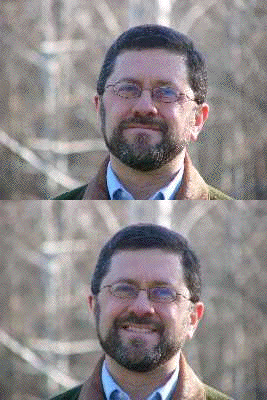
For those of you who listen regularly to my audio files, my son Michael has also posted a visual aid, which might enhance your listening pleasure.
Passage to Carthage
For those of you patiently waiting, Maria Lectrix has posted the conclusion of Tertullian’s “Of Patience.” As always, her brief comments are lovely, well worth the trip to her blog.
Bishop 1, Emperor 0
Call it spine. St. Ambrose had a sturdy one, and he used it to stand up to emperors and face them down. In a post titled Ambrose the Bruiser, Adrian Murdoch looks at Our Man from Milan’s famous “just try it” letter to Valentinian II. (You’ll find the full text of the letter here.)
Don’t Sell Celibacy Short
The pope and curial officials met last week to discuss the surreal affairs of the globetrotting apostate Archbishop Milingo. At the conclusion of their meeting they reaffirmed the value of priestly celibacy. Milingo has said publicly that he thinks it wise to jettison the western tradition to alleviate the “dire … shortage of priests.” Blazing a trail in this direction, he himself married a member of Sun Myung Moon’s Unification Church. He then went on to ordain a few married men, including one guy who had already been consecrated by almost a half-dozen other bishops of questionable credentials.
My friends among the Lutheran and Episcopal clergy say that Milingo’s claim is absurd. In fact, their denominations — which permit clergy to marry — have experienced a similar decline in candidates over the last few decades. They’ve relaxed academic standards (so they tell me), bumped up the salaries and benefits, and doubled the potential pool of candidates by admitting women — but they’re still coming up short.
The Vatican’s right to remind us of the value of celibacy. We shouldn’t need the reminder, with all the scriptural passages that so clearly promote the celibate life (e.g., Matthew 19:10-12; 1 Corinthians 7; Revelation 14:4). (It’s a marvel to me that so-called “sola scriptura” Christians have never warmed to something taught so explicitly and emphatically in the New Testament.) And if we manage to miss the message in the Good Book, the Fathers are always around to remind us. I just finished re-reading Eusebius’s History of the Church, where celibates and consecrated virgins are everywhere celebrated. Last week I mentioned Aphrahat’s Demonstration 18, which complements the New Testament witness with an argument drawn from numerous Old Testament texts.
In both the east and the west, the Church has always prized celibacy. In the west, celibacy has almost always been obligatory for priests. In the east, parish priests have ordinarily been married, while bishops are celibate. As a result, the eastern churches usually draw their bishops from the ranks of the monks. In the age of the Fathers, married priests who were elevated to the episcopacy ordinarily lived with their wives “as brother and sister.”
Some years back, the Vatican posted an interesting study, by an easterner, on the Fathers and celibacy. I’m fond of two book-length treatments: Celibacy in the Early Church: The Beginnings of Obligatory Continence for Clerics in East and West by Stefan Heid and Apostolic Origins of Priestly Celibacy by Christian Cochini.
None of these authors claim that celibacy is essential to the priesthood. It’s certainly not. But it seems clear to me from Scripture and the Fathers that celibacy should be more revered — and more common — than it is in the Church today. I don’t think that celibacy is the great deterrent to priesthood that Archbishop Milingo thinks it is. I suspect that we in the west — addicted as we are to comfort and control — fear the cost of discipleship. And that fear will keep us out of the seminaries and convents, which are all about training disciples.
We’re weak. And until we recognize our weakness — and begin with God’s help to build up our strength — we’ll remain in this “dire” situation that Archbishop Milingo laments. But we’re never going to get stronger by indulging our weaknesses. If we demand little, we’ll get nothing. If we demand much, we just might see our way out of this man-made crisis.
I’ll wager that’s true not just for us Catholics, but for the Orthodox, Lutherans, and Episcopalians who are also wringing their hands over a “vocations shortage.”
The Golden Child
It looks like last-minute cramming to me. But Phil, the Candian patristic blogger, is expecting his initiation into parenting any day now. He posted on St. John Chrysostom and children.