Posted on

History’s Stations

The Way of the Cross is the inevitable way of a Christian’s heart.

Indeed, it is almost impossible to imagine the Catholic Church without the devotion that goes by that name.

It goes by other names, too: “The Stations of the Cross,” “Via Crucis,” “Via Dolorosa” — or just “the stations.”

The practice has settled, for several centuries now, into brief meditations on 14 scenes from the suffering and death of Jesus Christ.

Why are Christians drawn so strongly to this devotion? Because Jesus wanted us to be. “Then He said to all, ‘If anyone wishes to come after me, he must deny himself and take up his cross daily and follow me’” (Lk 9:23).

When Jesus speaks the words “if” or “unless,” Christians listen carefully. For then Our Lord is laying down the conditions of our discipleship — the prerequisites of heaven.

• • • •

The Way of the Cross developed gradually in the life of the Church. In the Roman world, the cross was a “stumbling block” (Gal 5:11). Crucifixion was a most humiliating form of execution: a man was stripped naked and suspended in a public place; he was pelted with rocks and trash and left to suffocate slowly while passersby mocked his agony.

Crucifixion was still a common occurrence during the first three centuries of Christianity, so it was not easy for believers, like St. Paul, to “boast” (Gal 6:14) of the cross. For people who had seen criminals crucified, the cross could not have been an easy thing to love.

Yet love it they did. Devotion to the cross pervades the earliest Christian writings. And the earliest records of pilgrimage show us that Christians endured great hardships — traveling thousands of miles, from France and Spain to Jerusalem — so that they could walk the streets of Jesus’ suffering: the Way of the Cross.

The Jerusalem liturgy of Holy Week memorialized the events of Jesus’ Passion. On Holy Thursday, the bishop led the procession from the Garden of Gethsemane to Calvary. The fourth-century practice is well attested by St. Cyril of Jerusalem and by Egeria, the Bordeaux Pilgrim.

After Christianity was legalized in 313 A.D., pilgrims regularly thronged Jerusalem. The Way of the Cross became one of the standard routes for pilgrims and tourists … READ MORE.
Posted on

Friends, Romans, Countrymen

I just got back from a full week in the Eternal City, where I was traveling with my St. Paul Center colleagues Scott Hahn and Rob Corzine. We enjoyed a week packed with meetings in an exhausting number of Vatican dicasteries and pontifical universities and colleges. The conversations were exhilarating and encouraging.

Between meetings we found ourselves in the company of bloggers Gashwin Gomes and Joan in Rome. We even got to attend an inspired talk by Joan at Christendom College’s thirtieth anniversary bash. Among her rapt listeners were Cardinals Arinze and Law, former papal spokesman Joaquin Navarro-Valls, U.S. ambassador to the Vatican Mary Ann Glendon, Zenit’s Liz Lev, and blogger-TV personality Father John Wauck.

The Fathers were with us everywhere. On our way from meeting to meeting, we dropped in to visit the relics of St. Clement, St. Ignatius, St. Monica, St. Gregory, plus the Apostles, of course, and the popes. We passed these archeological digs quite often. Rob and I ran through the Forum Romanum — apparently among the last visitors to pass through free of charge! Big news on Italian TV was the exhuming of the body of Padre Pio.

Gashwin blogged (several posts) on our travels together and even added YouTube video of the papal audience on St. Leo the Great. If you listen closely at the end, you can hear us croaking the Our Father in Latin. Gashwin also attended a lecture by the Ecumenical Patriarch, Bartholomew, who was in town to visit his alma mater, the Pontifical Oriental Institute.

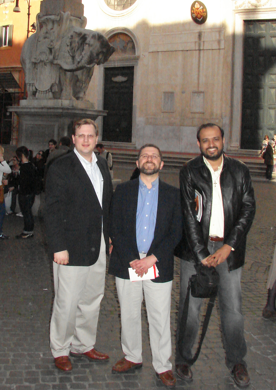
Gashwin is delightful company. Our conversations ranged from St. Catherine of Siena to the Bhagavad Gita, from gelato to Brownson and Hecker. Here’s Rob, me, and Gashwin at Santa Maria Sopra Minerva. (I don’t know the elephant’s name.)

picture-3.png

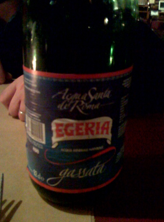
And just to show you how hard it is to avoid the ancients in Rome … They’re even on the label of your water bottle.
picture-1.png

Posted on

A Page Into History

The Independent (UK) reports on a big discovery at an ancient monastery in Egypt.

A year after the Romans packed up their shields in AD410 and left Britain to the mercy of the Anglo-Saxons, a scribe in Edessa, in what is modern day Turkey, was preparing a list of martyrs who had perished in defence of the relatively new Christian faith in Persia.

In a margin he dated the list November 411. Unfortunately for the martyrs, history forgot them. At some point, this page became detached from the book it belonged to. Since 1840, the volume has been one of the treasures of the British Library. It is known only by its catalogue code: ADD 12-150

The missing page has always been a fascinating mystery for scholars and historians. Now, after an extraordinary piece of detective work, that page has been rediscovered among ancient fragments in the Deir al-Surian monastery in Egypt. It is, according to Oxford University’s Dr Sebastian Brock, the leading Syriac scholar who identified the fragments, the oldest dated Christian text in existence.

“It is a list of martyrs and it must have been added to the main book at the last minute,” he said. “There were three fragments from the last page. It was a distinctive handwriting, and it was very exciting to identify it. It is very important to complete the book. Many of the names on this list we have not come across before. So it gives us a lot of clues about that half of that century. Rome at the time was officially Christian, so the rival Persians would have persecuted Christians.”

The fragments were among hundreds discovered beneath a floor in the Deir al-Surian, which is itself a treasure trove of ancient books. Dr Brock and his colleague, Dr Lucas Van Rompay of Duke University in North Carolina, are now working on the first catalogue of the many manuscripts that are more than 1,000 years old.

Elizabeth Sobczynski, founder of the Levantine Foundation, which supports the conservation of the mon-astery’s manuscripts, is raising money to build a state-of-the-art library to preserve the remaining ancient books. “I found four fragments, and joined three of them together,” she said. “These fragments survived for so many centuries, which is amazing …. They could so easily have been swept away.”

We’ve mentioned this monastery before.

Who knows what other lost texts are waiting to be found?

HT: PaleoJudaica.

Posted on

Book Meme

I got tagged by Maureen.

Here are the rules:

Pick up the nearest book of 123 pages or more. (No cheating!)
Find Page 123.
Find the first 5 sentences.
Post the next 3 sentences.

The Oxford Dictionary of the Christian Church, second edition, revised by F.L. Cross and E.A. Livingstone. It’s in the entry on Michel Baius:

“In 1560 eighteen of his propositions were censured by the Sorbonne. Even so, Baius and Hessels were chosen to represent the University in 1563 at the Council of Trent, and received the powerful protection of the King of Spain. Further publications by Baius resulted in the bull ‘Ex omnibus afflictionibus’ (1 Oct. 1567), in which a large number of propositions from his writings, or embodying his doctrine, were condemned, but which did not mention him by name.”

Why didn’t I have Hemingway on my desk?

Posted on

Zalot for the Kingdom

I’d say that my friend Bill Zalot is a tireless advocate for people with disabilities — but that’s not true, because he always has a set of tires on the ground. How could he be tireless in a wheelchair?

Bill was one of my regular authors when I edited New Covenant magazine (1996-2002). He’s currently a syndicated columnist appearing in several diocesan newspapers. And now he’s blogging as Wheelz. Please drop in and leave him a welcoming comment. You’ll be happy you got to know Bill.

He’s loyal even to his friends who are plagued by compulsive punning.

Posted on

She Oughta Be in Pictures

The esteemed Julie of Happy Catholic announces a new venture, Catholic Media Review.

We’re ordinary people who happen to have a particularly Catholic and Christian outlook on life. We will bring that sensibility to our reviews.

Our hope is that there also will be some discussion about what makes a good movie. We’ll be looking not only at which movies might have a positive impact on society (The Passion of the Christ, Amazing Grace, Into Great Silence, Bella) but also highlighting when secular mainstream films have underlying themes that support Christian values in general or those of the Catholic Church in particular. For example, Waitress and Juno have had their pro-life messages touted widely but few people are talking about the Christian themes underlying I Am Legend or Sweeney Todd.

Although movies are the reason the blog was begun, we’ll also be looking at other art (media) because we’re as passionate about those as we are about our faith and movies. Music, podcasts, books, television, and more will all be reviewed and reflected upon at Catholic Media Review.

Stop by Catholic Media Review for a visit – there are some exciting movie reviews up already. Some of the reviews already posted include: National Treasure, Juno, I Am Legend, Bella, Enchanted, and The Water House – Legend of the Deep.

Posted on

What We Do in December

I owe many apologies for my spotty posting. Several of you have emailed to let me know you’re pining for a patristic fix. A few days back I excused myself with December’s publishing deadlines and Advent’s speaking demands. Today I’ll add a third excuse — and then get back immediately to blogging, I promise!

My day job, as you may know, is vice-president of the St. Paul Center for Biblical Theology. So for me, as for many others who work in the apostolate, late-December means end-of-year fundraising. Many people want to give because it’s the spirit of the season — and, in the United States, the Internal Revenue Service blesses such giving by allowing you to deduct it from your federal income taxes. (God bless us, everyone!) Now, as every December, we at the St. Paul Center have been hustling to accommodate very generous donors.

Please consider joining their ranks as our supporter. Our mission is to promote biblical literacy for the laity and biblical fluency for clergy and Church teachers. We provide free online Bible studies. We travel to train catechists in leading Bible-study groups. We sponsor annual academic conferences, clergy conferences, pilgrimages, and other educational events. We publish an annual journal, a monograph series, and a monthly newsletter. We also make available, absolutely free, weekly homily helps, based on the lectionary. We post them in English and Spanish, and broadcast them, too, in both languages. We are currently having all our free online studies translated into Spanish.

Visit our website and you’ll see that our methods are rooted in the Fathers, the ancient liturgies, and the great Tradition.

When you give to the St. Paul Center, you do a lot of good for the world. You make my day. And you free me up for blogging instead of begging!

Christmas blessings!

Posted on

John, Golden Mouth

John Chrysostom (349-407) was a talented young man, the son of a government official who died when John was still a baby, leaving his wife a widow and single mother at age twenty. John’s mother made great sacrifices so that her son could study under the world’s most famous professor of rhetoric, the pagan Libanios of Antioch. John became his star pupil.

At eighteen, John discerned a call to dedicate himself entirely to the service of the Church. He placed himself under the tutelage of the renowned Scripture scholar, Diodore of Tarsus. Soon, once again, John was the most brilliant pupil of his master.

He decided, however, that he was interested in contemplation more than career, and so he stepped out of track for clerical orders and, in early adulthood, went off into a mountain cave, where he lived a hermit’s life for two years, till his health gave out.

When John returned to Antioch, his bishop ordained him first a deacon and then a priest. For twelve years, he was the main preacher in the city’s cathedral church. There, he preached the homilies that earned him his fame. He also served as vicar general for the metropolitan see.

It was his fame as a preacher, however, that brought him to the attention of the wider Church, and especially the imperial court. Thus, when the patriarch of Constantinople died, the emperor unexpectedly summoned John from Antioch to the most powerful bishop’s throne in the East. John declined the honor. But the emperor ordered that John be taken by force or subterfuge, if necessary, and so he was.

John’s habitual honesty and integrity did not serve him well, by capital standards. He was a reformer and an ascetic, demanding much of others, but even more of himself. The clergy of Constantinople were not, however, eager to be reformed or to imitate John’s spartan lifestyle. Nor was the imperial family — especially the empress — interested in John’s advice about their use of cosmetics, their lavish expenses, and their self-aggrandizing monuments. John found it outrageous that the rich could relieve themselves in golden toilet bowls while the poor went hungry. He reached the limits of his patience when the empress went beyond the law to seize valuable lands from a widow, after the widow had refused to sell the property. (John did not miss the opportunity to cite relevant Old Testament passages, like 1 Kings 21.)

Ordinary people found inspiration, solace, and — no doubt — entertainment in the great man’s preaching. But the powerful were not amused. They arranged a kangaroo court of bishops to depose John in 403. In fact, a military unit interrupted the liturgy on Easter Vigil, just as John was preparing to baptize a group of catechumens. Historians record that the baptismal waters ran red with blood.

John was sent away to the wild country on the eastern end of the Black Sea. His health was never good, and his guards took advantage of this. In moving him to a new location, they forced him to go on foot. They marched him to death in September 407.

Yet, immediately, he received popular veneration as a saint. Within a generation, a new emperor was welcoming the return of St. John Chrysostom’s relics to Constantinople.

Chrysostom is not a name John received from his parents. It was the name he earned from the congregations who loved him. Chrysostomos means “Golden Mouth” in Greek.

There’s an excellent online clearinghouse of works by an about St. John. I’ve posted some excerpts of his homilies here, here, and here. A good biography of St. John is J.N.D. Kelly’s Golden Mouth: The Story of John Chrysostom-Ascetic, Preacher, Bishop.

Jeff Ziegler gives us these links:
St. John Chrysostom, bishop of Constantinople, doctor of the Church (traditionally reckoned among the four greatest Eastern Fathers), patron of preachers and Istanbul.
Selected writings.
Today’s readings at Mass: Col. 3:12-17; Ps. 150:1-6; Lk. 6:27-38.
— Where the memorial is kept with special devotion, Eph. 4:1-7 and Mk. 4:1-10, 13-20 or 4:1-9 may instead be read.
Hagia Sophia, Istanbul.