Someone asked if the image up top of the blog is a family photo. It’s not. It’s actually a detail from a large mosaic at S. Apollinare Nuovo in Ravenna, Italy, and it dates from the sixth century. I chose this image not only because it dates from the era of the Fathers, but also because it depicts several of the Fathers. Visible in the detail above is St. Polycarp of Smyrna (second from left), the teacher of St. Irenaeus and disciple of St. John the Apostle. Alongside St. Polycarp are St. Demetrius, St. Vincent, and St. Pancras — all martyrs. Elsewhere in the same large sequence are Clement, Sixtus, Lawrence, Hippolytus, Cornelius, Cyprian, Cassian, John, Paul, and others. On the opposite wall are the women martyrs. The saints’ names appear above them: “SCS” is the abbreviation for “Sanctus,” which means “Saint” or “Holy.” They hold crowns because they are martyrs; it is a symbol of their victory, as winning athletes were crowned at the end of their events. The palm fronds beside them are another sign of athletic or military victory. Martyrdom was often portrayed as victory in a “contest” with the world, the flesh, and the devil. But you already knew all that if you read my book Signs and Mysteries: Revealing Ancient Christian Symbols, which is lavishly illustrated by Lea Marie Ravotti.
Author: Mike Aquilina
Book Binge
BMCR alerts us to new patristic titles:
Ravenna in Late Antiquity, by Deborah Mauskopf Deliyannis.
Byzantine Monuments of Istanbul, by John Freely and Ahmet S. Çakmak.
Orphism and Christianity in Late Antiquity, by Miguel Herrero de Jáuregui.
Mysteries in Season
Some years back, Scott Hahn and I compiled a collection of readings from the Fathers, designed to be read devotionally during the “mystagogy” phase of RCIA — or by anyone, really, over a fifty-day period. The book’s called Living the Mysteries. It just received a very nice review from Patty Bonds at Abba’s Little Girl.
I just finished the most amazing book. It’s called “Living The Mysteries” by Scott Hahn and Mike Aquilina. Actually, the meat of the book is written by several of the Early Church Fathers who write on the mysteries of the faith. It is the perfect book for this time of year for those who have just entered the faith. I wish I had been taken through this book as part of the RCIA program I was involved in. We all know how woefully lacking so many RCIA programs are. (Except for St. Thomas the Apostle, where RCIA is what it was meant to be.)
The Fathers take us through each of the Sacraments. Not just what they mean and how they are administered, but what their basis is and what they will accomplish in our lives if we are open to them. It’s like a tour through the channels of grace that bring us new life from the author of life. I’ve never read anything that explains the Sacraments so well…
Read on. It’s a lovely review.
Hip Hip …
A rousing cheer goes up for Rick Tomsick, Tertullian scholar at Ursuline College in Ohio, who finished admirably in the Pittsburgh Marathon day before yesterday.
Among Rick’s titles are “Tertullian’s Menagerie: De Idololatria and the Rule of Faith,” “Structure and Exegesis in Tertullian’s Ad Uxorem and De Exhortatione Castitatis,” “An Imperative to Defend: Tertullian’s Influence on the Definition of Doctrine in de Praescriptione Haereticorum,” “Early Christians and Culture,” and “What, Then, Can We Do? Symmetry and Substance in Tertullian’s Early Disciplinary Works.”
Maybe next he’ll turn to De Spectaculis.
Palms for Psalms
I just learned that The Bible Today reviewed Praying the Psalms with the Early Christians, the book I co-authored with Chris Bailey. The reviewer is none other than Sister Dianne Bergant, biblical scholar and devoted sister of my beloved St. Agnes.
The book is a guide for praying thirty-four of the one hundred fifty psalms of the Psalter. Each chapter includes the Revised Standard Version translation of the psalm under consideration. A short phrase or two from the psalm serves as the focus of the examination. This is followed by a reflection, taken from the writings of one of the ancient Christian writers, that addresses the theology found in that phrase. For example: death is the focus chosen from Psalm 73; St. Jerome’s musing on the death of a friend is the selected reflection. Each chapter ends with two questions that invite the readers to bring the implications of the reflections into their own lives. Each entry opens with a few sentences that provide a brief explanation of the psalm. However, this book is meant to lead the reader into a form of lectio divina, not biblical interpretation. Besides introducing the reader to a few of the early Christian writers, it is a fine guide for this form of prayer.
Why’s Words
Deanna at Not Lukewarm reviewed my little book Why Me? When Bad Things Happen.
Everyone should get a copy of this book. Why? Because bad things happen to people all the time and either you need an answer for yourself or need to be able to help someone else.
Or Is It Patristic Poetics?
Adrian Murdoch posted a poem by Peter Porter — a perfect pick for our progressive anthology of poetic patristics. Read The Last Hours of Cassiodorus.
Journal Ease
In WSJ, Stuart Ferguson reviews the book Ravenna in Late Antiquity, by Deborah Mauskopf Deliyannis. Ravenna remains my dream vacation destination.
Old Syria New Again
From the New York Times blogs, news of restoration of Byzantine sites in Aleppo, Syria:
In this ancient fortress city in northern Syria, one of the world’s oldest continuously inhabited settlements, an ambitious restoration project is near completion in the Old City. Bloomberg is reporting that a master plan for development has been laid out for the next 15 years.
Happyness
Go now, quick, and see what Happy Catholic said about my book The Fathers of the Church — quick, quick, before my head swells any more.
Easter Uprising
Roger Pearse has just posted the translation he commissioned of Eusebius’s On Easter. It’s a great time to be alive.
I Never Know When Family Will Turn Up
Rogue Classicism leads us to a fascinating Byzantine burial unearthed in Sicily.
When Children Became People
Lots of you were fascinated by two books I mentioned here last month: “Let the Little Children Come to Me”: Childhood and Children in Early Christianity, by Cornelia B. Horn, John W. Martens, and When Children Became People: The Birth of Childhood in Early Christianity, by O. M. Bakke.
Now BMCR reviews another, somewhat related title: Cecily Hennessy’s Images of Children in Byzantium.
To Life, To Life, To Brian
Brian at Theologia Perennis reviewed my book The Mass of the Early Christians.
I do love it when reviewers say things like …
The wonderful, almost poetic concluding chapter stands out in this excellent, beginner-friendly yet academic-oriented look at the ancient Mass.
Muy BN
Thanks to those of you who’ve written to ask if I’ve died. I haven’t. I have been busy in the Projects, though. And they’re all fascinating projects. The Fall harvest should be very good this year.
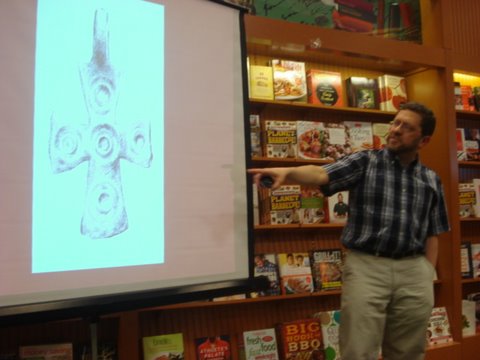
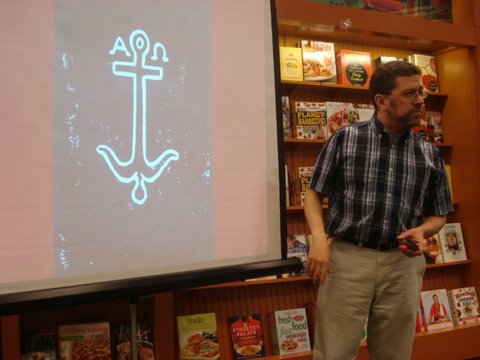
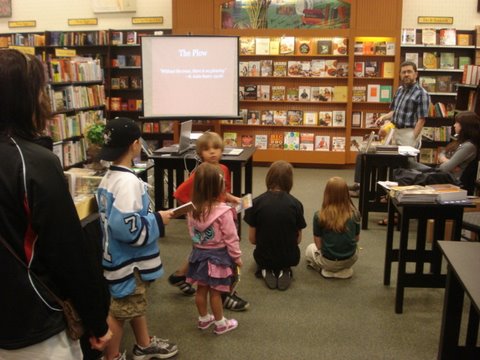
Last night, however, I snuck out with my dear daughter Mary Agnes and gave a presentation at a local Barnes & Noble on my book Signs and Mysteries: Revealing Ancient Christian Symbols. It was challenging — probably the youngest audience I’ve ever pitched patristics to. I’ll guess the average age was 12 or so. But what bright kids. By the end of the show, they were decoding inscriptions from the catacombs in seconds flat.
The event was organized elementary-school teacher Zee Ann Poerio, who is author of the “chapter book” A Griffin In Her Desk (about an elementary-school teacher much like Zee). Zee teaches Latin and history using ancient coins and artifacts. She’s amazing.