Joel has posted this month’s Patristics Carnival.
Author: Mike Aquilina
All Who Labor
In the States, today is Labor Day. On Labor Day, we don’t work. Go figure.
A day celebrating the dignity of labor would have been unthinkable among the ancient pagans. The aim in life was leisure. Cicero and Aristotle both frowned upon the day-to-day grind of the trades.
From the beginning, however, Christians (like the Jews before them) celebrated the work of their hands. They saw it as human participation in the act of creation. The new attitude is there in St. Paul: “We labor, working with our own hands” (1 Cor 4:12). “Work with your hands, as we charged you” (1 Thes 4:11). “For we hear that some of you are living in idleness, mere busybodies, not doing any work. Now such persons we command and exhort in the Lord Jesus Christ to do their work in quietness and to earn their own living” (2 Thes 3:11-12).
The attitude is everywhere in the works of the Fathers. The Didache, written perhaps as early as 48 A.D., exhorts: “If a prophet desires to abide with you, and if he is a tradesman, let him work and eat … See to it that as a Christian he will not live with you idle.”
In the fourth century, The Apostolic Constitutions decreed: “Attend to your employment with all appropriate seriousness, so that you will always have sufficient funds to support both yourselves and those who are needy. In that way, you will not burden the Church of God.”
Christ came to give rest to those who labored and found life burdensome. It is edifying to see that the grave markers in the catacombs and ancient cemeteries bear the symbols of trades the Christian men and women had practiced in life. The pagans noticed the difference in Christian attitude. In the second century, Celsus, the great critic of Christianity, sneered that Christian congregations were made up of “wool–workers, cobblers, laundry–workers, and the most illiterate and bucolic yokels.” Christians were, he added, disciples of “a poor woman of the country, who gained her subsistence by spinning, and [whose husband was] a carpenter by trade.”
Indeed, we are still today disciples of those ordinary laborers. And that’s one good reason why we can celebrate Labor Day, a thought that never occurred to Aristotle or Cicero or Celsus. Enjoy your day off.
New Book Is Out
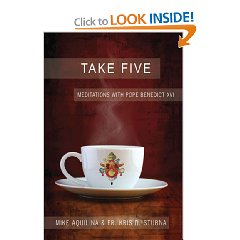
I just got my first copy in today’s mail.
It’s Take Five: Meditations with Pope Benedict XVI, co-authored with my good friend Father Kris Stubna. And it has a foreword by everyone’s favorite patrologist in the U.S. hierarchy, Daniel Cardinal DiNardo of Galveston-Houston.
Patristically Counter-Cultural
The National Catholic Register quotes me at length in Faithful Is the New Countercultural, an article by Joseph Pronechen.
Q&A with Aq
EarlyChristians.org ran a ranging interview with Yours Truly, in which I am much encouraged to pontificate.
Tunnel Vision
From Turkey comes news of a documentary film about the tunnels under Hagia Sophia:
Chasing 1,700-year-old secrets hidden beneath Hagia Sophia is no easy feat, but documentary filmmaker Göksel Gülensoy has navigated the labyrinths, ancient and bureaucratic, and will soon release his cinematic chronicle of the subterranean adventure.
Gülensoy’s team of two divers and four spelunkers searched the reservoirs connecting the famous Byzantine building to Topkapı Palace and the Yerebatan Cisterns. The spelunkers tried to find the secret passages said to extend from Tekfur Palace, next to the old city walls, to the islands of the Marmara Sea.
The Great Name-Caller
BMCR posted a list of books received, including some patristic titles. This caught my eye: Jerome of Stridon: His Life, Writings and Legacy, by Andrew Cain and Josef Lössl.
Reviews Rolling In
Lots of people have been reviewing my books. God bless them.
Three have posted reviews of Fire of God’s Love: 120 Reflections on the Eucharist:
This, That, and the Other Thing
and Karin.
You can find several more reviews of Fire of God’s Love at The Catholic Company.
Someone who goes by the name of catholicmommybrain (I love it) reviewed The Fathers of the Church (Expanded Edition). (There are more reviews here.)
Sometime commenter Joel at The Church of Jesus Christ posted a very thoughtful review of my book Signs and Mysteries: Revealing Ancient Christian Symbols.
And St. Peter’s Parish of Stevens Point, Wisconsin, posted an excerpt from my book Love in the Little Things.
Gus on Film
CNS tells of a new movie about Augustine — that’s won the praise of Pope Benedict:
CASTEL GANDOLFO, Italy (CNS) — Pope Benedict XVI praised a made-for-television movie dedicated to St. Augustine, saying the two-part miniseries “represents every aspect of the human life experience with all of its problems, sorrows and failures.”
Furthermore, the movie shows how “in the end truth is stronger than any obstacle,” he said Sept. 2 after viewing a shortened version of the more than three-hour-long film.
“This is the great hope that it ends up with: We cannot find truth by ourselves, but the truth, which is a person (Christ), finds us,” he said.
The movie, called “St. Augustine,” was directed by the award-winning Canadian director Christian Duguay, and was co-produced by Italian, German and Polish television companies …
The pope said St. Augustine’s life seemed to end tragically because the city of Hippo, “the world for which and in which he lived, ends and is destroyed.”
“But as it has been shown here, his message has remained and, even as the world changes, that message lives on because it is based on truth and guides charity, which is our common destiny,” he said.
The pope has often said his own thinking has been greatly inspired by the fourth-century theologian. When he was a young priest in 1953, the pope wrote his doctoral thesis on St. Augustine’s teachings, and his encyclical, “Deus Caritas Est” (“God Is Love”), owes much to the thought of this saint.
Born in North Africa, St. Augustine for many years ignored the counsel of his Christian mother and led a hedonistic lifestyle before converting and being baptized in Milan, Italy, at the age of 33.
St. Augustine’s spiritual awakening was not an overnight event but a continual process. The saint’s eyes were opened, the pope once said, by an awareness of God’s love, which is “the heart of the Gospel, the central nucleus of Christianity.”
In other Augustinian news: The Tablet (U.K.) ran a mildly irritating review of Henry Chadwick’s posthumously published biography Augustine of Hippo: A Life. The reviewer chides Chadwick for not coming to the conclusion that “the Donatists had a better claim to represent what had long been the orthodoxy of the North African Church than did the Catholics, whom they saw, not unreasonably, as an import from “overseas”, imposed in North Africa by the imperial authorities.” You can trace this line of historical thinking back to W.H.C. Frend, who saw the African schismatics as proto-Protestants much oppressed by Rome. The Chadwick book, though, sounds better all the time.
Round the feast days, Father Z ran some lovely posts on Monnica and her prodigal son. If I were a better man, I would have been linking all along.
New Reviews …
Brandon at The Thin Veil considers my book The Fathers of the Church (Expanded Edition).
Susan Stabile at Creo en Dios reviews Fire of God’s Love: 120 Reflections on the Eucharist.
The Fathers for Fun
Katie is not Just Another Catholic Mom — though that’s the name she blogs by. She’s a very astute reader and reviewer of my books. She’s posted a review of The Fathers of the Church (Expanded Edition), and here’s a little excerpt:
Thorough enough that it’s used by clergy and seminarians, the books is also easy to read and accessible to lay Catholics, which was just what I was looking for. I’ve always been interested in learning more about the early Church, but have found other books to be entirely too academic and boring for me to get through. Aquilina’s book, in contrast, I actually thought was fun to read … This expanded version also includes a short chapter on “Mothers of the Church” that was fascinating.
Free Book!
Polycarp at The Church of Jesus Christ is giving away my book Signs and Mysteries: Revealing Ancient Christian Symbols.
Letter to Levertov
While we’re on the subject of poets and patristics …
Last month I read This Great Unknowing, a collection of the last poems (posthumously published) by Denise Levertov. A British-born American poet, Levertov was the longtime poetry editor for The Nation. She converted to Roman Catholicism late in life. In her last notebook was a poem, “Translucence,” about Christians she knew. Her conclusion got me choked up:
They know of themselves nothing different
from anyone else. This great unknowing
is part of their holiness. They are always trying
to share out joy as if it were cake or water,
something ordinary, not rare at all.
“To share out joy as if it were cake or water, / something ordinary.” Sound familiar? I know those folks. You probably do, too. So did the anonymous author of the second-century Letter to Diognetus:
Christians are indistinguishable from other men either by nationality, language or customs. They do not inhabit separate cities of their own, or speak a strange dialect, or follow some outlandish way of life. Their teaching is not based upon reveries inspired by the curiosity of men. Unlike some other people, they champion no purely human doctrine. With regard to dress, food and manner of life in general, they follow the customs of whatever city they happen to be living in, whether it is Greek or foreign.And yet there is something extraordinary about their lives. They live in their own countries as though they were only passing through. They play their full role as citizens, but labor under all the disabilities of aliens. Any country can be their homeland, but for them their homeland, wherever it may be, is a foreign country. Like others, they marry and have children, but they do not expose them. They share their meals, but not their wives.They live in the flesh, but they are not governed by the desires of the flesh. They pass their days upon earth, but they are citizens of heaven. Obedient to the laws, they yet live on a level that transcends the law. Christians love all men, but all men persecute them. Condemned because they are not understood, they are put to death, but raised to life again. They live in poverty, but enrich many; they are totally destitute, but possess an abundance of everything. They suffer dishonor, but that is their glory. They are defamed, but vindicated. A blessing is their answer to abuse, deference their response to insult. For the good they do they receive the punishment of malefactors, but even then they, rejoice, as though receiving the gift of life. They are attacked by the Jews as aliens, they are persecuted by the Greeks, yet no one can explain the reason for this hatred.To speak in general terms, we may say that the Christian is to the world what the soul is to the body. As the soul is present in every part of the body, while remaining distinct from it, so Christians are found in all the cities of the world, but cannot be identified with the world. As the visible body contains the invisible soul, so Christians are seen living in the world, but their religious life remains unseen. The body hates the soul and wars against it, not because of any injury the soul has done it, but because of the restriction the soul places on its pleasures. Similarly, the world hates the Christians, not because they have done it any wrong, but because they are opposed to its enjoyments.Christians love those who hate them just as the soul loves the body and all its members despite the body’s hatred. It is by the soul, enclosed within the body, that the body is held together, and similarly, it is by the Christians, detained in the world as in a prison, that the world is held together. The soul, though immortal, has a mortal dwelling place; and Christians also live for a time amidst perishable things, while awaiting the freedom from change and decay that will be theirs in heaven. As the soul benefits from the deprivation of food and drink, so Christians flourish under persecution. Such is the Christian’s lofty and divinely appointed function, from which he is not permitted to excuse himself.
A Lion of Verse
A few months ago I posted about modern poems about the Fathers. The commenters and I came up with at least enough to fill a chapbook — poems by Richard Wilbur (Chrysostom), Phyllis McGinley (Jerome), Percy Shelley (Polycarp), Bob Dylan (Augustine), John Henry Newman (Gregory Nazianzen), and Samuel Hazo (Tertullian).
My friend (and favorite living poet) Jane Greer has me reading Stevie Smith these days. In her Collected Poems I found this gem:
Sunt Leones
The lions who ate the Christians on the sands of the arena
By indulging native appetites played what has now been seen a
Not entirely negligible part
In consolidating at the very start
The position of the Early Christian Church.
Initiatory rights are always bloody
And the lions, it appears
From contemporary art, made a study
Of dyeing Coliseum sands a ruddy
Liturgically sacrificial hue
And if the Christians felt a little blue —
Well people being eaten often do.
Theirs was the death, and theirs the crown undying,
A state of things which must be satisfying.
My point which up to this has been obscured
Is that it was the lions who procured
By chewing up blood gristle flesh and bone
The martyrdoms on which the church has grown.
I only write this poem because I thought it rather looked
As if the part the lions played was being overlooked.
By lions’ jaws great benefits and blessings were begotten
And so our debt to Lionhood must never be forgotten.
And while we’re speaking of poets. Today the New York Times trotted out the ancient denials of Wallace Stevens’ conversion to Catholicism. Here’s the backstory of the final act of a mind “finding what will suffice.”
Good News Comes in Twos
Roger Pearse leads us to a Russian site that stockpiles patristics Greek and Syriac texts.
Archeologists have dug up a paleochristian church in Algeria’s capital. (Hat tip: Jim Davila.)