I’m reading and thoroughly enjoying Rodney Stark’s Cities of God: The Real Story of How Christianity Became an Urban Movement and Conquered Rome. I hope to post something about it in the coming weeks. Meantime, this news item resonated, on the unearthing of a temple of Cybele in Bulgaria. Stark discusses Cybele worship as one of the forerunners of Christianity (in a sociological sense).
Author: Mike Aquilina
Expect the Unexpected
Before the discovery of the Dead Sea Scrolls, there was the Cairo Geniza. A Geniza is the storeroom in a synagogue where old, worn-out books were kept. In the Geniza of Cairo’s Ben Ezra synagogue, there were almost a quarter of a million manuscripts, some dating back to the ninth century. In the late 19th century a Jewish antiquarian realized the value of the documents and drew attention to them. Since then, they’ve occupied many academics, some of whom are deciphering layers and layers of palimpsest.
Jim Davila reports on a very cool, unexpected discovery — “a fragment of vellum containing a Latin text of a sermon by Saint Augustine — an unquestionably Christian text … probably one of the last things you’d expect to find in the Cairo Genizah … a piece of vellum containing Book 2 Chapter 24 of St. Augustine’s De Sermone Domini in Monte (the Sermon on the Mount).” Here’s a picture of the fragment.
Rome Come of Age
A very cool virtual model of Rome in 320 A.D.
ROME (Reuters) – Tourists puzzled by the jumble of buildings in classical and modern Rome can now find their bearings by visiting a virtual model of the imperial capital in what is being billed as the world’s biggest computer simulation of an ancient city.
“Rome Reborn” was unveiled on Monday in a first release showing the city at its peak in 320 AD, under the Emperor Constantine when it had grown to a million inhabitants.
Brainchild of the University of Virginia’s Bernard Frischer, Rome Reborn (www.romereborn.virginia.edu) will eventually show its evolution from Bronze Age hut settlements to the Sack of Rome in the 5th century AD and the devastating Gothic Wars.
Reproduced for tourists on satellite-guided handsets and 3-D orientation movies in a theatre to be opened near the Colosseum, Frischer says his model “will prepare them for their visit to the Colosseum, the Forum, the imperial palaces on the Palatine, so that they can understand the ruins a lot better”.
“We can take people under the Colosseum and show them how the elevators worked to bring the animals up from underground chambers for the animal hunts they held,” he said, referring to the great Roman amphitheatre inaugurated by Titus in 80 AD.
Frischer’s model is sourced from ancient maps and building catalogues detailing “apartment buildings, private houses, inns, storage facilities, bakeries and even brothels”, plus digital images of the vast “Plastico di Roma Antica” model built from plaster of Paris in 1936-74, which measures 16 by 17 meters.
The “reverse modeling” by Frischer and the Politecnico di Milano and University of Florence enables scholars to populate ancient monuments with virtual reality figures for experiments on practical details like ventilation, capacity or acoustics.
“For example, in scholarly literature the Colosseum has a great reputation for being a great people mover where people could find their seats very quickly. But estimates of the carrying capacity vary wildly from 35,000 to 78,000,” he said.
Engineers have populated his model with virtual spectators to narrow down that estimate to 48,000-50,000 people.
The model can also show how the Romans, who worshipped the sun and moon, aligned their buildings with the summer solstice.
St. Barnabas
Today’s his feast day.
Of the Making of Books
David Meadows alerts us to Bryn Mawr Classical Review’s review of a new history of early Christianity.
Fathers for Father’s Day
Our friends at Our Sunday Visitor have done something foolhardy. The newspaper turned over almost half of the editorial space in its June 17 edition to Yours Truly.
It’s all for Father’s Day. So they invited me to write a four-page pullout section titled “Fathers Know Best,” which is my best attempt at a pew-level introduction to patristics. Just a few hours after it appeared in the mail, an author I respect called to tell me it was the best popular intro he’s ever seen. So find yourself a Church that keeps a stack of OSV for distribution. Or call up with credit card in hand (1-800-348-2440) and ask that your own subscription begin with the June 17 issue.
Publisher Greg Erlandson makes an ardent pitch for patristics in his opening column:
Aquilina — who is well-known to many readers for his appearances on EWTN as well as for his numerous books and articles — helps us to understand the importance of the Fathers: who they are; what impact they have had on the Church; what wisdom they offer us today.
The Fathers (and the Mothers too) of the Church deepen our appreciation of the Bible and of our faith. They also give us some perspective on these times we live in.
Greg was OSV’s editor-in-chief when the company published the first edition of my book The Fathers of the Church. In fact, he’s encouraged me through four books on the early Church, all published by OSV.
Later in the same issue of the paper, my byline appears over the newspaper’s more traditional Father’s Day feature: “Lessons I’m Still Learning from Dad.” It’s a reflection on my pop’s virtuosity at fathering, and it includes a rare photo of the host of this blog, from younger, thinner, beardless days. In one of my books, I explain how my love for my father prepared me to appreciate the Church Fathers — even though I’m fairly certain that Pop’s only reading in patristics was in his youngest child’s books. Still, it was by living with him that I learned to look fatherward for good example, guidance, and wisdom; and that lesson served me well when I began to ponder the life of the Church.
I include many reminiscences about my dad in the book Love in the Little Things: Tales of Family Life. OSV had asked me to extract material on Pop from that book for their Father’s Day feature; but, after a couple of hours at the task, I found myself writing something new.
I hope you can lay hands on a copy of the June 17 OSV.
You Filk Up My Senses
Maureen marks St. Ephrem’s day and invokes him as patron saint of filk.
Filk is, according to Wikipedia, “a musical culture, genre, and community tied to science fiction/fantasy fandom. I once worked with an award-winning filker named Randy; but I doubt he ever asked the intercession of St. Ephrem, as he was a devout and ardent Baptist.
Maureen even adapted one of our saint’s songs in this very modern idiom.
Poet Laureate of the Fathers
From Sinai’s Height
A story of Muslim-Christian cooperation — for the benefit of the Fathers!
Dubai: A senior church leader in the Middle East has praised a Dubai cultural centre for offering to preserve Christian heritage.
Archbishop Damianos of Sinai, the Abbot of St Catherine’s Monastery in Egypt, has thanked the Juma Al Majid Centre for Culture and Heritage for saying it will assist in taking copies of the monastery’s well-known collection of manuscripts.
Some of the manuscripts at the Greek Orthodox monastery date back 1,500 years and the Juma Al Majid Centre will provide expertise and equipment so that digital records of the documents can be taken.
The Deira-based Juma Al Majid Centre’s initiative is the second example of UAE-Christian ties being strengthened this week.
Hat tip: PaleoJudaica.
In the Nick of History
Maureen Wittmann, my personal homeschooling guru, is also the founder and moderator of the Pope St. Nicholas V group at Yahoo. The purpose of the list is noble and edifying: “to help Catholics make purchasing suggestions to their public libraries.” Maureen spots new books that are promising, provides their basic bibliographic information, links to reviews and endoresements — and, most important of all, she trains library cardholders in the delicate diplomacy of putting the petition to our town or county library systems.
Maureen kindly listed my book The Resilient Church: The Glory, the Shame, and the Hope for Tomorrow as this week’s featured title on Pope St. Nick.
Maureen’s own books, Catholic Homeschool Companion and A Catholic Homeschool Treasury, approach canonical status for homeschoolers in this home.
Mourning the Martyrs
Cyprian Teaches the Pope to Pray
Zenit has posted an English translation of the catechetical lecture from yesterday’s papal audience. Continuing his series on the Fathers, Pope Benedict takes up Cyprian. Father Z posted commentary and video. Here’s the pope…
Dear brothers and sisters,
Continuing with our catechetical series on the great figures of the ancient Church, we arrive today to an excellent African bishop of the third century, St. Cyprian, “the first bishop in Africa to attain the crown of martyrdom.” His fame, as his first biographer, the deacon Pontius, testifies, is linked to his literary production and pastoral activity in the 13 years between his conversion and his martyrdom (cf. “Vida” 19,1; 1,1).
St. Cyprian was born in Carthage to a rich pagan family. After a squandered youth, Cyprian converted to Christianity at age 35. He himself tells us about his spiritual pilgrimage: “When I was still in a dark night,” he wrote months after his baptism, “it seemed to me extremely difficult and exhausting to do what the mercy of God was proposing to me. … I was bound by many mistakes of my past life and I didn’t think I could be free, to such extent that I would follow my vices and favored my sinful desires. … Later, with the help of the regenerative water, the misery of my previous life was washed away; a sovereign light illumined my heart; a second birth restored me to a completely new life. In a marvelous way, all doubt was swept away. … I understood clearly that what used to live in me were the worldly desires of the flesh and that, on the contrary, what the Holy Spirit had generated in me was divine and heavenly” (“A Donato,” 3-4).
Immediately after his conversion Cyprian, despite envy and resistance, was chosen for the priestly office and elevated to the dignity of bishop. In the brief period of his episcopacy, he faced the two first persecutions mandated by imperial decree: Decius’ in 250 and Valerian’s in 257-258. After the particularly cruel persecution of Decius, the bishop had to work hard to restore order in the Christian community. Many faithful, in fact, had renounced their faith or had not reacted adequately in the face of such a test. These were the so-called lapsi, that is, “fallen,” who fervently desired to re-enter the community.
The debate regarding their readmission divided the Christians of Carthage into those who were lax and those who were rigorists. To these difficulties was added a serious plague that scourged Africa and posed grave theological questions both within the Church and in regard to the pagans. Finally, we must remember the controversy between St. Cyprian and the Bishop of Rome, Stephen, regarding the validity of baptism administered to the pagans by heretical Christians.
Amid these truly difficult circumstances, Cyprian showed a true gift for governing: He was strict, but not inflexible with the “fallen,” giving them the possibility of forgiveness after a period of exemplary penance; in regard to Rome, he was firm in his defense of the traditions of the Church in Africa; he was extremely understanding and full of a truly, authentic evangelical spirit when exhorting Christians to fraternal assistance toward pagans during the plague; he knew how to maintain the proper balance when reminding the faithful, quite afraid of losing both their lives and their material possessions, that their true life and authentic goods are not of this world; he was unyielding in fighting the corrupt practices and sins that destroy the moral life, especially avarice.
“Thus were his days spent,” narrates Deacon Pontius, “when by the command of the proconsul, unexpectedly, the police arrived at this house” (“Vida,” 15,1). That day the holy bishop was arrested and, after a brief interrogation, courageously faced martyrdom amid his people.
Cyprian composed numerous treatises and letters, always linked to his pastoral ministry. Seldom given to theological speculation, he wrote mostly for the edification of the community and to encourage the good behavior of the faithful. In fact, the Church was his favorite subject. He distinguishes between the hierarchical “visible Church” and the mystical “invisible Church,” but he strongly affirms that the Church is one, founded on Peter.
He never tires of repeating that “he who abandons the Chair of Peter, upon which the Church is founded, lives in the illusion that he still belongs to the Church” (“The Unity of the Catholic Church,” 4).
Cyprian knew well, and strongly stated it, that “there is no salvation outside the Church” (Epistle 4,4 and 73,21), and that “he who doesn’t have the Church as his mother can’t have God as his Father” (“The Unity of the Catholic Church,” 4).
Unity is an irrevocable characteristic of the Church, symbolized by Christ’s seamless garment (Ibid., 7): a unity that, as he says, finds its foundation in Peter (Ibid., 4) and its perfect fulfillment in the Eucharist (Epistle 63,13).
“There is only one God, one Christ,” Cyprian exhorts, “one Church, one faith, one Christian people firmly united by the cement of harmony; and that which by nature is one cannot be separated” (“The Unity of the Catholic Church,” 23).
We have spoken of his thoughts on the Church, but let us not forget, lastly, his teachings on prayer. I particularly like his book on the “Our Father” which has helped me to understand and pray better the “Lord’s Prayer.” Cyprian teaches us that precisely in the Our Father, Christians are offered the right way of praying; and he emphasizes that this prayer is said in plural “so that whoever prays it, prays not for himself alone.”
“Our prayer,” he writes, “is public and communal, and when we pray, we pray not only for ourselves but for the whole people, for we are one with the people” (“The Lord’s Prayer,” 8).
In this manner, personal and liturgical prayer are presented as firmly united to each other. This unity is based on the fact that they both respond to the same Word of God. The Christian does not say “My Father,” but “Our Father,” even in the secret of his own room, because he knows that in all places and in all circumstances, he is a member of the one Body.
“Let us pray then my most beloved brothers,” writes the bishop of Carthage, “as God, the teacher, has taught us. It is an intimate and confident prayer to pray to God with what is his, elevating to his ears Christ’s prayer. May the Father recognize the words of his Son when we lift a prayer to him: that he who dwells interiorly in the spirit would also be present in the voice. … Moreover, when we pray, we ought to have a way of speaking and praying that, with discipline, remains calm and reserved. Let us think that we are under God’s gaze.
“It is necessary to be pleasing to the divine eyes both in our bodily attitude and our tone of voice. … And when we gather with the brethren and celebrate the divine sacrifice with a priest of God, we must do it with reverent fear and discipline, without throwing our prayers to the wind with loud voices, nor elevating in long speeches a petition to God that ought to be presented with moderation, for God does not listen to the voice but to the heart (‘non vocis sed cordis auditor est’)” (3-4).
These words are as valid today as they were then, and they help us to celebrate well the sacred liturgy.
Undeniably, Cyprian is at the origins of that fertile theological-spiritual tradition that sees in the “heart” the privileged place of prayer. According to the Bible and the Fathers of the Church, the heart is, in fact, the inner core of the human being where God dwells. That encounter in which God speaks to man and man listens to God takes place there; there man speaks to God and God listens to man; all this takes place through the only divine Word. It is precisely in this sense that, echoing Cyprian, Smaragdus, abbot of St. Michael, at the beginning of the ninth century, asserts that prayer “is the work of the heart, not of the lips, because God does not look at the words, but at the heart of him who prays.” (Diadem of the Monks, 1.)
Let us have this “listening heart” of which Scriptures and the Fathers speak (cf. 1 Kings 3:9): How greatly we need it! Only then will we be able to experience fully that God is our Father and the Church, the holy Bride of Christ, is truly our Mother.
Yester-Bester-Sellers
Julie of Happy Catholic is now podcasting audio of once-popular, now neglected books — page-turners from before everything was sleaze and scandal. Consider the project patristics in a pop-cultural sense.
Mass of the Early Christians, Take 2
I’m holding in my hands the new edition of The Mass of Early Christians. It’s in the warehouse. It’s even on Amazon.
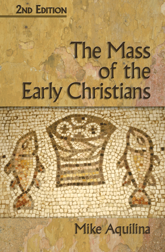
What’s new in this expanded edition? Lots. The book’s a good deal bigger. There are at least six new chapters — on Clement of Rome, Cornelius, Firmilian, the Anaphora of St. Mark, Eusebius, and the Council of Nicea. I added several more apocryphal texts, and included a discussion of the recently discovered Gospel of Judas. I also added more texts by Irenaeus, Cyprian, Origen, Clement of Alexandria, and others. Still other chapters were extensively rewritten based on more recent scholarship.
In case you missed the reviews the first time around, here’s a sampling:
“This is an excellent and exciting work. I wish that The Mass of the Early Christians was compulsory reading for all ordinands. Mike Aquilina is to be congratulated.”
— Robert Beaken, New Directions (U.K.)“All Christians from liturgical traditions can read this book with profit and find comfort in the firm historical basis of their own worship. Those who have shunned liturgical worship might after reading this book reconsider their position and wonder what they have been missing.”
— Christian Book Reviews“The Mass we know on Sunday—the Mass you encounter in this book—is where Tradition lives, where Church’s memory reigns ‘in the Spirit.’ Read this book, then, and remember.”
— Scott Hahn, professor, Franciscan University“Aquilina is to be congratulated for making these texts accessible to a new and wide-ranging audience allowing us to echo the cry voiced by the martyrs of North Africa in the third century: ‘we cannot live without the Mass!'”
— Fr. Joseph Linck, rector, St. John Fisher Seminary“Mike Aquilina has performed a needed service in making this heritage accessible to non-specialists.”
— Oswald Sobrino, Esq.
Can you tell I’m excited? Hope you like the new edition as much as I do.
Be, Hear, Now
I have been delinquent. While I was away, Maureen posted much wonderful audio, burning through her volumes of Gregory the Great and John Damascene. St. John’s defense of the veneration of icons is as fresh and needed today as it was way back when.