Posted on

Census Fidelium

It’s fabulously expensive, but looks fascinating: Fasti Sacerdotum: A Prosopography of Pagan, Jewish, and Christian Religious Officials in the City of Rome, 300 BC to AD 499. You’ll find it reviewed in BMCR.

Scholars of ancient Rome will be delighted that Rüpke’s monumental work, Fasti Sacerdotum, has been translated into English and thus become accessible to a wider readership … For those unfamiliar with the German edition, its aim was to construct annual lists for the city of Rome of attested priests, cult officials and followers from 300 BCE to 499 CE, lists that included not just pagan priests but also the officials from Jewish and Christian groups. The work falls into two main parts: a compilation of annual lists of priests and religious functionaries and a set of alphabetically arranged individual biographies. Understandably, the whole work was 14 years in the making and required a team of assistants.

The idea of the compiling the biographies is to personalize the religious history of the city of Rome through a biographical approach. Rüpke intends the work to be an instrument for researchers in the field of religious and cultural history. At all times he is aware of the limited nature of the source material at our disposal, which is derived largely from inscriptions.
Posted on

Toward Greater Under-Standing

“Benedict XVI has created and filled the post of archeological superintendent of the catacombs, in a move that will bring the Pontifical Commission for Sacred Archeology to function more like other Vatican dicasteries.”

Um, I think that’s good news! I’m reminded of Pope John XXIII’s response to the journalist who asked how many people work in the Vatican: “About half.”

Still, Zenit’s report promises that “great discoveries” are waiting in the catacombs. That’s exciting.

This part is certainly good news: “Fabrizio Bisconti, the outgoing secretary of the archeology commission, has been named the archeological superintendent of the catacombs, a post that did not previously exist.” Bisconti is the author of the mind-blowing book The Christian Catacombs of Rome: History, Decoration, Inscriptions, which I reviewed here.

Posted on

Signs and Goodies

This very cool homeschooling website just posted a kind review of my book Signs and Mysteries: Revealing Ancient Christian Symbols, which is gorgeously illustrated by Lea Marie Ravotti.

This is a beautiful little book. The design, typography, and illustrations are exquisite, light, and graceful. However, it is not light reading. To fully comprehend the meaning of each symbol, take it one chapter at a time. An understanding of these ancient symbols will bring us closer to our Christian roots, and in turn, closer to our Risen Lord.

Posted on

Feast of Saints Peter and Paul

Scott and Kimberly Hahn and I closed out the Year of St. Paul with a special two-day event at spacious St. Thomas More Church in Bethel Park, Pa. There were three talks and a weekend-long book fair. The parishioners were lovely.

Father Z provides reports and commentary on the breaking St. Paul news — namely, what was found in his tomb, and the discover of the oldest icon of St. Paul (fourth century).

Happy feast day, everybody. Celebrate!

Posted on

Good Sam’s Museum

Israel has opened a “mosaic museum” in the West Bank, reports The Art Newspaper.

The $2.5m Museum of the Good Samaritan, housing nearly 50 mosaics and a collection of antiquities, was opened at the Christian pilgrimage site where the Bible’s “Parable of the Good Samaritan” is believed to be set. The site also comprises the restored Good Samaritan Inn, a reconstructed Byzantine church, and Second Temple-era dwelling caves.

The museum’s preserved and restored mosaics and other relics from the fourth to the sixth centuries originate from Christian, Jewish and Samaritan historic sites, based on themes in the parable, Dr Magen said. He also said that excavations at the site show it to be the location where King Herod’s palace once stood.

There’s a good chance the St. Paul Center will return, with Steve Ray, to the Holy Land in 2011. Maybe we can see this museum together.
Hat tip: Jim Davila of PaleoJudaica.
Posted on

Saving the Monastery

While I was in Israel, Reuters reported on the happy resolution of a nasty situation I blogged on some time back.

Christian monastery in Turkey wins back land

ISTANBUL (Reuters) – One of the world’s oldest functioning Christian monasteries has won a legal battle to have land it had owned for centuries restored to it, after a Turkish court ruled on Friday it could not be claimed by the state.

The dispute over the boundaries of Mor Gabriel, a fifth-century Syriac Orthodox monastery in eastern Turkey, had raised concerns over freedom of religion and human rights for non-Muslim minorities in Turkey, a predominantly Muslim country and European Union aspirant.

In a statement, the Syriac Universal Alliance (SUA), a leading Syriac group based in Sweden, said a Turkish court in Midyat had reversed an initial decision by the land registry court to grant villages some 110 hectares (272 acres) of monastery land.

Posted on

All Lost in Wonder

Al Ahram posted a nice feature on the old lighthouse of Alexandria, one of the Seven Wonders of the World. The Pharos occupies a chapter in my book Signs and Mysteries: Revealing Ancient Christian Symbols, as it appears often in ancient Christian art and literature. Basil compared Athanasius to the towering wonder that cast brilliant light to guide wayfarers to safety. Athanasius, of course, was bishop of Alexandria.

There seems to be talk about assembling the lighthouse from the rubble.

Posted on

Naples Explodes with Delights

The New York Times, of all places, regales us with early-Christian archeological finds in Naples, Italy. Tolle, lege: Deep in the Heart of Historic Naples.

Another day, we took an English-language tour at the catacombs of San Gennaro, the patron saint of Naples, which began behind the Church of Madre del Buon Consiglio and just past a courtyard overlooking clotheslines, lemon trees and scooters. Down below we walked, first seeing small chapels, which held the bodies of wealthy families; in one “cubico,” a haunting fresco from the sixth-century A.D. memorialized a family with a young child. The bodies of humbler citizens were placed in wall niches that are now empty. We walked through ancient arches amid a silent mustiness, and learned that this catacomb’s earliest use was in the second century A.D. Here, too, is the site of three early churches, the oldest dating to the fourth century; two of them were built underground. We saw a painting of Adam and Eve from the third century A.D. and symbols of Greek goddesses. Near the exit was a fresco of a bishop from the ninth or 10th century, found about a year ago.

Later, in the Sanità district, we toured the Catacombs of San Gaudioso — named for an African bishop who arrived in Naples in 439 — and saw skulls set into wall niches with frescoes below them depicting the dress of their owners’ professions: a judge’s robes, a knight with a sword. In the women’s area, the frescoes showed only long dresses: “The women had no professions, of course,” our guide explained.

You’ll find more up-to-the-minute Neapolitan archeological news here.

Posted on

Essene Essay

On the long flight from Newark to Tel Aviv, I occupied myself with Jesus and First-Century Christianity in Jerusalem, by Elizabeth McNamer and Bargil Pixner, OSB. I see that Dr. McNamer has posted an online essay based on that fascinating book.

For more of Father Pixner’s work, see here and here. He has since gone to his reward. Two of my fellow pilgrims went looking for his excavations and were shown the way by a Palestinian boy who remembered the priest and his digging.

Father Pixner and Dr. McNamer connect the first-century Christians genetically (literally and figuratively) with the Essenes.

One does not have to look far to see that many of these practices [Essene] were adopted by the early Christian community. They returned to that upper room after the death of Jesus. They were altogether there at Pentecost. They celebrated this according to the Essene calendar. (“Devout men “were present in Jerusalem.) They choose Matthias by lot (there is a house of Matthias mentioned in the copper scroll). Pentecost became the main feast for the early church. Baptism became the initiation rite of the new community; The Holy Spirit (not mentioned anywhere in the O.T.) is prominent in the Dead Sea Scrolls and in the literature of the early Jewish community. They celebrated a sacred meal. They practiced communal living. Both sects observed a community rule (Didache for Christians). There was a hierarchy of twelve for both. Times of prayer were the same. Healing was done by both groups. Could it all just be coincidence? We are told early on that a group of priests converted. They couldn’t have been Sadducees, who are shown as opposed to the Christian sect in the Acts. So who else? The only alternative was the Essenes.

Posted on

Signs of the Times

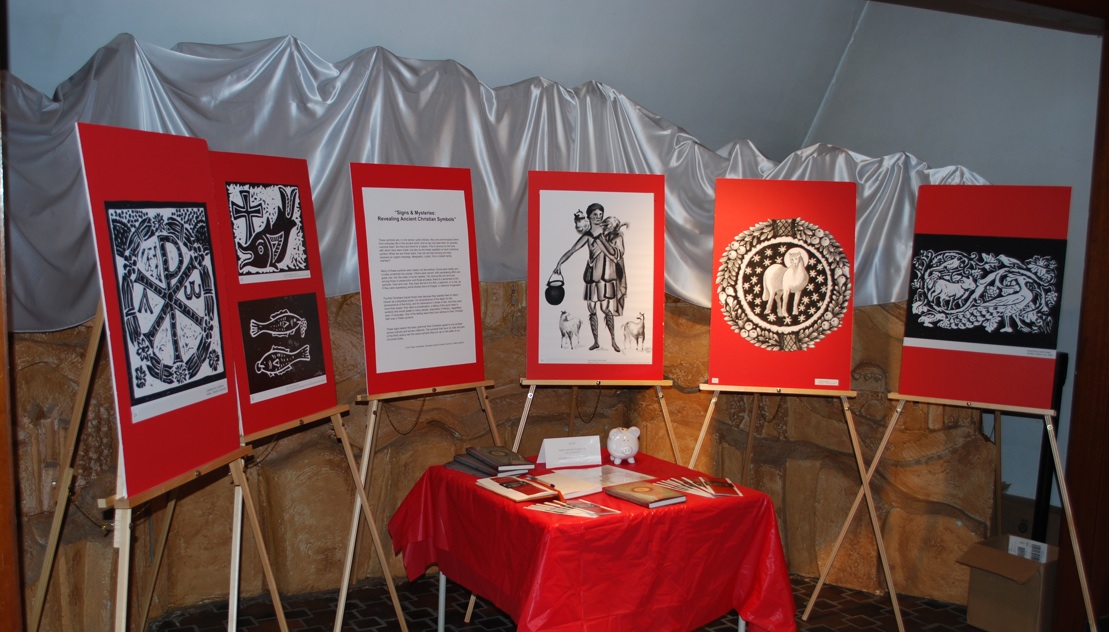
The Signs and Mysteries traveling road show is, briefly, at St. Sebastian Parish in Ross Township (a suburb of Pittsburgh). The intersection is McKnight and Siebert Roads. The book’s renowned illustrator, Lea Ravotti, sent along a photo of part of the exhibit, which is in the nave of the Church. Hurry if you plan to visit. It’s only there this week, June 7-15, 2009! Other parishes will follow. Stay tuned.