It’s amazing that I’m still trying to catch up after my ten days in the Holy Land. If you track the activity of those days, though, you’ll understand why. My fellow pilgrim Piotr has posted narrative (in Polish and English!) plus photos plus video of the trip. I make cameos frequently, as Piotr and I were assigned to the same bus.
Category: Archeology
Prescriptions of the Desert Fathers
The Toledo Blade reports on Modern Chemistry and Ancient Medicine:
A team of researchers at the University of Pennsylvania have begun using modern chemistry to identify key ingredients in ancient Egyptian medicines. Chemical testing techniques have allowed scientists to identify certain herbs and other ingredients that were added to wine. The mixture had medicinal qualities that were so highly valued that people traveled from abroad to seek them. Some ingredients were recorded as hieroglyphs, and these inscriptions are being used as well to help with the identification of the medicinal ingredients.Recently two clay jars, one approximately 1,500 years old and the other as old as 5,000 years, have provided residue that can be identified as herbs such as coriander and rosemary. Some researchers, including scientists from Penn’s Abramson Cancer Center, are testing these ancient remedies to see if the herbalists of antiquity were on to anything with their concoctions. By taking these ancient compounds and applying them to modern medical studies such as cancer research, scientists are effectively using archaeology to gain greater knowledge of modern science.
Made My Day
Father Christian Mathis posted a review of my book Signs and Mysteries: Revealing Ancient Christian Symbols.
Aquilina succeeds in creating a work that connects modern Christians with those who lived in the first centuries. He invites his readers to reclaim symbols that may be unfamilar while deepening their understanding for those that remain common today. Twenty-five symbols are presented in a clear and straightforward manner along with the beautiful illustrations of Lea Marie Ravotti. The author’s clear expertise on the writings of the Fathers is evident as he easily brings together thoughts from various ancient texts. Examples from Scripture, homilies and early accounts of martyrdom are recounted in order to demonstrate how the early Church was able to strengthen its prayer, liturgy, and communal life by keeping these symbols central.
Ancient News
Once again, I’m behind in posting news. Here’s a summary from my email box:
* Wheaton College has established a “Center for the Study of Early Christianity, with a vertically integrated program from undergraduate courses up through master’s and doctoral studies.” Here’s the Center’s site.
* Pope Benedict XVI finally got around to talking up St. Germanus of Constantinople and St. John of Damascus. St. John is often called the last of the Fathers of the “early Church,” so I suppose that marks the end of his series, though word has it that he plans to forge ahead chronologically.
* A kind commenter tells us: “You can wallow in chant from all rites (even extinct ones) if you listen to Radio Walsingham online. The guy who runs it can answer all your questions; frequently comments on the historical and liturgical context of the music. He has made a CD collection of some of the most obscure and beautiful chants from all eras and nations. ”
* The Roman catacombs — jealous, no doubt, of the catacomb discoveries in the Holy Land last week — have been in the news almost nonstop. The latest development is the video cataloging of the tunnels — “a three-year project to create the first fully comprehensive three-dimensional image using laser scanners.” This will make virtual tours delightfully possible. All the usual suspects have been covering this. Adrian Murdoch will take you directly to the BBC video. David Meadows, too, has been all over it.
* Amy Welborn gives us a snatch of video on St. Anthony of the Desert.
* At PaleoJudaica, we meet an American monk who travels the world gathering images of rare ancient manuscripts.
* Friend Binks points us to PBS coverage of Philip Jenkins on Christianity in ancient Asia.
More to come, surely, as I plow through a backlog of email!
Tunnel Vision
Roman-era catacombs were unearthed last week in Bethlehem during construction in an empty lot beside Bethlehem University. Can’t wait to find out more.
Signs in Syria
An early-Christian mosaic has been found in Syria. Readers of my book Signs and Mysteries: Revealing Ancient Christian Symbols will have fun decoding it.
Out of the Shadows
Al Ahram gives us a rare glimpse at an early Christian artwork on Mount Sinai.
Unearthing Apocrypha
Alert from Jim Davila PaleoJudaica: “The book of 2 Enoch, previously known only in versions in Old Church Slavonic, has now been partly recovered in an earlier Coptic translation. The fragments were found nearly four decades ago and the transcriptions and photos have been sitting unnoticed for many years.”
He also points us to a nice profile of St. Jerome. (Don’t forget Jerome’s theme song, “The Thunderer,” penned by Rock n Roll Hall-of Famer Dion.)
The Fathers and Fish: It Wasn’t Just for Friday
This (from the London Times) is just too cool.
In Ancient Rome lions ate Christians, so we are told. But what did early Christians eat? A lot of fish, according to recent research on bones from the Roman catacombs.
“The eating habits of Rome’s early Christians are more complex than has traditionally been assumed,” say Leonard Rutgers and his colleagues in The Journal of Archaeological Science. Their work was based on analysis of 22 skeletons found in the Catacombs of St Callixtus on the Appian Way, an area utilised in the 3rd to 5th centuries AD (although some of the skeletons were radiocarbon-dated to the 2nd century).
Albania Mania
BBC slide show: A patristic-era Albanian site with a baptistery, early-Christian mosaics and such.
Dig These Digs
• The church and winery of a Byzantine monastery have been unearthed in central Israel.
• An online dissertation: Milton Luiz Torres, Christian burial practices at Ostia Antica.
Best of Show
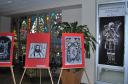
This Friday evening my family and I attended a great event: the opening of an exhibit of the artwork of Lea Marie Ravotti. Specifically, it was the work she did for our collaboration, Signs and Mysteries: Revealing Ancient Christian Symbols. The show is in the vast new parish center of St. Thomas More Church in Bethel Park, Pa. (a suburb of Pittsburgh), and it will continue until March 30. Afterward, Lea hopes to move the show to other venues — churches, libraries, schools, hospitals, colleges and universities. She is also selling prints of selected works from the book. She gave me a tee-shirt with a third-century sarcophagus banquet scene. Now how cool is that?
Hope you can stop by and see the exhibit. If you can’t get to Pittsburgh, don’t fret: you can still buy the book.
Lea is a well-known and well-shown artist in her native Prague. She was raised an atheist in communist Czechoslovakia, came to the States for work when the walls fell, and here she questioned her way to Christian faith. Take a few minutes to read OSV’s interview with the artist about her art and her conversion.
Fit from a King
PhDiva gives us detail on the recent Davidic discoveries in Israel — descriptions, background, photos, and even a patristic angle:
Some three years ago the impressive remains of a monastery from this period were excavated that together with the remains of the current excavation confirm the identification of the place as “Metofa”, which is mentioned in the writings of the church fathers in the Byzantine period. The name of the Arab village, “Umm Tuba” is therefore a derivation of Byzantine “Metofa”, which is Biblical “Netofa” and is mentioned as the place from which two of David’s heroes originated (2 Samuel 23:28-29).
De-Classifying the Secret History
New excavations are helping us to understand Justinian. We really need more than Procopius to go on. Hat tip to Adrian Murdoch.
Laser Searchery
David Meadow directs us to news of a laser mapping tool that will soon allow us very cool virtual tours of the Roman catacombs. (Right now, the next-best thing to being there is this book.)