Posted on

Bacteria in the Cubicula

The Roman Catacombs are back in the news

ScienceDaily (Sep. 24, 2008) — Life has been discovered in the barren depths of Rome’s ancient tombs, proving catacombs are not just a resting place for the dead. The two new species of bacteria found growing on the walls of the Roman tombs may help protect our cultural heritage monuments, according to research published in the September issue of the International Journal of Systematic and Evolutionary Microbiology.

The Catacombs of Saint Callistus are part of a massive graveyard that covers 15 hectares, equivalent to more than 20 football pitches. The underground tombs were built at the end of the 2nd Century AD and were named after Pope Saint Callistus I. More than 30 popes and martyrs are buried in the catacombs.

Posted on

Scuba Scholarship

Bryn Mawr Classical review has posted a review of a new book, Egypt in the Byzantine World, 300-700, edited by Roger Bagnall.

If you want to see Byzantine Egypt up close, though, you’ll have to go underwater. The modern Alexandrians are, according to Al Ahram, constructing an “underwater plexi-glass tunnel providing a unique window on the sunken capital of the Ptolemies” — not to mention Origen, Athanasius, and Cyril.

Posted on

Some Pious Old Folks in Salonika…

It’s quite possible that the protagonists of the ancient limerick are buried here…

Archaeologists in Greece have unearthed more than 1,400 ancient graves and tombs during excavation work for a new metro in the northern city of Salonika, the culture ministry said on Thursday. The graves and tombs spanned an 800-year period from the fourth century BC to Roman times in the fourth century AD. The finds range from humble pits and altar tombs of stone to marble sarcophagi, the ministry said. One in five burial sites were found to contain offerings including Roman-era gold coins from Persia, jewellery made of gold, silver and copper, clay vessels and glass perfume-holders. Founded in the fourth century BC by King Cassander of Macedon, Salonika was a major metropolis through Hellenistic and Roman times and possesses a rich archaeological heritage, some still undiscovered. As in the case the Athens Metro a decade ago, ongoing work on the Salonika underground has already brought other archaeological treasures to light. In June, archaeologists found four gold wreaths and a pair of gold earrings in the grave of a woman who lived in the city over 2,000 years ago. The metro also runs beneath the city’s historic Jewish cemetery, which was one of the largest in Europe and is believed to hold more than 300,000 graves. The 9.6-kilometre (six-mile) network is expected to be completed in 2012.

Hat tip: Rogue Classicism.

UPDATE: Another ancient cemetery turned up in England. Given the period of both, it’s possible they’ll produce some Christian artifacts. In any event, they’ll certainly shed more light on the world of the Fathers.

Posted on

Olive My Love

You can’t read too far into the Fathers without picking up on the importance of the olive in Mediterranean life. Called the “meat of the poor,” it was a staple in the diet, an ingredient in food, a seasoning, and a main course in itself. Its oil was a medicine, a lotion, a base for perfumes. In the Church, it was the myron, the sacred chrism used in sacramental anointings. Archaeology magazine has posted an interesting interview that gets to the pit of the matter: Olives and People, Past and Present.

I can’t really fault God for choosing to become incarnate in a place where his mama would cook so much with olive oil. I had no choice in my placement, but it sure worked for me.

Posted on

Head in the Sand

Archeologists have unearthed a colossal head of the Roman Emperor Marcus Aurelius. Marcus, who reigned 161-180, was a stoic philosopher and the last of the so-called “Five Good Emperors.” While other stoics admired the fortitude of the Christian martyrs, Marcus held Christianity, and especially its martyrs, in contempt. In his Meditations, he mentions Christianity only once, disdainfully.

How blessed and happy is the soul that is always ready, even right now (if need be), to be separated from the body, whether by way of extinction, or dispersion, or continuation in another place and state. But its readiness must proceed, not from an obstinate and peremptory resolution of the mind, violently and passionately set upon opposition, as we find in Christians; but from a peculiar judgment, with discretion and gravity, so that others may be persuaded also and drawn to follow the example, without any noise and passionate exclamations.

Marcus was a persecutor of the Church. And, though he issued his executive orders in cold blood, his attitude inspired the non-stoic rabble to form murderous anti-Christian mobs. Between the executions and the riots, it was a difficult time for believers. Christian victims of Marcus’s reign include Justin Martyr, Blandina and Pothinus, and possibly Polycarp. But the same hostile climate also produced a great flowering of Christian apologetic literature, some of it directed at Marcus himself, from great Fathers such as Melito of Sardis. The sociologist Rodney Stark holds that the Church grew at an alarming pace during this period, at least 40% per decade. Further proof of The Tertullian Principle: The blood of the martyrs is seed.

In spite of Marcus’s contempt for Christians, Christians have harbored a fondness for him. Witness the judgment of the old Catholic Encyclopedia: “Marcus Aurelius was one of the best men of heathen antiquity.”

I own a biography of the American martyr Father Marquette that concludes with a line not from Jesus Christ, but from Marcus Aurelius: “Take pleasure in one thing and rest in it, in passing from one act to another, thinking of God.”

Posted on

Villa of the Papyri

When Vesuvius erupted August 24, A.D. 79, it left Pompeii and Herculaneum buried under 30 meters of volcanic mud. We’ve learned so much about Roman life from the excavated bakeries and cafes sealed forever in that long-ago moment, with petrified food still on the tables and petrified bread still in the ovens. Most intriguing to nerds is the haul taken out of the Villa of the Papyri. It’s a library of scrolls that were instantly turned to blocks of charcoal. We don’t know what most of them contain. A month or so ago, a few of us were dreaming about the possibilities. Now The Australian is doing the same. “Scholars today, using multi-spectral imaging technology, are able to decipher the otherwise inscrutable surface of black ink on black fabric of the papyrus scrolls. A multinational team has assembled to transcribe the collection.” There’s no news, as the process has been temporarily halted, but there’s plenty of speculation to fuel our fantasies.

Posted on

Holy Martyrs Fun Fair

There’s a town not far from me called Tarentum, and in Tarentum there’s a parish called Holy Martyrs, and every summer the parish hosts the “Holy Martyrs Fun Fair” — the signs for which always bring a smile to the face of my friend and sometime co-author Chris Bailey. He’s imagining, no doubt, Neronian spectacles. The reality is probably more like Bingo and pierogies.

But it seems that the Eternal City is planning its own Holy Martyrs fun fair on a grand scale: a Disney-style theme park. Not even Chris could make this up.

Posted on

Pressing for Details

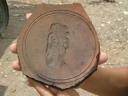
A few weeks ago we looked at the excavation of a Byzantine wine press near or at an ancient Egyptian monastery. Today let’s look at a Byzantine olive press just unearthed in Israel, also quite probably associated with a monastery. Among the artifacts found are two fragments of a marble chancel screen and what seems to be a plate bearing an image of the Madonna and Child.
ahihudplateiaasmall.jpg
Olives for anointing … the fruit of the vine … the mother with her suckling infant … these images abound in my new book, Signs and Mysteries: Revealing Ancient Christian Symbols, which is lavishly illustrated by Lea Marie Ravotti. No less an authority than Adrian Murdoch has said that Signs and Mysteries is “an essential book to keep to hand when visiting early Christian sites” — even if you’re just visiting them as archeological sites on the Web!

UPDATE: The Jerusalem Post reports on the dig.

Posted on

Portrait Gallery

David Meadows leads us to a haunting YouTube slide show of ancient portraits, most of them from Egypt’s Roman period and discovered in the Fayoum. Many are painted on burial cloths. My favorite image from this style and period now hangs in the Louvre. It portrays the deceased, a beautiful young Christian woman, holding the traditional Coptic cross, the ankh. (I discuss this image in my new book, Signs and Mysteries: Revealing Ancient Christian Symbols.)

These are lovely images. You’ll see their influence later in Byzantine icons. Enjoy the show!

And may the souls of the faithful departed, through the mercy of God, rest in peace.

Posted on

Spoils of Egypt

Egypt’s native Christian community, tracing their origins to the apostolate of St. Mark the Evangelist, long marginalized by the Muslim majority, the Copts cling tenaciously to their ancient culture, which finds expression in distinctive and beautiful art — art all but unknown in the West.

The Treasures of Coptic Art includes hundreds of color images, well photographed to highlight even the small details. And the accompanying text is written by two outstanding scholars: Gawdat Gabra, former director of Cairo’s Coptic Museum, and Marianne Eaton-Krauss, a specialist in pharaonic art at the Berlin-Brandenburg Academy of Science and Humanities. The editors use the term “art” broadly, to include many items of material culture: combs, lamps, flasks, and jewelry, for example.

The ancient Copts were aware of their native heritage — the art of the Pharaohs — but they also drew from other influences: Hellenistic, Jewish, Roman, and even Indian. The port of Alexandria was the mercantile and intellectual hub of the ancient world; people of all nations converged there and left their marks on the arts.

Egypt’s Christians experienced their greatest freedom in the three-century interlude between Roman persecution and Muslim invasion, and many of the works included in this book come from that period. Much of the art is in the folk idiom. “Coptic monuments never enjoyed the patronage of emperors, kings, rulers, or sultans,” write the authors. “In the absence of court patronage, the artistic heritage of the Copts [was] expressed in monasteries and churches.”

The varied influences are easy to spot. Like their forebears in the age of the Pharaohs, the Christian Copts favored the brighter hues in the palette. Like the later Byzantines, they rendered proportionally oversized eyes, ears, and foreheads, to suggest prodigious spiritual senses. Coptic icons, however, are often simpler and less ornate than their Byzantine counterpart. Facial expressions tend to be softer; and the figures are usually, of course, darker-skinned. Overall, they have a more “primitive” and even naïve quality, as one might find in the folk paintings of the American South or the self-consciously primitivist works of Edward Hicks or Henri Rousseau.

Egypt’s desert climate has preserved a remarkable number of works that could not survive in other, damper places: textiles, for example, including tapestries, vestments, and carpets; wood carvings; papyrus manuscripts; and, of course, devotional icons and wall paintings. They’re all in this book, alongside the more durable media, like sculpture and architecture, and decorated items from everyday life: dishes, keys, jugs, children’s toys, combs, and brooches.

The illustrations alone tell of the minute particulars of Coptic devotion. Carvings give evidence of the early devotion to the Blessed Virgin, St. Michael the Archangel, and especially the holy family, whose sojourn in Egypt is recorded in Matthew’s gospel. There is a great multitude of portrayals of Coptic saints, most of them monks and nuns of the desert, portrayed in the robes of their habit, with the characteristic wide-eyed frontal stare.

The book, perfectly calibrated for an introduction, provides historical context, made vivid by arresting details from the documentary and archeological record. Egyptian Christians continued to practice the ancient methods of mummifying their dead till well into the eighth century, for example, while the ankh, the symbol of the Nile River god, gradually became Egypt’s dominant Christian symbol, the “cross with a handle,” still a sign of waterborne life.

Pilgrimage has been an enduring expression of the fervor of the Copts. Pilgrim shrines are focal points of devotion, and so are often ornamented by visitors and patrons. The subject merits a full chapter in Treasures.

Most interesting is the treatment of the shrine of Abu Mina, the Lourdes of the ancient world. St. Mina (or Menas) was a third-century soldier who died in the first eruption of Diocletian’s persecution. As he was borne homeward by his comrades, the camels stopped suddenly in the desert and refused to budge. The soldiers, who were Christian, took this as a sign that Mina should be buried there.

A spring miraculously appeared at the site, and its waters were renowned for their healing power. Pilgrims converged on the site from everywhere. Abu Mina flasks, given close treatment in the book, have been found “as far afield as Italy and the Balkans.” Mina always appears in the orant posture (hands outstretched in prayer), usually with the features characteristic of Coptic art: the oversized round head and large, otherworldly eyes.

Other Egyptian pilgrimage sites track the Holy Family’s travels through the land. These, too, inspired many images — the Christ child riding St. Joseph’s shoulders, the Virgin riding a donkey or a horse (symbolizing the flight from Herod). Some ancient renderings of the Madonna nursing the baby Jesus hark back to common pharaonic images of Isis with the suckling infant Horus.

Additional chapters treat the cultures of the Nile, monasticism, Gnosticism, church architecture, and many other subjects. The chapter on the “Glorification of the Holy Virgin” is especially beautiful. Throughout the book, the authors draw from the writings of the great Fathers and the counsels of the desert ascetics.

This is the ancient faith made visible and made durable — a desert faith that has survived almost two millennia of tremendous hardship. The Treasures of Coptic Art invites a new Christian audience to look into the outsized eyes of Egypt’s icons.