Posted on

New Book Is In

My newest new book, Fire of God’s Love: 120 Reflections on the Eucharist, has arrived!

It’s a collection of unusual (if I do say so myself), but entirely orthodox meditations from a diverse assortment of saints and thinkers. For example:

Marshall McLuhan

J.R.R. Tolkien

Maria Montessori

Blaise Pascal

Richard John Neuhaus

G.E.M. Anscombe

Plus the Fathers, of course: Augustine, Chrysostom, Ambrose, Ephrem, Caesarius of Arles, Cyril of Jerusalem, Balaeus, Irenaeus, Justin, Ignatius, Jacob of Sarugh, Maximus Confessor, Sechnall … And, as the folks at Ronco used to say, many more.

I’ve also invoked some names that were ubiquitous a century or a half ago, and should not be forgotten: Moritz Meschler, Nicholas Gihr, Maurice Zundel, April Oursler Armstrong, A.M. Roguet, Lawrence Lovasik … And, as the folks at Ronco used to say, many more.

And I’ve included my beloved friends Carl Sommer and Father Ronald Lawler — and Scott Hahn, to whom the book is dedicated.

I think you’ll like it. It’s a substantial book that sticks to your ribs. The readings I chose have stuck to mine, down the years.

Posted on

Signs and Goodies

This very cool homeschooling website just posted a kind review of my book Signs and Mysteries: Revealing Ancient Christian Symbols, which is gorgeously illustrated by Lea Marie Ravotti.

This is a beautiful little book. The design, typography, and illustrations are exquisite, light, and graceful. However, it is not light reading. To fully comprehend the meaning of each symbol, take it one chapter at a time. An understanding of these ancient symbols will bring us closer to our Christian roots, and in turn, closer to our Risen Lord.

Posted on

For the Journey

Kevin Branson, of the blog Journey to Rome, reviewed The How-To Book of Catholic Devotions: Everything You Need to Know but No One Ever Taught You, which I wrote with my friend Regis Flaherty, who’s something of an expert in this area, having also written Catholic Customs: A Fresh Look at Traditional Practices. Kevin also does quick hits on a few of my other books. May his tribe increase and his crops be abundant.

Posted on

A Little Vindication

BMCR reviews Alden A. Mosshammer’s The Easter Computus and the Origins of the Christian Era (in the Oxford Early Christian Studies series). What’s it all about? It’s about …

… Dionysius Exiguus, the sixth-century putative inventor of Anno Domini dating. Skeptics … noted that Dionysius’ dating of the nativity was quite likely wrong … The Venerable Bede had observed back in the early eighth century that Dionysius’ dating of Christ’s birth contradicted biblical, annalistic, and patristic evidence, which favored the years BC 2/3. Most modern scholars thus have assumed that Dionysius willfully broke with tradition, and calculated his own (incorrect) nativity date.

Mosshammer effectively undermines this accusation in a lengthy, highly technical, and meticulously-argued study … That he largely succeeds is a testament to his clearly extensive knowledge of antique calendrical traditions.

Posted on

Essene Essay

On the long flight from Newark to Tel Aviv, I occupied myself with Jesus and First-Century Christianity in Jerusalem, by Elizabeth McNamer and Bargil Pixner, OSB. I see that Dr. McNamer has posted an online essay based on that fascinating book.

For more of Father Pixner’s work, see here and here. He has since gone to his reward. Two of my fellow pilgrims went looking for his excavations and were shown the way by a Palestinian boy who remembered the priest and his digging.

Father Pixner and Dr. McNamer connect the first-century Christians genetically (literally and figuratively) with the Essenes.

One does not have to look far to see that many of these practices [Essene] were adopted by the early Christian community. They returned to that upper room after the death of Jesus. They were altogether there at Pentecost. They celebrated this according to the Essene calendar. (“Devout men “were present in Jerusalem.) They choose Matthias by lot (there is a house of Matthias mentioned in the copper scroll). Pentecost became the main feast for the early church. Baptism became the initiation rite of the new community; The Holy Spirit (not mentioned anywhere in the O.T.) is prominent in the Dead Sea Scrolls and in the literature of the early Jewish community. They celebrated a sacred meal. They practiced communal living. Both sects observed a community rule (Didache for Christians). There was a hierarchy of twelve for both. Times of prayer were the same. Healing was done by both groups. Could it all just be coincidence? We are told early on that a group of priests converted. They couldn’t have been Sadducees, who are shown as opposed to the Christian sect in the Acts. So who else? The only alternative was the Essenes.

Posted on

Budz Light (Not Lite)

In today’s mail came J. Budziszewski’s new book, The Line Through the Heart: Natural Law as Fact, Theory, and Sign of Contradiction. I put it aside as interesting for future reading, but perhaps far afield for this blog. Then, tonight, while waiting for my wife to finish up on the computer, I opened to a random page and found the author defending the Fathers against charges of intolerance. “Nor do the patristic writers argue merely that God detests the persecution of Christians; they say that persecution as such is repugnant to faith and to the will of God. This argument is elaborated by diverse early Christian figures, just the sort of thinkers whom liberals assume to have been impossible before liberalism.” Then follows the abundant evidence, from Lactantius, Hilary, Isidore of Pelusium, Gregory Nazianzen, John Chrysostom, Athanasius, and Augustine. The quotes are generous. The argument covers many pages. As I glance through the index, I see many more familiar names from antiquity. Looks like I’ll be reading this sooner rather than later.

I’m a longtime fan of Budziszewski. I’ve used his Ask Me Anything: Provocative Answers for College Students and How to Stay Christian in College with my kids.

Posted on

Signs of the Times

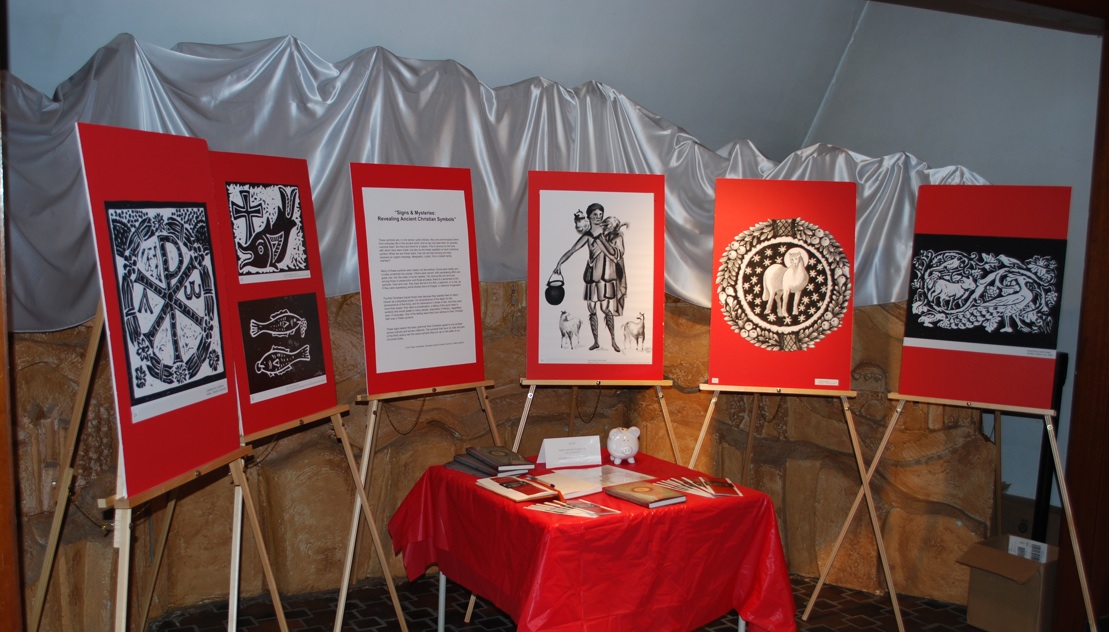
The Signs and Mysteries traveling road show is, briefly, at St. Sebastian Parish in Ross Township (a suburb of Pittsburgh). The intersection is McKnight and Siebert Roads. The book’s renowned illustrator, Lea Ravotti, sent along a photo of part of the exhibit, which is in the nave of the Church. Hurry if you plan to visit. It’s only there this week, June 7-15, 2009! Other parishes will follow. Stay tuned.

Posted on

Keys to Educational Success

Yesterday I had the singular honor of giving the high-school commencement address at Aquinas Academy in Pittsburgh, Pennsylvania. In case you didn’t know: Aquinas has the highest SAT average in its region and for four years in a row has been ranked one of the Top 50 Catholic High Schools in the United States. See what happens when a school incorporates my books (The Resilient Church and The Fathers of the Church) in its religion and history curricula?

I served on the board of Aquinas, way back at its founding (1996).

Posted on

Big Bible News II: The Dictionary


My friend Scott Hahn’s  Catholic Bible Dictionary is now in the warehouse and shipping from Amazon. Scott’s beaming. He says: “It weighs in with more than a thousand pages. It’s sturdily and beautifully bound. And it includes more than five thousand clear and accessible entries covering a wide range of people, places, and topics, from Genesis to Revelation. Best of all, perhaps, it comes at a very affordable price.”

He’s quite right.