Had lunch a couple days back with my good friend Mike Sullivan of Emmaus Road Publishing. At an opportune moment, he reached into his bag and pulled out a fresh copy of the massive Catholic Bible Concordance for the Revised Standard Version Catholic Edition — the first and only concordance for the RSV-CE. It includes more than 15,000 words and 300,000 entries. It was compiled by C.W. Lyons and has a foreword from my friend Scott Hahn. It’s quite lovely, and I can’t wait to own a copy. It’s on sale now!
Category: Books
A Gathering of Angels
Just got back from Jerusalem, and my little brain has not yet adjusted to the new time zone. I was very happy to return to new reviews of my book Angels of God: The Bible, the Church and the Heavenly Hosts.
Happy Catholic reviewed it, saying: “With his customary clarity and thoroughness, Mike Aquilina not only enlightens us about angels but actually makes us realize that our angelic brethren are just that … our brothers.” She says it’s “easy to understand without dumbing down” and “highly recommended.”
Meanwhile, Donna-Marie Cooper O’Boyle said, in the first installment of her review: “I am loving Mike Aquilina’s new book Angels of God: The Bible, the Church and the Heavenly Hosts … I especially love this author’s style of writing. He brings us so much enlightenment on his subjects in a wonderful conversational way. Mike helps us to discover the reality and the power of our Angel friends, escorting them seemingly ever closer to us. I really feel like I’m sitting down with Mike and chatting about the Angels over a cup of coffee every time I pick up this book to read more. I know you’ll love this book and learn much too, which is why I am highly recommending it. I’ll be posting a review of it soon. Stay tuned!”
Angel Music
Though oceans away, I’m excited to learn that Stateside readers are encountering noted author David Mills‘ review of my book Angels of God: The Bible, the Church and the Heavenly Hosts. It apparently appeared in the Pittsburgh Catholic newspaper, and included these musical words, among others:
Mike Aquilina’s new book, Angels of God, explains why angels are good news for us … Aquilina notes, “Our fellowship with them is not an ornament on our religion; it’s a life skill.”
Angels of God begins by describing the angels of the Bible and how the Church has drawn out the biblical teaching in its understanding of the orders of angels and the work of guardian angels, and of the angels’ place in the Mass. It then describes the three angels whose names we know — Michael, Gabriel, and Raphael — before discussing briefly the right response to the fallen angels. It closes with instruction on how we should “walk in the company of angels.” The book includes a short appendix of prayers to and poems about the angels.
Aquilina … gives an exceptionally clear and accessible introduction to the subject, but that is not all. He shows us that the world is a much happier place when you remember the angels, not least the one looking over your shoulder, and it is a safer place when you remember the fallen angels who wish you harm. The study of the angels is a very practical doctrine.
How is it practical? Let me give just two examples. First, it helps us better understand the Bible. Many of us tend to blank out all the times the angels are included — and they are included a lot — as if they were merely decorative. But they’re not.
For example, how many of us have shot through “Thy will be done on earth as it is in heaven” with no thought at all about who is it doing God’s will in heaven? With at most the vague thought that we are asking that things be better here on earth?
Actually thinking of all the hosts of angels serving God in perfect love and freedom, each doing his part, like a vast chorus (angels do sing a lot), gives us an inspiring vision of what the Church should be and how each of us should be living before the Lord. It changes the way you say that prayer. At least it did for me.
And there’s more. Playing off the mistake that “heaven” refers to outer space and not “the realm of the spirits,” Aquilina notes that “We’re praying not that we might be more predictable, like planets and asteroids, but that we might be as morally sure and true as the angels are.” Thinking about the angels gives us a more precise idea of what we’re asking for …
Angels of God introduces the subject very well, but that is not its only value. By showing us how the angels serve God, and especially how some of them serve God by serving us, it encourages us to serve Him better, because we know we have friends in high places.
Review Revue
BMCR has been reviewing patristic books aplenty: on Theodoret, Ephrem, and ancient monastic literature, among others.
Guy Talk
Our diocesan newspaper, the Pittsburgh Catholic, ran my review of a recent book on men’s spirituality.
Read the mainstream media and you’ll get the impression that the Catholic Church is a men’s club where women feel alienated.
Go to church, though, or attend a parish function, and you’re more likely to get the opposite impression. Women dominate the field — as volunteers and in liturgical ministries. Among church leaders and thinkers, anxious conversations turn on the questions of how to “reach” men and “get them more involved.”
It’s not exactly a new problem. I grew up in an Italian-Catholic ghetto in the 1960s, and it was fairly common to see men smoking outside church after dropping off their wives at Mass.
There was, even then, a perceived disconnect between the Church’s thriving devotional culture and the needs of ordinary men.
Thanks be to Robert P. Lockwood, then, for writing a book that connects (or re-connects) the Gospel to Catholic males in an authentically masculine way: A Guy’s Guide to the Good Life: Virtues for Men (Servant Books, $13.99).
A Guy’s Guide is, in a sense, a review of the seven basic habits of Christian life: the three theological virtues (faith, hope and charity) and the four cardinal virtues (prudence, justice, temperance and fortitude). But this is no re-packaging. It’s a fresh presentation. The basic definitions are there, occasionally buttressed by witnesses from tradition, but the heart of this book is the storytelling. We learn about faith from the story of Snuffy Stirnweiss, who was the 1945 American League batting champion. We learn about hope by watching Lockwood’s college-aged son fly model airplanes. We learn about charity, self-giving love, from the men Lockwood meets at a Holy Name dinner in Beaver County, Pa.
(In fact, Pittsburgh Catholic readers will often find themselves on familiar turf as they read these stories. Since Lockwood lives in Chippewa, he writes about our steel mills, our ballparks, our roadways and waterways.)
The prose is direct and plain-spoken, but memorable and quotable. What’s virtue all about? “It not about how I make a living but how I live … [W[hat we really want out of our lives is happiness. Not three-beer happiness, I-got-a-raise happiness or the-Steelers-made-the-playoffs happiness but that quiet contentment that comes with living a good life.”
Lockwood speaks consistently to male concerns, and he manages to do it without lapsing into stereotypes or dumbing down his material. In fact, his guide throughout the book is the great poet Dante — a man’s man of the thirteenth century, who was very much engaged in his world and the Church. Though I’ve been reading Dante on and off for decades, I was genuinely surprised by how well he fit beside the batting champions, bankers, barstool philosophers, and other characters in this book. Then I remembered a fact that Lockwood probably had in mind from the start: that Dante addressed his poetry to ordinary men, and he was the first Italian poet to use common, everyday language for that purpose. Lockwood uses his English artfully and subtly for the same glorious ends.
Like Dante, he knows that our greatest obstacles are not the big sins, like murder, grand theft and adultery. If we avoid these, it can be very easy — and deadly — to give ourselves a pass on Christian living. Lockwood identifies the enemy for most of us, however, not as the big sins, or the usual clichéd package of temptations (money, power and sex), but rather as “benign mediocrity.”
Lockwood notes instead that Jesus calls everyone to greatness and, as one manly saint put it, “our hearts are restless” till we answer that call.
I do not know a man I’d hesitate to give this book to. It’s simple enough for those who grow impatient with reading. It’s smart enough for those who appreciate wit and subtlety. Its humor is so strong that, as I read one spot — where our hero goes out to buy a pair of sneakers — I laughed so hard that my wife feared I would damage my internal organs.
St. Gregory the Great once compared the Scriptures to a river that’s calm and low enough for a child to play in, but deep enough to drown an elephant. This book uses the same rare combination of qualities — simplicity and subtlety — to deliver a powerful reflection on Scriptural living, and deliver it directly to the heart, soul, and gut of us guys.
Made My Day
Father Christian Mathis posted a review of my book Signs and Mysteries: Revealing Ancient Christian Symbols.
Aquilina succeeds in creating a work that connects modern Christians with those who lived in the first centuries. He invites his readers to reclaim symbols that may be unfamilar while deepening their understanding for those that remain common today. Twenty-five symbols are presented in a clear and straightforward manner along with the beautiful illustrations of Lea Marie Ravotti. The author’s clear expertise on the writings of the Fathers is evident as he easily brings together thoughts from various ancient texts. Examples from Scripture, homilies and early accounts of martyrdom are recounted in order to demonstrate how the early Church was able to strengthen its prayer, liturgy, and communal life by keeping these symbols central.
Call It Matristics
At last, it’s out!
I’m talking, of course, about Karen Edmisten’s The Rosary: Keeping Company with Jesus and Mary, a beautiful, beautiful book. It’s my great honor to have written the book’s foreword, telling the story of my mom and her many Rosaries down the years.
If you haven’t visited Karen’s blog, you should. But I hope you won’t tarry long before going to Amazon to order your own copy of The Rosary: Keeping Company with Jesus and Mary (plus maybe a few for friends and family). Do it for Mother’s Day. Do it for my mom. Do it for our Mom!
Ancient News
Once again, I’m behind in posting news. Here’s a summary from my email box:
* Wheaton College has established a “Center for the Study of Early Christianity, with a vertically integrated program from undergraduate courses up through master’s and doctoral studies.” Here’s the Center’s site.
* Pope Benedict XVI finally got around to talking up St. Germanus of Constantinople and St. John of Damascus. St. John is often called the last of the Fathers of the “early Church,” so I suppose that marks the end of his series, though word has it that he plans to forge ahead chronologically.
* A kind commenter tells us: “You can wallow in chant from all rites (even extinct ones) if you listen to Radio Walsingham online. The guy who runs it can answer all your questions; frequently comments on the historical and liturgical context of the music. He has made a CD collection of some of the most obscure and beautiful chants from all eras and nations. ”
* The Roman catacombs — jealous, no doubt, of the catacomb discoveries in the Holy Land last week — have been in the news almost nonstop. The latest development is the video cataloging of the tunnels — “a three-year project to create the first fully comprehensive three-dimensional image using laser scanners.” This will make virtual tours delightfully possible. All the usual suspects have been covering this. Adrian Murdoch will take you directly to the BBC video. David Meadows, too, has been all over it.
* Amy Welborn gives us a snatch of video on St. Anthony of the Desert.
* At PaleoJudaica, we meet an American monk who travels the world gathering images of rare ancient manuscripts.
* Friend Binks points us to PBS coverage of Philip Jenkins on Christianity in ancient Asia.
More to come, surely, as I plow through a backlog of email!
Angels on the Air
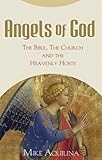
I’ve been doing lots of radio to talk about my new book, Angels of God: The Bible, the Church and the Heavenly Hosts. I’ve never experienced anything like this level of interest and even exhilaration as folks discuss the material. I did Frank Morock’s show (#918, archived here), and Frank said that audience response was tremendous. Yesterday I appeared on Al Kresta’s show (archived here). And last week I recorded a three-part series with Bruce and Kris McGregor for KVSS radio. As those shows air, they’ll be posted on KVSS’s Aquilina Archive Page. Come to think of it, Al Kresta has an Aquilina Archive as well.
The angels book draws from many of our favorite authors (yours and mine), and so do the interviews. I’m indebted to Gregory the Great, Dionysius the Areopagite, Augustine, and Chrysostom, with an occasional dash of Ignatius of Antioch, Origen, Hermas, and Tertullian.
Signs in Syria
An early-Christian mosaic has been found in Syria. Readers of my book Signs and Mysteries: Revealing Ancient Christian Symbols will have fun decoding it.
Three Rivers Studium
Many apologies for the slow blogging. It’s been a busy couple of weeks. My friend Bob Lockwood and I spent a chunk of last weekend at the great annual gathering of the Pittsburgh Catholic Men’s Fellowship. Last night, Bob and I were honored, along with Dr. Susan Muto and Father Mark Gruber, O.S.B., during the Catholic Historical Society’s celebration of Pittsburgh’s Catholic writers. (Afterward, I took the kids to see the dazzling Brenda Polk as the Fairy Godmother in a local production of Rogers and Hammerstein’s Cinderella.)
If you don’t mind, I’d like to share with you my remarks from the dinner last night. It’s not patristic, except in an extremely accommodated sense. But hey.
Three weeks ago, when I saw the ad for this event in the Pittsburgh Catholic, with my photograph placed alongside those of Bishop Zubik, Dr. Muto, Fr. Gruber, Mr. Lockwood, and Mr. [Regis] Flaherty, I remembered a story about the poet Howard Nemerov.
In one remarkable week in 1977, Mr. Nemerov received word that he had won the Pulitzer Prize … and then the National Book Award.
His reaction was exuberant. He cried out: “Overrated! At last!”
I took those words as my own. “Overrated! At last!” A writer knows when he’s outclassed by present company. But he lives for such moments. So I thank God, and I thank the Historical Society for inviting me to share such an Olympian table. I am happy to be overrated if it means I am allowed to praise this city’s Catholic culture — if I am allowed to praise our communion of saints, the Church of Pittsburgh.
I didn’t have the privilege of growing up here. But that hardly matters. To grow up when I did was to live off the largesse of Pittsburgh’s Catholic literary scene. My friends and I, like millions in our generation, learned our early lessons in the faith from the picture books produced by that prolific priest of Western Pennsylvania’s coal fields, Father Lawrence Lovasik.
Father Lovasik had an almost-papally infallible instinct for identifying the facts that would resonate with kids. We consumed his Picture Book of Saints, his catechisms and prayerbooks, and his primers on angelology and sacraments. As we grew older, Father Lovasik offered us spiritual direction in the finer points of kindness and Eucharistic devotion. He guided us along simple paths to the divine life, to the familiar places in our neighborhoods where heaven meets earth.
When we went off to school — if we went to Catholic schools, as my mother insisted we must — we took our lessons from Pittsburgh authors. If our school was struggling, we were still using textbooks produced in the early twentieth century by Pittsburgh’s Father Jerome Hannan — his Bible History: A Textbook of the Old and New Testaments; and his excellent The Story Of The Church, Her Founding, Mission And Progress. In my hometown, these books retained canonical status — more than half a century after their first publication — because Father Hannan had eventually become bishop of our diocese.
If a school of my generation was more well off and up to date, then it could afford the state-of-the-art textbooks, like the Cathedral Basic Readers produced by Monsignor John B. McDowell. They were no less Catholic than their predecessors, though they bore more modern-sounding titles like Cavalcades; All Around America; Fun with Our Family; and Fun Wherever We Are.
Monsignor McDowell, too, would go on to become a bishop — an auxiliary here in Pittsburgh. And I know him well enough to know that he would pass along any credit for Pittsburgh’s Catholic literary culture to the generations before him. In fact, over the last decade, he has devoted his own literary labors to that end: writing histories that give cultural credit, across the centuries, wherever it’s due.
He would have us hear the voice of Pittsburgh’s church in those who lived here, and wrote here, and have been raised to the altars: John Neumann, Francis Seelos, Maria Theresa Gerhardinger, Katharine Drexel — but also in those whose fame was more local, though no less fascinating, and maybe no less important to history — and whose lives, in some cases, were perhaps no less holy than those who have been canonized: Michael O’Connor, Suitbert Mollinger, James Cox, and Adrian van Kaam.
If we draw the genealogical lines, we would all, I think, find our way back to a remarkable man of the nineteenth century, Monsignor Andrew Lambing (1842-1918), a prodigious and prolific man of letters. Not least among his accomplishments was the founding of the Catholic Historical Society of Western Pennsylvania, which still sponsors an annual lecture in his honor. Monsignor Lambing wrote the foundational histories of Allegheny County and of Pittsburgh — and he wrote histories of the Dioceses of Pittsburgh and of Allegheny. He wrote serious theological studies in pneumatology (the science of the Holy Spirit) and mariology (the study of the Blessed Virgin), as well as a handbook of comfort for children who had lost their parents.
Academic history was his avocation, which he pursued in addition to the running of parishes and an orphanage. A giant of a man, grown fit through his early work on farms, in brickyards, and in an oil refinery, he served as a priest for 30 years before he missed a single day on account of illness. He is reputed never to have taken a vacation.
In the multivolume History of Pittsburgh and Environs published by the American Historical Society in 1922, Monsignor Lambing is listed prominently among the region’s “MEN WIDELY FAMED.” How prominently? Well, he appears just after Charles Schwab and George Westinghouse, but before Andrew Carnegie and Henry Clay Frick. He’s number three out of forty men identified as builders of this region.
I get exhausted just thinking about Monsignor Lambing’s literary accomplishments, which seem to have been an afterthought to his pastoral work and brick-and-mortar administration.
But I can’t help but be grateful to him for setting the high standard for the next generations — for Father Hannan, and Father Lovasik, and then Monsignor McDowell and so many others.
Twenty-three years ago this month I dropped, as if by a providential parachute, into this wonderful culture when I took a writing job at a high-tech company in the suburbs of Pittsburgh. My wife and I fell in love with this place and this church. Here we’ve raised our six children in the faith — on a hearty diet of Lovasik and Hannan and McDowell — not to mention Muto and Gruber and Lockwood, Lawler and Wuerl and Hugo. We cannot quite imagine leaving.
It’s good to be here, as everyone in this room well knows.
It’s a privilege for me to speak here tonight and get all these mushy affections out of my system. If I have to be overrated for a moment to seize the opportunity, so be it!
As for my own accomplishments, I’ll prefer to recall an experience I had speaking to a group of Catholic high-school students here in the city. It was a career-day sort of thing, and I was supposed to talk about my important work as a writer. I rattled off the titles of my books as if they were a long litany, figuring the kids would be impressed.
Then I invited questions about the writing life — I was ready to play the seasoned sage — and after an awkward pause a hand went up in the back.
“Yes,” I said as I pointed to the young man.
And he asked me a question it’s good to remember as I stand here among my heroes, past and present. He said: “Um … have you ever written anything that anyone would actually read?”
Perhaps for the first time in my life I was left speechless. And I’ll take this moment now to begin the second time.
Thank you for being here, and for listening.
Easter Reads
These are the books I mentioned on Chuck Neff’s Relevant Radio show, “Searching the Word,” today.
 Easter in the Early Church, by Father Raniero Cantalamessa, O.F.M. Cap.
 From Darkness to Light, by Sister Anne Field
 The Awe-Inspiring Rites of Initiation, by Father Edward Yarnold, S.J.
Season Your Psalter
The new book is in!
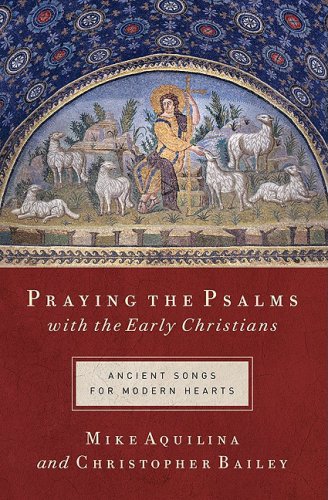
Praying the Psalms with the Early Christians, co-authored with Chris Bailey, with whom I wrote The Grail Code.
What a joy to read the Psalms as they were read in the early Church. For us, as for the first Christians, the Psalms are a treasury of counsel for ordinary living, insight into the power of the sacraments, praise for God’s glory and mercy, and love for his kingdom, which is the Catholic Church. The Fathers call King David to witness as they preach fidelity in marriage, kindness in speech, and even the mercies of purgatory. As we pray this book, we recognize that ancient Church as our own, and we raise our prayer in unision — no, in communion — with the saints of long ago, who are living still.
— Scott HahnProfessor of Scripture and TheologyFranciscan University of Steubenville
This June, Chris and I will be helping to host a pilgrimage with Happy Catholic.
Jewish Scholars on Christian Fathers on Jewish Matters
The New Republic reviewed Paula Fredriksen’s Augustine and the Jews: A Christian Defense of Jews and Judaism.
The Economist reviewed Miri Rubin’s Mother of God: A History of the Virgin Mary. I haven’t read this one. Her Corpus Christi: The Eucharist in Late Medieval Culture was very useful to me as I was writing The Grail Code: Quest for the Real Presence. Her thesis, in a nutshell, was that the realist doctrine of Transubstantiation made possible many of the great things in Christendom: the hospitals, hostels, and hospices, the orders dedicated to charitable works, etc. She was great on the medieval, but she didn’t quite get the Fathers’ doctrine of the Eucharist. In fact, she acted as if eucharistic realism arose in the Middle Ages, and she showed no evidence of having read Cyril of Jerusalem, Gregory of Nyssa, or more than a bit of Chrysostom on the subject. I fear the same thing might happen in this book — but, again, I can’t say because I haven’t read it.
Signs on the Line
Christian Book Reviews has sized up my book Signs and Mysteries: Revealing Ancient Christian Symbols. You can review all their reviews of my books right here.