Posted on

A Surprising Patrologist

The biography of Meg More that came out in the U.K. last year is now shipping from the U.S. So I’m re-running my little notice. This is a lovely book for fathers of daughters. It’s a lovely book for lovers of the Church Fathers, devotees of Thomas More, and folks who are fascinated by the history of the Reformation era.

* * * * * * *

I just finished reading John Guy’s A Daughter’s Love: Thomas and Margaret More. It’s a sketch of the relationship between the sainted Lord Chancellor and his firstborn child, his “dearest Meg.”

I was first drawn to the book because I, like Tevye in Fiddler on the Roof, have five daughters — and what father doesn’t see hints of his young daughters’ great virtue in Meg’s character in A Man for All Seasons?

I did not know, however, that Meg was quite a patrologist. Like her father and the Mores’ friend Erasmus, she was a great reader of Eusebius, Cyprian, Jerome, and Augustine. She even corrected mistakes in Erasmus’s scholarship on the Fathers. John Guy thinks she should have been the obvious candidate to translate the Bible into English — except that it never would have occurred to anyone to ask a woman. Meg’s daughter Mary would one day translate Eusebius’s Ecclesiastical History out of the Greek.

I do recommend A Daughter’s Love: Thomas and Margaret More, and not just for dads with lovely daughters, but for everyone. It’s not a devotional book, or even a “Catholic” book (I got no hint that Guy was a co-religionist of mine). It’s a book for all folks, all seasons.
Posted on

Angels Have Landed

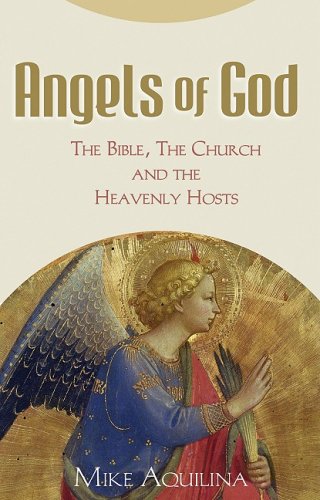
My new book has arrived — Angels of God: The Bible, the Church and the Heavenly Hosts.

Inside, you’ll encounter many of the usual suspects — Dionysius the Areopagite, John Chrysostom, Gregory the Great, and Augustine. Plus Michael, Gabriel, Raphael and a countless host of others.

.

What they’re saying about it:

RUSSELL SHAW: “Angels of God is a learned, readable and ultimately inspiring account — based on Scripture, the teaching and worship of the Church, and the real-life experience of many individuals — of the role played by these heavenly friends of ours in God’s providential plan and in our lives. If you want to get to know your guardian angel, start here.”

MARCUS GRODI: “… by far one of the most thorough and helpful books I’ve ever read about angels. Michael’s book remains safely within the boundaries of Sacred Tradition and gives readers a clearer understanding of ourselves, in relation to God and his heavenly realm.”

FATHER T.G. MORROW: Everything you ever wanted to know about angels and never asked. Another big hit for Mike Aquilina.”

As the catalog says: forget the sweet-faced cherubs of popular culture, and brace yourself for a far more potent reality: powerful heavenly beings who play a significant role in the drama of your daily life. Our fellowship with the angels (says Aquilina) is “not an ornament on our religion; it’s a life skill.”
Posted on

Best of Show

This Friday evening my family and I attended a great event: the opening of an exhibit of the artwork of Lea Marie Ravotti. Specifically, it was the work she did for our collaboration, Signs and Mysteries: Revealing Ancient Christian Symbols. The show is in the vast new parish center of St. Thomas More Church in Bethel Park, Pa. (a suburb of Pittsburgh), and it will continue until March 30. Afterward, Lea hopes to move the show to other venues — churches, libraries, schools, hospitals, colleges and universities. She is also selling prints of selected works from the book. She gave me a tee-shirt with a third-century sarcophagus banquet scene. Now how cool is that?

Hope you can stop by and see the exhibit. If you can’t get to Pittsburgh, don’t fret: you can still buy the book.

Lea is a well-known and well-shown artist in her native Prague. She was raised an atheist in communist Czechoslovakia, came to the States for work when the walls fell, and here she questioned her way to Christian faith. Take a few minutes to read OSV’s interview with the artist about her art and her conversion.

lea's exhibit

Posted on

Indian Patristics: Rather Huge News

Regular visitors know that I am just a few shades shy of an obsession with the ancient traditions of St. Thomas’s apostolate in India. I hope to complete a book on the subject this year, and I may contribute to a documentary film. For years, Rick Hivner and Merging Currents fed my obsession by providing the subcontinent’s best religious and historical scholarship and astonishingly low prices. Then, on November 30, 2006, Rick took Merging Currents offline. Now he tells me that, after more than two years, Asian Trading Corporation in Bangalore finally has the website functioning again, with all the old book stock and helpful descriptions. I’m sharpening my credit card.

Posted on

Dragon Feat

It’s clear — from the mail I get, and from the click-through to Amazon — that a lot of people out there are looking for good fiction about early Christianity. I find it only mildly irritating that books by both Michael Curtis Ford and Father Michael Giesler have outsold my own books over the last month, from my own blog.

You are apparently a great part of that elusive market for patristifiction. (I follow after Father Z, who coined the term patristiblogging.)

But what about matristifiction, you ask? What about the Mothers of the Church?

As if on cue, I received a copy of Andrea Lorenzo Molinari’s Climbing the Dragon’s Ladder: The Martyrdom of Perpetua and Felicitas. It’s a fictional interpretation of the passion, written by a scholar who fell head over heels for the saint and needed to know “the rest of the story,” even if that meant writing it himself. If anachronism’s bug you, breathe easy here. This guy has the scholarly chops. He’s the author of The Acts of Peter and the Twelve Apostles: Allegory, Ascent, and Ministry in the Wake of the Decian Persecution, published by the SBL, and Romans and Christians AD 64: An Intergenerational Catechetical Experience of Martyrdom and Persecution in the Early Church. He teaches New Testament and early Church history at Barry University, and he’s president of the Blessed Edmund Rice School for Pastoral Ministry. The book includes a fulsome foreword from no less a scholar than Joyce Salisbury, who wrote, some years ago, a well regarded study of Perpetua and Felicity.

I’ll post more as I read more. So far (as you might suspect) I’ve been mostly hanging around the tavern owned by the narrator’s family.

But I’ll violate no secrets. Here I say only that Dr. Molinari proposes an intriguing — and dramatically satisfying — answer to the perpetually vexing question: So what about Perpetua’s husband?

The book is lavishly illustrated in the style of the graphic novels my kids love to read. So it is surpassing cool. It’s a perfect style for combat with superhuman dream-gladiators and demonic dragons. Check it out: Climbing the Dragon’s Ladder: The Martyrdom of Perpetua and Felicitas.

Posted on

Linkin’ Logs

Some things I’ve been meaning to post …

Adrian Murdoch gives us something to Cro about — a fifth-century mosaic.

Jim Davila reveals that one of the oldest active monasteries (fourth century!) is endangered by land-grabbing in Turkey.

David Meadows traces the ancient origins of pizza. (I know only its evolutionary Omega Point, which is at Revello’s in Old Forge, Pennsylvania.)

BMCR reviews a fascinating book that I talked up last week, The Trophies of the Martyrs: An Art Historical Study of Early Christian Silver Reliquaries. It is the archeological and art-historical complement to such excellent historical studies as Peter Brown’s The Cult of the Saints: Its Rise and Function in Latin Christianity.

Posted on

The Virtue of Wanderlust

Now that all that New Year’s stuff is behind you, you’re probably getting around to planning your pilgrimages for the year. It’s a practice I’ve heartily recommended, for individuals, families, and friends. If you’re willing to travel within these United States, Happy Catholic has a deal for you. (More on that in the days to come.)

All this faithful tourism has deep roots in the age of the Fathers, and receives fascinating treatment in some recent books.

Pilgrimage in Graeco-Roman and Early Christian Antiquity: Seeing the Gods includes essays by seventeen scholars, and a little over a third of the book deals with Jewish and Christian notions of pilgrimage. The book breaks Christian pilgrimage down according to a very helpful typology: (1) scriptural pilgrimage; (2) pilgrimage to living saints; (3) relics; and (4) icons and images. (I think I’ve done all four. I’m waiting for magisterial confirmation on number 2.) For Christians, pilgrimage “is not a sacrament, has no doctrine, and unlike the Hebrew Bible and the Qur’an, the New Testament does not make it obligatory.” Yet we’ve always done it, as this book beautifully attests. The patristic quotations and citations are many and generously unabridged. Quite fascinating is the long discussion, late in the book, on pilgrimage as a metaphor for Christian life.

Also very helpful is The Trophies of the Martyrs: An Art Historical Study of Early Christian Silver Reliquaries, by Galit Noga-Banai of Hebrew University in Jerusalem. Some of these reliquaries were, of course, the very destination for ancient pilgrims. In addition to the Scriptures and the writings of the Fathers, these reliquaries — the book includes photos of almost a hundred — are material evidence for the very early presence of the cult of the saints and the cult of relics.

Though neither of these books were composed as works of apologetics, they do serve to help Christians make their case.

And the beat goes on. Diana von Glahn’s The Faithful Traveler videos are an excellent way to plan for pilgrimages here on my little continent. Her first installment takes us to Philadelphia’s Miraculous Medal Shrine. Many years ago, I walked many miles on pilgrimage to visit there with my good friend and colleague David Scott.

Which brings us back to Happy Catholic and her pilgrimage, which includes David and me and Chris Bailey and others. Check it out.

Posted on

Pop Go the Fathers

Kevin at Biblicalia has posted a very helpful overview of the Popular Patristics Series published by Saint Vladimir’s Seminary Press. I like the series — and I love the price — though some (very few) volumes’ introductions are marred by an anti-Roman edge that’s unnecessary and counter-productive. (This problem does not affect much of the series, which includes the work of outstanding Catholic scholars, including Robert Louis Wilken and Father Brian Daley, S.J.) Kevin gives us a list of the works included in each volume and other useful details.

Posted on

Now That’s Rich

Rich Leonardi reviews my Companion Guide to Pope Benedict’s ‘The Fathers’. He calls it…

a valuable resource that should help popularize the Holy Father’s recent cycle of catecheses on the Fathers of the Church. Mike Aquilina is an expert on this subject, and in the book’s introduction he explains who and what the Fathers are and why we ought to study them. He groups Pope Benedict’s addresses (or “audiences” as they are properly called) into six sessions, with one Father serving as the session “representative.” Within the sessions, which are linked to an era in Church history, each Father is given one or two pages, with a synopsis of the papal address, a list of its main points, and a series of questions for discussion and reflection. All in all, it is a pleasing, well-organized format. This companion guide should prove to be an excellent aid for group or individual study, and my men’s fellowship group will be using it later this year. Also worth noting is the beautiful cover design by Lindsey Luken — the book is more attractive than Our Sunday Visitor’s edition of Pope Benedict’s The Fathers! Highly recommended.

Posted on

Resolve: Learn Greek in 2009

I’m sorry to say I didn’t take my first stab at learning Greek till I was almost forty. Luckily, I’d had some pretty good schooling in the other dialect, Latin, so it was a relatively painless transition. Rod Whitacre made it so by leading me to some pretty good resources.

But I must say that I longed for a text that would treat Greek the way Sister Herberta treated Latin. She made it unforgettable, ineradicable in our memory. The trend these days, though, is away from form and drilling and toward immersion, which may work for many kids, but not so well for me.

How grateful I am, now, to lay hands on Ann F. Castro’s brand-new Greek For All Ages: An Introduction to New Testament Greek. It’s a clear, concisely written book that actually lays out the rules so that they’re easily committed to memory.

Greek For All Ages reminds me so much of Sister Herberta’s teaching — spare, essential, memorable, no gimmicks, no nonsense. This book will work well for teens or adult learners. I plan to use it with my pre-teen Latin scholar next year.

This is a great gateway drug to reading the Fathers in their original Koine. Next step, of course, is Rod Whitacre’s A Patristic Greek Reader. Make your resolution now, while the year is young!

If you need still more reasons, visit a good Greek teacher, my other brother Darrell, and view this video.