Kevin gives us a glimpse of a hard-to-find collection of St. Isaac of Syria.
Category: Books
Something Fishy…
Julie at Happy Catholic reveals some secrets of the ancient fish symbol — with the help of my book Signs and Mysteries: Revealing Ancient Christian Symbols.
Scuba Scholarship
Bryn Mawr Classical review has posted a review of a new book, Egypt in the Byzantine World, 300-700, edited by Roger Bagnall.
If you want to see Byzantine Egypt up close, though, you’ll have to go underwater. The modern Alexandrians are, according to Al Ahram, constructing an “underwater plexi-glass tunnel providing a unique window on the sunken capital of the Ptolemies” — not to mention Origen, Athanasius, and Cyril.
Portrait of the Artist
If you’ve seen the reviews of my book Signs and Mysteries: Revealing Ancient Christian Symbols, you know by now that it’s abundantly and beautifully illustrated by Lea Marie Ravotti.
Raised in an atheist home in communist Czechoslovakia, Lea studied in Prague and began her career there. She has had shows on both sides of the Atlantic. I’m proud to have my name associated with hers.
Lea is herself a sign and mystery — quiet and self-effacing — though she reveals a bit in an interview in the October 5 edition of Our Sunday Visitor newspaper. Content’s only visible to those who subscribe — so start your subscription with this issue! Lea talks about her conversion from atheism, her art, and the techniques of the early Christian artists. Contrasting ancient Christian art with medieval illumination, she says …
In contrast, the paintings in the catacombs seem to be hastily painted, modest, sketchy and lacking details. You don’t have the perfect execution or range of colors that people expect from artwork. But do not be mistaken. There is something more. Every genuine artistic intuition goes beyond what the senses perceive, reaching beneath reality’s surface. The poor quality contrasts with the richness of the content, giving vibrancy to the early Christian artwork. Early Christian artists may [have drawn] simply, but they leave profound messages accompanied by symbols. They rejected the ideals of artistic perfection and sophisticated beauty. Communication is valued above artistic refinement.
Her conversion story is quite moving. So subscribe now. And while you’re at OSV, pay a visit to the awesome multimedia tour of our book.
Rivalry
Magical Mysteries Tour
Sarah Hayes, of my beloved publisher Our Sunday Visitor, has produced an awesome multimedia tour of my book, Signs and Mysteries: Revealing Ancient Christian Symbols. The presentation includes a sample chapter, sample illustrations by Lea Marie Ravotti, and several short interviews with Yours Truly. If you choose to read our bios, you can make Lea or me get bigger or smaller just by moving the mouse over our photos. When you’re listening to the interviews you’ll have a big advantage over my wife, as you at least can enjoy the luxury of an off switch.
Meantime, Julie the Happy Catholic has continued her meditations on the wonders encountered in Signs and Mysteries. To God the glory. To our ancient ancestors the honor that is their due.
Spousal Secrets
Catholic Educators’ Resource Center has posted what its webmaster calls my “catechism on being a good husband.”
Signs on the Line
Chris Cash of Catholic Spotlight interviewed me about my book Signs and Mysteries: Revealing Ancient Christian Symbols. He’s posted audio and a transcript.
Meanwhile, Gretchen has posted links to recent articles related to a symbol I discuss in the book.
Up to Code
Christian Book Reviews has posted an analysis of my book The Grail Code: Quest for the Real Presence. Five stars out of five.
In telling the tales of not only the legends of King Arthur and the quest for the Holy Grail (and how these two diverse traditions became intertwined) but also the evolution of how these tales were presented, Aquilina and Bailey delve into the stylistic devices authors have employed to add their own twists to these venerable legends and how these gradual accretions reflect the spiritual state of their audiences. In times of spiritual decay, the tales would take on views of love totally at odds with the Christian vision; in times of renewal, the quest would not be fulfilled in adventure but in the most sublime of the Christian mysteries.
Extreme Ankh-tion
Last week I was on Chuck Neff’s “Searching the Word,” on Relevant Radio, talking up my new book, Signs and Mysteries: Revealing Ancient Christian Symbols. Chuck took a special interest in my chapter on early Christian use of the Ankh, or crux ansata (cross with a handle). Since the time of the Pharaohs, Egyptians have used the Ankh as a symbol of everlasting life. An emblem of the Nile River god, the ankh represented the “key” he used to unlock the floodgates for the annual fertility of the land. Later, for Coptic Christians, it represented the cross of Christ, the key that released the baptismal flood upon the entire earth.
Anyway … I got an email from my old buddy Andy Owens, a great financial whiz, who’s now living and banking in Chicago. And he says: “I’m listening to you now on Relevant Radio discussing your new book. I’m going to mass-produce and sell ‘Ankh if you love Jesus’ bumper stickers. You want in? We’ll make $100s.”
Well, no one ever went broke by taking Andy’s advice. (I’m sure Lehman wouldn’t listen.) So I’ll see you at the country club. I’ll be wearing my Ankh.
Series Opener
Happy Catholic has begun her series of posts on my book Signs and Mysteries: Revealing Ancient Christian Symbols.
Jester Minute
Jeff Miller, the Curt Jester, has rendered judgment on my new book, Signs and Mysteries: Revealing Ancient Christian Symbols.
I really learned a lot from this book and while I had a general idea of meaning of many symbols I found a wealth of details. For example I will never look at the Ichthys when I see it on someone’s bumper the same way. I knew how it came about and that it was a Greek acronym and often used in the early Church, but I had no idea about the Eucharistic overtones and some of the other theological depths involved. Being an ex-Navy Chief I was also pleasantly surprised to see how the anchor was another common symbol used and its meaning.
I need to have Lea Marie Ravotti illustrate more of my books. All my heroes of the blogosphere have reviewed this one enthusiastically.
Adrian Murdoch, late of Bread and Circuses (moment of silence, please), was first out of the gate with this capsule notice: “Mike Aquilina’s Signs and Mysteries provides a popular yet academically rigorous guide to symbols in the early church. The immediately accessible prose — which quotes thoughtfully from the church fathers, classical and Jewish sources — is complemented by generous illustrations. He has not only drawn on the obvious archaeological and epigraphic record, he has also delved into the fascinating world of Christian graffiti. An essential book to keep to hand when visiting early Christian sites.”
Then Kevin Edgecomb at Biblicalia wrote the kind of close-reading, sensitive review that every author (or artist) dreams of.
Happy Catholic is promising a series.
And now the Curt Jester himself.
A man could retire on such praise — if he didn’t have so many teenagers to feed.
Who Needs an Oscar?
Wow! For an author, it doesn’t get much better than to wake up to a review like this one. Kevin Edgecomb of Biblicalia has taken a close look at my new book, Signs and Mysteries: Revealing Ancient Christian Symbols. A few snippets.
First off, this is a beautifully printed little book… these illustrations are absolutely beautifully done … and all represent the ancient art accurately … making the images much more accessible … The selected illustrations are excellent accompaniment to the text, and another pleasure is that there are so many of them, on average more than one every other page.
Mike has managed to write a short beginner’s introduction to the visual imagery of the first four centuries of the Church … Mike explains clearly and simply the symbology (that is, the system of visual typology) used by the ancient artists which is so very similar to the textual typology employed in Patristic commentary of Scripture. The book is, in fact, peppered with Patristic citations, cementing the two. The book is not directed at an academic audience. As Mike says, “This is not a work of scholarship, but an act of devotion—an act of piety toward our ancestors, so that we might learn to see the world once again with their eyes, and to pray and live as they once prayed and lived” (p. 9). But I would take issue with the statement that this book “is not a work of scholarship.” It most certainly is. I’ve seen no errors in any of the references to subject matter that I’m at all familiar with … It is not intimidating scholarship, not overpowering and jargon-laden, and is thus perfect for those who know nothing about the subject of early Christian art and the symbols employed therein. Those who will appreciate learning what their ancestors in the Faith were up to with all these anchors, ankhs, and alphas will be well repaid for their time spent within the pages of this truly lovely little book. For great are the signs and mysteries contained in them.
Hola, Mis Amigos
My book Love in the Little Things: Tales of Family Life is now available in Spanish.
The publisher of Amor en las pequeñas cosas: relatos de vida familiar is Ediciones Paulinas in Mexico. And they have this to say: “El autor nos relata anécdotas de la vida familiar ordinaria, experimentadas por él mismo, y nos comparte su experiencia acerca de la gran satisfacción de guiar y ser feliz dentro de la familia desde la perspectiva del amor. Dios quiere construir una sucursal de su paraíso en tu familia.”
I couldn’t have said it better myself!
Signs, Sealed, Delivered
Just getting back into the groove after some days away. With my better-looking colleagues Rob Corzine and Matt Leonard, I made a trip to my beloved publisher, Our Sunday Visitor. I returned home with a freshly printed copy of OSV’s collection of Pope Benedict’s Wednesday audience talks on the Fathers (up to and including Augustine). It’s called, cleverly, The Fathers, and it’s a very sturdy and attractive volume, with a very lowly price tag.
Also out from OSV is John Salza’s The Biblical Basis for the Eucharist, which also includes (like all of John’s book) a handy chapter of patristic bases for the Catholic doctrine.
And then there are two great new products from my bro, Scott Hahn: A Pocket Guide to the Bible and The Bible at a Glance (Faith Charts). These are very handy tools, and very attractive to the eye.
Timely for this jubilee year, from OSV, is Jesuit Father Mitch Pacwa’s St. Paul: A Bible Study for Catholics.
OSV was pleased to report that my most recent title, Signs and Mysteries: Revealing Ancient Christian Symbols, is also doing well. While I was there, editor Sarah Hayes interviewed me for a multimedia presentation on that book. Stay tuned. I’ll let you know when it’s posted.
Meantime, look into Signs and Mysteries. After my children and my wife, it’s the most beautiful thing to bear my name, thanks to plentiful illustrations by my favorite contemporary artist, Lea Marie Ravotti. Like The Fathers, it’s hardcover, beautifully made, and priced very low. You can buy them in bulk to hand out for birthdays and at Christmas.
The folks at OSV are lovely, and it would make them happy.
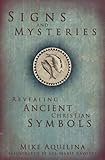
Adrian Murdoch, Fellow of the British Royal Historical Society and author of The Last Pagan (inter alia), said: “Mike Aquilina’s Signs and Mysteries provides a popular yet academically rigorous guide to symbols in the early church. The immediately accessible prose — which quotes thoughtfully from the church fathers, classical and Jewish sources — is complemented by generous illustrations. He has not only drawn on the obvious archaeological and epigraphic record, he has also delved into the fascinating world of Christian graffiti. An essential book to keep to hand when visiting early Christian sites.”