There’s a new (very affordable) paperback English translation of Eusebius: The Church History. The translator has tried to make the ancient work accessible to a wider modern audience. You’ll find a review here.
Category: Books
Happy About Signs and Mysteries
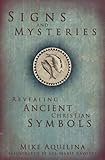
Happy Catholic has joined Adrian Murdoch in praising my new book, Signs and Mysteries: Revealing Ancient Christian Symbols. That means a lot to me, as HC knows the book very intimately. She’s the one who lovingly designed the pages, for perfect coordination of my words and the gorgeous lillustrations by Lea Maria Ravotti.
First Review!
“Mike Aquilina’s Signs and Mysteries provides a popular yet academically rigorous guide to symbols in the early church. The immediately accessible prose — which quotes thoughtfully from the church fathers, classical and Jewish sources — is complemented by generous illustrations. He has not only drawn on the obvious archaeological and epigraphic record, he has also delved into the fascinating world of Christian graffiti. An essential book to keep to hand when visiting early Christian sites.”
— Adrian Murdoch
Fellow, British Royal Historical Society
Author, The Last Pagan, Rome’s Greatest Defeat, and The Last Roman
The “generous illustrations,” numbering in the hundreds, are by the great Lea Marie Ravotti. The book is out any day now. Order yours today!
Spoils of Egypt
Egypt’s native Christian community, tracing their origins to the apostolate of St. Mark the Evangelist, long marginalized by the Muslim majority, the Copts cling tenaciously to their ancient culture, which finds expression in distinctive and beautiful art — art all but unknown in the West.
The Treasures of Coptic Art includes hundreds of color images, well photographed to highlight even the small details. And the accompanying text is written by two outstanding scholars: Gawdat Gabra, former director of Cairo’s Coptic Museum, and Marianne Eaton-Krauss, a specialist in pharaonic art at the Berlin-Brandenburg Academy of Science and Humanities. The editors use the term “art” broadly, to include many items of material culture: combs, lamps, flasks, and jewelry, for example.
The ancient Copts were aware of their native heritage — the art of the Pharaohs — but they also drew from other influences: Hellenistic, Jewish, Roman, and even Indian. The port of Alexandria was the mercantile and intellectual hub of the ancient world; people of all nations converged there and left their marks on the arts.
Egypt’s Christians experienced their greatest freedom in the three-century interlude between Roman persecution and Muslim invasion, and many of the works included in this book come from that period. Much of the art is in the folk idiom. “Coptic monuments never enjoyed the patronage of emperors, kings, rulers, or sultans,” write the authors. “In the absence of court patronage, the artistic heritage of the Copts [was] expressed in monasteries and churches.”
The varied influences are easy to spot. Like their forebears in the age of the Pharaohs, the Christian Copts favored the brighter hues in the palette. Like the later Byzantines, they rendered proportionally oversized eyes, ears, and foreheads, to suggest prodigious spiritual senses. Coptic icons, however, are often simpler and less ornate than their Byzantine counterpart. Facial expressions tend to be softer; and the figures are usually, of course, darker-skinned. Overall, they have a more “primitive” and even naïve quality, as one might find in the folk paintings of the American South or the self-consciously primitivist works of Edward Hicks or Henri Rousseau.
Egypt’s desert climate has preserved a remarkable number of works that could not survive in other, damper places: textiles, for example, including tapestries, vestments, and carpets; wood carvings; papyrus manuscripts; and, of course, devotional icons and wall paintings. They’re all in this book, alongside the more durable media, like sculpture and architecture, and decorated items from everyday life: dishes, keys, jugs, children’s toys, combs, and brooches.
The illustrations alone tell of the minute particulars of Coptic devotion. Carvings give evidence of the early devotion to the Blessed Virgin, St. Michael the Archangel, and especially the holy family, whose sojourn in Egypt is recorded in Matthew’s gospel. There is a great multitude of portrayals of Coptic saints, most of them monks and nuns of the desert, portrayed in the robes of their habit, with the characteristic wide-eyed frontal stare.
The book, perfectly calibrated for an introduction, provides historical context, made vivid by arresting details from the documentary and archeological record. Egyptian Christians continued to practice the ancient methods of mummifying their dead till well into the eighth century, for example, while the ankh, the symbol of the Nile River god, gradually became Egypt’s dominant Christian symbol, the “cross with a handle,” still a sign of waterborne life.
Pilgrimage has been an enduring expression of the fervor of the Copts. Pilgrim shrines are focal points of devotion, and so are often ornamented by visitors and patrons. The subject merits a full chapter in Treasures.
Most interesting is the treatment of the shrine of Abu Mina, the Lourdes of the ancient world. St. Mina (or Menas) was a third-century soldier who died in the first eruption of Diocletian’s persecution. As he was borne homeward by his comrades, the camels stopped suddenly in the desert and refused to budge. The soldiers, who were Christian, took this as a sign that Mina should be buried there.
A spring miraculously appeared at the site, and its waters were renowned for their healing power. Pilgrims converged on the site from everywhere. Abu Mina flasks, given close treatment in the book, have been found “as far afield as Italy and the Balkans.” Mina always appears in the orant posture (hands outstretched in prayer), usually with the features characteristic of Coptic art: the oversized round head and large, otherworldly eyes.
Other Egyptian pilgrimage sites track the Holy Family’s travels through the land. These, too, inspired many images — the Christ child riding St. Joseph’s shoulders, the Virgin riding a donkey or a horse (symbolizing the flight from Herod). Some ancient renderings of the Madonna nursing the baby Jesus hark back to common pharaonic images of Isis with the suckling infant Horus.
Additional chapters treat the cultures of the Nile, monasticism, Gnosticism, church architecture, and many other subjects. The chapter on the “Glorification of the Holy Virgin” is especially beautiful. Throughout the book, the authors draw from the writings of the great Fathers and the counsels of the desert ascetics.
This is the ancient faith made visible and made durable — a desert faith that has survived almost two millennia of tremendous hardship. The Treasures of Coptic Art invites a new Christian audience to look into the outsized eyes of Egypt’s icons.
Basque in This
Happy St. Ignatius day! No, not Antioch, but Loyola. He’s the subject of my recent book Take 5: On the Job Meditations With St. Ignatius.
My publisher chose the title, and I’ll always be grateful for it. Now I can’t think of the founder of the Jesuits without hearing Dave Brubeck and Paul Desmond.
We Wuz Robbed!
Well, the results are in at The Catholic Summer Reading Program, and my book Love in the Little Things: Tales of Family Life came in seventh overall.
Seventh! Can you believe that? And just look at the authors who finished ahead of me:
Pope Benedict XVI
G.K. Chesterton
Georges Bernanos
Evelyn Waugh
Fr. George Rutler
J.R.R. Tolkien
Should I demand a recount? Who are these guys anyway?
Belief and Unbelief in the Dark Night
Many years ago, when I was very young and agnostic, I was browsing an enormous used-book sale in Philadelphia and came across an old paperback copy of Michael Novak’s Belief and Unbelief. I bought it and read it at a gallop. That was a quarter-century ago, and I can’t say I remember anything from the book — except that it changed the way I thought about the subject, and it opened my mind to the witness of friends and the arguments of other books. It’s good to see Novak revisiting that subject — and even re-examining that long-ago book — in his most recent title, No One Sees God: The Dark Night of Atheists and Believers. I just unpacked a copy, and I hope to read it in the coming weeks. In the meantime, our other brother Darrell leads us to a Novak op-ed on the problem of evil.
Maddening
I got a recommendation from one of my favorite historians, so I figure I’ll pass it on to you. He directs our attention to Thomas Madden’s new book, Empires of Trust: How Rome Built–and America Is Building–a New World, which was released last week. Madden, I’m told, tells the history of the era of the Fathers and applies lessons to events today. I’m looking forward to a good read. Join me?
New ‘Last’ Chances!
Adrian Murdoch’s The Last Pagan: Julian the Apostate and the Death of the Ancient World is — finally! — available in an affordable U.S. edition. To celebrate, I’m re-running my review of that book and Murdoch’s more recent biography, The Last Roman: Romulus Augustulus and the Decline of the West.
————————————
Julian, known as “the Apostate” (who ruled from 361–363), was arguably the last Roman emperor to cling to Rome’s classical heritage. Romulus Augustulus (475–476) was simply the last Roman emperor. The Scottish historian Adrian Murdoch’s two most recent books, The Last Pagan and The Last Roman, examine these two very different emperors, both of whom ruled after Christianity’s “triumph.”
A fellow of the British Royal Historical Society, Murdoch is also a prominent journalist, covering international affairs and economics in the mainstream press, so he brings to his books the depth of a professional historian and the readability of a newspaper’s front page. His books are not confessionally Christian histories—not in the least—but neither are they the hatchet jobs Christians have come to expect from secular historians in recent centuries.
A Puny Rome
Hollywood has just released its own version of the story of Romulus, The Last Legion, so perhaps it is best to begin with a discussion of The Last Roman.
Barely pubescent, Romulus ruled for only ten months as a mouthpiece for his father, a power-brokering general in the Roman army. The child-emperor, easily removed by a barbarian warlord, is an apt image of the empire at its end. Even his nickname—Augustulus, “little Augustus”—suggests the puniness of fifth-century Rome compared to its first-century glory.
Murdoch traces Romulus’s movements through the rest of his probably long life. The former emperor seems to have retired to a monastery well stocked with books, ending his life as “an old man in a library in Campania, corresponding with leading intellectuals of the day, his early life and elevation to power becoming an increasingly indistinct memory.”
Since so little is known about Romulus, Murdoch must sketch his life in chiaroscuro, finding the boy’s life, and then the man’s, in the shadows of the barbarian conquerors Odovacer and Theoderic. And the shadows are dark indeed. Against recent historians who argue that the transition from Roman to barbarian rule went fairly smoothly for common folk, Murdoch counters that it was close to catastrophic, beginning with pillage and ending in lawlessness.
Murdoch is at his best when describing battles, raids, campaigns, and diplomatic missions. Religion he declares beyond the scope of his study, though he does touch lightly on the differences between the Arian barbarians and the Catholic Romans, and how these played out in the decades after the fall. Along the way he tells the tragic story of Boethius, the most famous victim of Theoderic’s growing suspicion of Nicene Christians.
All the ancient voices in this book sound human, a rare quality attributable to Murdoch’s ease with ancient languages and his ability to turn a phrase in English. He manages even to replicate wordplay: “Cattily, the poet Martial wrote that women would arrive in the region as a Penelope, the famously chaste wife of Odysseus, and leave a Helen, the much chased wife of Menelaus.”
The Potent Apostate
The Last Roman is an important book for its development of the symbol of Rome’s fall in the boy-emperor Romulus. But the more potent book by far is the biography of the more potent ruler, Julian, The Last Pagan.
Though he ruled for less than three years, Julian looms colossal in memory and imagination. He was born in 331 (or 332) into a brutal family and a bloody business. His father was Emperor Constantine’s half-brother. Murdoch notes that, after Diocletian’s retirement in 305, “Julian’s family spent a great deal of the next fifty years developing ingenious ways to kill each other.” The motive was usually intrigue, plots for accession, or just the suspicion bred by such an atmosphere.
In 326, one year after the Council of Nicaea, Constantine ordered the execution of his wife and eldest son. The three remaining sons succeeded their father in 337 and rather quickly dispatched almost all their male relatives. Two young boys were spared, five-year-old Julian and his teenage brother Gallus. Julian was too young to be a threat and Gallus too sickly.
Though Julian continued to live the privileged life of the imperial family, he kept the memory of that purge, whose victims included his own father. The imperial family was officially Christian by this time, and the hypocrisy was not lost on Julian, who was himself raised a Christian, and was a schoolmate of St. Basil the Great and St. Gregory Nazianzen. His cousin the emperor Constantius, the murderer of his family, professed the doctrine of Jesus Christ.
Julian learned to keep his thoughts to himself. Constantius was his patron, and alienation from him meant certain death. Julian studied philosophy and rhetoric at Athens and secretly investigated the “old religion,” the pagan mysteries. Though he kept up his exterior practice of Christianity, his mind and heart belonged to the old gods.
Appointed to leadership in the military, he rose rapidly with some stunning campaigns in the western provinces and barbarian lands. He gained a reputation for toughness; for, unlike other generals, he shared the hardships of his troops and rewarded them handsomely. All this made for tenacious loyalty. Not surprisingly, in 360 they declared him emperor.
Julian’s Mirror Image
Julian began his march toward Byzantium to confront Constantius. But Constantius died in 361, before their forces could meet.
Then began the reign that gave Julian his place in history. Murdoch notes that Julian did some things extremely well—tax reform, for example, and military leadership. But no one remembers Julian as a tax reformer or even much as a general.
He is remembered as “the Apostate,” and Murdoch gives a fascinating analysis of his religious ideas and practical reforms. He made vast sums available to restore temples that had fallen into disrepair over a generation of Christian hegemony. He promoted pagans to prominent positions in the capital and boosted the wages of the pagan priesthoods.
He tried, at least in the beginning, to include Christians in his dawning era of toleration, but the Church’s big names were wary. Pagan restoration became the keynote of Julian’s rule.
Yet, as Murdoch makes clear, Julian’s paganism was not really the old religion. It was, rather, a mirror image of Christianity. It was an anti-Church, a reactionary project.
Julian himself recognized Christianity’s influence on his ideas. You can take the emperor out of the Church, but you can’t take the Church out of the emperor. Murdoch says: “Julian’s attempts at creating a pagan doctrine betray his Christian upbringing. . . . By the very fact of his early education, he was already, as he would have put it, polluted.”
Whereas the old religion had been a riot of gods, cults, and feasts, Julian strove, in a very Roman way, to impose unity and uniformity on worldwide polytheism. It was the religious equivalent of herding cats.
In Julian’s schema, the emperor himself served as a sort of pope over a hierarchy that mirrored the Catholic structure of metropolitans, bishops, and priests. He set up pagan philanthropies in imitation of Catholic charities. He urged his clergy to lead lives of virtue and preach philosophy to the people. Julian himself had chosen to lead a celibate life after the death of his wife. As Murdoch puts it: “He wanted the pagans to out-Christian the Christians.”
Julian’s Coming Out
His pagan “coming out” climaxed during an extended stay in Syrian Antioch, a city of a half-million people situated en route to the battlegrounds where he would meet the Persians.
While in Antioch, he renewed the pagan practices, though he was hardly satisfied with the priests’ performance and showed himself to be as prissy and uptight as the most over-educated diocesan liturgist. And if the pagans were tepid in their response to Julian, the Christians were downright contemptuous. Murdoch does not miss the irony of a pagan prig enraged by his encounter with a city full of Christian sensualists.
Julian’s experience in Antioch led to harsher strictures on Christians. He banned believers from teaching grammar, rhetoric, and philosophy. This, says Murdoch, was Julian’s “master stroke.” Banished from the public square, Christianity could be minimized as a cultural force. He “had marginalised Christianity to the point where it could potentially have vanished within a generation or two, and without the need for physical coercion.”
It was not to last, however. As Julian shook the dust of Antioch from his feet, he marched his troops to their devastating defeat at the hands of Shapur II of Persia. Murdoch is superb in his systematic yet suspenseful narrative of that miserable campaign.
On that battlefield at the Persian frontier, Julian fell, and with him the eastern empire began to crumble. Some (Christian) histories portray the emperor struck by a spear and crying out, “Thou hast won, O Galilean!”
Yet Julian the Apostate lives in our collective memory. For some, he is the archetype of the ideological dictator, the bloodless wonk whose ideas justify his bloodletting. For others, he is a romantic anti-hero—the rebel against the inevitable.
He survives in spite of his utter lack of the qualities that make Nero and Caligula—and even Constantine—perennial subjects of potboiler novels and gory flicks. In contrast to other emperors, Murdoch says, Julian’s story usually bogs down with “an excess of philosophy and too little sex.” To Murdoch’s credit, the story never bogs down in his telling.
For Murdoch, Julian’s death was—like the deposition of Romulus—a critical moment in the fall of the empire: “To all intents and purposes we can say that paganism died as a credible political and social force in the last days of June 363.”
In ends such as these, Christians found their beginnings.
Perpetua Light
Here’s word on an interesting new book (in Italian) on Saints Perpetua and Felicity.
Marco Formisano (ed.), La passione di Perpetua e Felicita. Classici Greci e Latini. Milano: Biblioteca Universale Rizzoli, 2008. Pp. xiii, 133. ISBN 9788817020732. €9.20 (pb).
Reviewed by Vincent Hunink, Radboud University Nijmegen
One of the most fascinating documents of early Christian literature, and arguably of ancient literature as a whole, is the so called Passion of Perpetua and Felicitas. This account shows how a group of young Christians was executed in Carthage in the year 203. It is probably best known on account of sections III-X, which is a diary written in prison by Perpetua herself during her final days. It is not only highly interesting as an almost unique ancient prose text written by a woman, but also allows for various scholarly approaches to its style and content. Accordingly, many studies of the diary and of the whole document have been published in recent years. In 2007, a conference on the Passion of Perpetua was organized at the Humboldt University in Berlin (a volume with papers is in preparation). One of the organizers, Dr. Marco Formisano, has now published a new edition with Italian translation and notes in the convenient pocketbook series of BUR (Bibliotheca Universale Rizzoli).
It is an attractive little volume, which brings up-to-date information about Perpetua and her companions within the reach of all who can read Italian. Even undergraduate students will be able to purchase and use this low-priced book, which is well printed and easy to handle. Some questions, however, may be asked about the target audience of this publication and the general approach taken by the editor.
The volume opens with a short introductory essay (13 pages) by Eva Cantarella, who underscores the importance of Perpetua’s diary. Notably, she points out that the text presents an authentic, feminine voice concerning a woman’s personal life, to be compared only with the poems of Sulpicia. The text also provides many details about Perpetua’s family life, where some elements remain mysterious. For example, Perpetua never mentions her husband, but does have her child with her in prison. Cantarella suggests that Perpetua was formally divorced. This would of course explain the silence about her husband, but not the presence of her baby. For as Cantarella notes, normally a Roman child of divorced parents would be cared for by the man’s family. (One is tempted to think that the husband’s whole family may have been dead.) A third item in Cantarella’s interesting preface is devoted to ‘female executions’, a phenomenon which may be traced back to other Roman texts, such as Martial’s Liber de spectaculis.
The introduction by the editor himself is much longer (67 pages) and hence makes rather less easy reading. First, it tackles the well known problem of the composition of the whole document (which involves at least three different authors: Perpetua, Saturus and an ‘editor’), the authorship of the various sections, notably the Perpetua diary, and the question of whether the Latin or Greek versions of the texts should be considered as the originals. Formisano remains cautious but seems inclined to the common view that we have authentic documents written by Perpetua and Saturus, originally written in Latin and not substantially revised.
A second part of the introduction analyses the Acta Martyrum as a possible literary genre in its own right. It studies various other literary forms in antiquity, such as collections of ‘famous last words’. There is a clear tension in these Christian texts between historical accuracy and literary elements (p.34), but according to Formisano, this tension only adds to the fascination of the Passion of Perpetua. He also compares Perpetua to other heroines–even modern ones–‘who have sacrificed their lives for an idea’.
A third and final section focuses on three themes that allow an even more literary approach: the concepts of writing (‘scrittura’), the body, and death. In the course of this lengthy section, the Passion of Perpetua is compared to modern texts such as the writings of Primo Levi and Jorge Louis Borges, and to the modern genre of ‘prison literature’. There are some interesting ideas here (such as the notion that in the course of the text Perpetua’s body gradually seems to become more masculine), but one wonders if it is all truly relevant to the general reader, for whom the BUR volumes seem intended. The introduction is accompanied by 110 footnotes containing references and further discussion. This shows that the text is well documented, but in the end it is perhaps too much of a good thing.
Personally, I would have preferred a more modest introduction to the most important issues and questions concerning the text, its composition and function. Formisano’s predominantly literary study would seem better placed at the end of the volume as an essay for further reading, or as a separate publication in the form of a paper.
A similar remark may be made about the presentation of the Latin texts and Italian translations. Here too, the reader is presented with sound material and reliable texts, although one may wonder why the critical edition by Van Beek (Nijmegen 1936) has been adopted rather than the more recent critical texts by Bastiaensen (Milano 1982) or Amat (Sources Chrétiennes, 1996). But no fewer than 204 footnotes have been added. These contain all due explanations of difficult points, but also much more which does not serve the reader’s immediate needs. The fact that the numerous footnotes on every page are directly connected to words in the Italian translation constantly invites users to interrupt their reading. Often, there are footnote marks at the end of a number of successive sentences. In the end, this makes undisturbed reading of the original text (surely one of the primary aims of the series) almost impossible.
Having said this, the notes do serve a scholarly readership. They also describe views by other scholars on a variety of issues including psychoanalytical and feminist approaches to Perpetua’s visions; notably Bastiaensen and Bremmer are often referred to. A useful bibliography (10 pages) records all relevant secondary literature that is discussed.
In short, this inexpensive pocketbook seems suitable for academic libraries rather than for the general readership which must have been the intended audience of the publisher. A reader who is unfamiliar with this fascinating text will probably be overwhelmed by the mass of information and literary analysis provided by Formisano, and as a result he or she can hardly come to a personal reading experience. However, for those who already know Perpetua, Severus, Felicitas and the others, this new publication is a welcome addition, if only because it shows that the Passion of Perpetua and Felicitas can also be appreciated and studied as a moving piece of literature.
Paul for All
Father Mitch Pacwa, S.J., is a biblical scholar of remarkable depth, but he’s also a preacher and television host who can communicate to ordinary people. In St. Paul: Jubilee Year of the Apostle Paul Edition: A Bible Study for Catholics, has produced something rare indeed: a profound synthesis of St. Paul’s thinking on a variety of subjects, but in a form that’s digestible for parish groups and home Bible studies. His special focus is the Church’s sacraments, but he also touches upon other doctrinal, moral, and disciplinary issues. With this overview, we can recognize our present-day parishes in the congregations of so long ago. The Church is one, not only throughout the world, but through all time. This is the best introductory Bible study to Paul I’ve seen.
Master Stroke!
Jesuit Father Raymond Gawronski has this to say about the book I co-authored with Father Kris Stubna, Take 5: On the Job Meditations With St. Ignatius:
Take 5 is a very rich collection of gems from the very practical yet profound wisdom of St. Ignatius Loyola, one of the greatest spiritual masters the world has known. The authors have mined the deep veins of St. Ignatius’ many writings to present a most helpful and balanced overview of what it is to be an active apostle in the marketplace. It is a work that Jesuits have been doing for centuries: that is, helping people in the world order their lives according to God’s plan to live the mission that God shares with us in Jesus. Now, in our time which has been re-discovering the mystical dimension of the spiritual life Take 5 offers a fine, solid and much needed help toward laying the ascetical foundation that is the key to “finding God in all things.”
That means much coming from EWTN’s own Ignatian master! In a note to us, he added: “I greatly enjoyed the book, and really do believe it is a fine contribution. It is wonderfully sober — a key spiritual virtue — and very thorough and solid in its research and presentation. So congratulations and thanks…! May the work prosper!”
Don’t forget to buy copies for your co-workers! It’s a low, low price.
Spotlight on Five
My co-author Fr. Kris Stubna and I were interviewed on Catholic Spotlight this week about our new book Take 5: On the Job Meditations With St. Ignatius.
Catholic Spotlight is an internet radio show sponsored by The Catholic Company and hosted by Chris Cash.
You can hear us here.
Five Alive
My book Take 5: On the Job Meditations With St. Ignatius is the Fathers’ Day feature on Maureen Wittmann’s blog.
Craig’s Take on Take 5
Craig Maier, Ph.D., wrote a kind review of my new book, Take 5: On the Job Meditations With St. Ignatius, for the Pittsburgh Catholic. Here’s a slice:
For those of us who work in the real world of office politics, bitter competition, and muddy ethical waters, Mike Aquilina and Fr. Kris Stubna’s Take Five offers both inspiration and guidance. Drawn from the spirituality of Saint Ignatius of Loyola, the founder of the Jesuits, it offers 74 daily meditations connecting the rich heritage of Ignatian spirituality to working life.
At first blush, Saint Ignatius, whose life spanned the turbulent beginnings of the Reformation, can seem a distant figure, whose exploits and faith would have little to do with our bustling lives. But his spirituality isn’t for hermits sealed off in contemplative prayer but for people, like Ignatius himself, who are involved in the active life of the world.
“Most Christians spend a large part of their waking hours in activity related to their professional work,” say Aquilina, a prominent local Catholic writer, and Fr. Stubna, who works as the Diocese of Pittsburgh’s secretary for education. “Yet so many sermons and books on the spiritual life seem to pass over these matters that are important—methods of mediation, volunteer work, almsgiving—but that hold a marginal place of the ordinary lives of ordinary people.”
For Aquilina and Stubna, Saint Ignatius isn’t just a spiritual teacher but also a model of someone who was able to bring Christ into his working life in real, profound—and often highly effective—ways. His success as a spiritual teacher and an organizational leader was not accidental. In fact, he saw the Society of Jesus as filling what he believed to be a desperate need in the church: A community of priests who would work in the world at the service of Christ, helping laity to fulfill their role in Christ’s plan of redemption.
Saint Ignatius’s vision required a prodigious amount of work, and he threw himself into his task. During his lifetime, Aquilina and Stubna write, the saint oversaw the formation and ordination of thousands of priests, the establishment of what would become the “Jesuit tradition” of higher education, and the development of missions worldwide.
During this immensely productive time, he wrote almost seven thousand letters giving advice, making plans, and providing spiritual direction. “He found very practical ways to bring Christ into the workday, and he shared his methods with others,” Aquilina and Stubna observe.
“He wrote letters full of good advice about getting work done, and doing it with care, yet not wearying yourself; about getting along with co-workers; about dealing with office politics; and about the challenge of keeping your eye on the goal, which is not worldly success but godly glory.”
These letters form the backbone of the book’s meditations, which include a passage from Saint Ignatius, questions to ponder, a verse of scripture, and a thought to memorize and take with you throughout the day. For those who don’t currently have a daily devotional practice, the exercises, which can be read over breakfast, can be the beginning of a deepening encounter with God.
For those accustomed to seeing spirituality as something disconnected with the world or as a set of impractical platitudes, Aquilina and Stubna show how faith can flow into even the most mundane things: setting goals, meeting deadlines, dealing with office gossip, putting people before paychecks, and even asking for a raise.
Throughout, the meditations cultivate a way of seeing working life through Christian eyes, offering both encouragement and, at times, correction. Yet, as Saint Ignatius urged, we should not fear loving correction but should in fact encourage it as an act of charity. “It is with this solid love and honest desire that I speak, write, and advise you just as I should honestly wish and desire you to advise, urge, and correct me,” he wrote his brother Martin.
In a business world where looking out for “Number One” has become the mantra, Saint Ignatius offers solid spiritual footing. Across the centuries, he gives us the inspiration to live the faith in the working world and the courage to “blow the whistle”—on ourselves.
Order copies for all your co-workers: Take Five: On the Job Meditations With St. Ignatius.