Posted on

In the Nick of History

Maureen Wittmann, my personal homeschooling guru, is also the founder and moderator of the Pope St. Nicholas V group at Yahoo. The purpose of the list is noble and edifying: “to help Catholics make purchasing suggestions to their public libraries.” Maureen spots new books that are promising, provides their basic bibliographic information, links to reviews and endoresements — and, most important of all, she trains library cardholders in the delicate diplomacy of putting the petition to our town or county library systems.

Maureen kindly listed my book The Resilient Church: The Glory, the Shame, and the Hope for Tomorrow as this week’s featured title on Pope St. Nick.

Maureen’s own books, Catholic Homeschool Companion and A Catholic Homeschool Treasury, approach canonical status for homeschoolers in this home.

Posted on

Mass of the Early Christians, Take 2

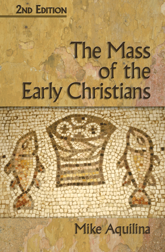
I’m holding in my hands the new edition of The Mass of Early Christians. It’s in the warehouse. It’s even on Amazon.
t419_cover_rgb.jpg
What’s new in this expanded edition? Lots. The book’s a good deal bigger. There are at least six new chapters — on Clement of Rome, Cornelius, Firmilian, the Anaphora of St. Mark, Eusebius, and the Council of Nicea. I added several more apocryphal texts, and included a discussion of the recently discovered Gospel of Judas. I also added more texts by Irenaeus, Cyprian, Origen, Clement of Alexandria, and others. Still other chapters were extensively rewritten based on more recent scholarship.

In case you missed the reviews the first time around, here’s a sampling:

“This is an excellent and exciting work. I wish that The Mass of the Early Christians was compulsory reading for all ordinands. Mike Aquilina is to be congratulated.”
Robert Beaken, New Directions (U.K.)

“All Christians from liturgical traditions can read this book with profit and find comfort in the firm historical basis of their own worship. Those who have shunned liturgical worship might after reading this book reconsider their position and wonder what they have been missing.”
Christian Book Reviews

“The Mass we know on Sunday—the Mass you encounter in this book—is where Tradition lives, where Church’s memory reigns ‘in the Spirit.’ Read this book, then, and remember.”
Scott Hahn, professor, Franciscan University

“Aquilina is to be congratulated for making these texts accessible to a new and wide-ranging audience allowing us to echo the cry voiced by the martyrs of North Africa in the third century: ‘we cannot live without the Mass!'”
Fr. Joseph Linck, rector, St. John Fisher Seminary

“Mike Aquilina has performed a needed service in making this heritage accessible to non-specialists.”
Oswald Sobrino, Esq.

Can you tell I’m excited? Hope you like the new edition as much as I do.

Posted on

Little Things on Your Radio Dial

KVSS Radio interviewed me about my book Love in the Little Things: Tales of Family Life.

Of course, since that interview, Kris McGregor of KVSS has spent more than a week living in Italy with my son and me. So I’m not sure that all of her positive comments still apply.

Both Our Sunday Visitor and Philadelphia’s Catholic Standard & Times will be featuring that same book in their Father’s Day issues.

Posted on

Historical Sketches

The Resilient Church: The Glory, the Shame, and the Hope for Tomorrow
My collection of historical sketches, The Resilient Church: The Glory, The Shame, and the Hope for Tomorrow, has just rolled off the press. It’s my first book for the good folks at Word Among Us. Here’s what they have to say about it:

Beginning with the earliest martyrs and ending with the twentieth century, The Resilient Church offers a fascinating look at the trials and triumphs of the Catholic Church over the past two thousand years. Fast-paced sketches of critical periods in church history give readers perspective on the challenges faced by the church today. Short selections in each chapter highlight some of the great heroes who influenced the course of history. Mike Aquilina does not shrink from the realities of the past, including badly behaved leaders and those who betrayed the Lord. Yet he also leaves readers with well-founded hope for the future: God remains faithful in every circumstance and fulfills his promise to remain with his church always.

Here’s what the experts say:

Mike Aquilina’s The Resilient Church is an erudite but highly readable illustration of Pope Benedict XVI’s remark that the Lord “encounters us ever anew” in the pages of Church history. Aquilina takes us on a fascinating ramble through the past two thousand years that ultimately delivers a powerful message: No matter how hard the going gets, God does not abandon his people. A work of insight and inspiration.
— Russell Shaw, author of Catholic Laity in the Mission of the Church

The Resilient Church is a wonderfully engaging read and a timely reminder of the ways in which the Lord Jesus has been with His Church throughout the centuries. His well chosen stops along the timeline of history remind us all that in moments of crisis and times of joy, God has always responded to the voices (and hands) of His people raised in prayer. Read this book and discover why a solid understanding of church history is one of the best arguments for the Catholic faith.
— Father Joseph Linck, Church historian and rector of St. John Fisher Seminary, Stamford, Conn.

Posted on

Hungary? Czech It Out!

While our backs were turned, somebody went and translated The Grail Code into Czech and Hungarian.

Hungarian, my co-author Chris Bailey points out, is our first language outside the Indo-European family. I think that’s cause for celebration. And what better way to celebrate than by reminding you that the English edition is still on sale when you buy direct from the publisher?

Those of you who don’t speak Czech, Hungarian, or English can still order the book in the following languages:

German

Italian

Brazilian Portuguese

Canadian French

Soon to come are French French and Portuguese Portuguese, not to mention Croatian.

And some of these covers are stunning. The Grail seems to bring out the best in all of us.

Posted on

Papy R Us

In the London Times, Mary Beard shows us The Strangely Familiar World of Oxyrhynchus. Oxyrhynchus is the Egyptian town where hundreds of thousands of ancient manuscripts were discovered in the early twentieth century — including fragments of Christian apocrypha and the New Testament. It’s an entertaining essay that raises important questions about how and why we read history. The occasion is the publication of City of the Sharp-Nosed Fish by Peter Parsons.

Posted on

Cover Me

t419_cover_rgb.jpg

It looks like this is the new cover of the new edition of The Mass of the Early Christians. The new one’s not available on Amazon yet, but can be pre-ordered from the publisher, Our Sunday Visitor. To order the expanded edition, call toll-free 1-800-348-2440 and make sure to request T-419.

What’s on the cover? It’s a fifth-century mosaic depicting loaves and fishes, a favorite eucharistic symbol of the patristic era. This particular mosaic was found in the remains of a Byzantine church in Tabgha, Israel, the traditional site of Jesus’ feeding of the 5,000 (Mark 6:41).

Here are a few details on what’s new in this edition.

Posted on

Mamas and the Papas

I mentioned last week that my wife Terri and I contributed a chapter titled “Milk and Mystery: On Breastfeeding and the Theology of the Body” to a new collection, Catholic for a Reason IV: Scripture and the Mystery of Marriage and Family Life. A commenter asked, somewhat incredulously, what the Fathers could have to do with such an exclusively maternal activity as breastfeeding. It’s a good question, and she put it to me with three question marks. So it merits at least a partial answer. (For a full answer, you’ll have to buy the book!)

My wife and I begin the essay by reviewing the ample biblical material on breastfeeding — the customs observed in Israel, the blessings and curses associated with the practice, the use of nursing as a metaphor, and instances where the inspired authors used breastfeeding as an essential part of a narrative plot.

The second section deals with the world of the Fathers, and again we discuss the cultural norms for breastfeeding mothers. And then we provide many examples of the Fathers’ use of breastfeeding imagery. A few examples:

Odes of Solomon: breastmilk is a metaphor for the Eucharist.
Odes of Solomon: the Holy Spirit is compared to a nursing mother.
Irenaeus of Lyons: speaks of Scripture as the breast of the Church.
Clement of Alexandria: Christ and the Eucharist are compared to milk; salvation is compared with lactation.
Ephrem of Syria: Christ is called “the breast of life.”
The Book of Steps: compares the Church to a nursing mother.
Augustine: speaks of Christians as nurslings, Christ as milk, the Bible’s two testaments as two breasts, and the Church as a nursing mother. He also uses the mother-child nursing relationship to illustrate how God creates us to be interdependent.

Again, that’s just a sampling. Both Clement and Augustine ponder the act of breastfeeding from physiological, moral, and theological angles. The full treatment is in our essay, “Milk and Mystery: On Breastfeeding and the Theology of the Body,” in Catholic for a Reason IV: Scripture and the Mystery of Marriage and Family Life.

I have another post on the subject of breastfeeding, here, with links to some great scholarship.
Posted on

Easter Duty

At the beginning of Lent, I announced that Loyola Press, publisher of my book The Grail Code: Quest for the Real Presence, was offering a seasonal 30% discount. I want to say again that the offer extends to the end of the Easter Season.

Loyola’s discount applies also to the Loyola Classics series, which I’ve often blogged upon, and two books by my youngest daughter’s beatific godfather, David Scott: The Catholic Passion: Rediscovering the Power and Beauty of the Faith and A Revolution of Love: The Meaning of Mother Teresa. Also check out the titles by the great and powerful Bob Lockwood, by Liz Kelly, and by Matthew Lickona. This is the stuff of a true Easter celebration. Think of it as a holy sale of obligation.

The discount is good for one-time use only and not valid on textbook or curriculum orders. The offer expires at the end of the Easter season, May 27, 2007.

TO GET THE DISCOUNT, make sure to enter the promotional code 2261.

Posted on

Nouveaux Riches

Sophia Institute Press has just re-released Henri Daniel-Rops’ What Is the Bible?, a good, intelligent introductory work that was originally produced for the Twentieth-Century Encyclopedia of Catholicism.

Daniel-Rops was a great historian and an immortal of the French Academy. He’s remembered and justly beloved for such popular historical studies as Daily Life in the Time of Jesus and The Book of Mary. His two-volume work The Church of Apostles and Martyrs was my early introduction to the world of the Church Fathers. Daniel-Rops is a lively storyteller, and his books are page-turners. I’m pleased to see so many of them in print, and others coming back into print. We live in great times.