Posted on

Pilgrim’s Progress

Last year, while I was roaming the Holy Land, I was reading Pilgrimage in Graeco-Roman and Early Christian Antiquity: Seeing the Gods, a pricey book, but worth its weight in the gold of Ophir, thanks especially to the gorgeous essay by Wendy Pullan: “‘Intermingled until the End of Time’: Ambiguity as a Central Condition of Early Christian Pilgrimage.” My reading of that in situ led to a talk on the subject at my parish, and I’m expanding that talk for the pilgrim group that’s going to Rome next week with me and Scott Hahn.

That’s a windy way for me to begin to say that BMCR has posted a review of a book that promises an interesting follow-up to Pullan’s study: Benjamin H. Dunning’s Aliens and Sojourners: Self as Other in Early Christianity.
Posted on

Since You Asked

Someone asked if the image up top of the blog is a family photo. It’s not. It’s actually a detail from a large mosaic at S. Apollinare Nuovo in Ravenna, Italy, and it dates from the sixth century. I chose this image not only because it dates from the era of the Fathers, but also because it depicts several of the Fathers. Visible in the detail above is St. Polycarp of Smyrna (second from left), the teacher of St. Irenaeus and disciple of St. John the Apostle. Alongside St. Polycarp are St. Demetrius, St. Vincent, and St. Pancras — all martyrs. Elsewhere in the same large sequence are Clement, Sixtus, Lawrence, Hippolytus, Cornelius, Cyprian, Cassian, John, Paul, and others. On the opposite wall are the women martyrs. The saints’ names appear above them: “SCS” is the abbreviation for “Sanctus,” which means “Saint” or “Holy.” They hold crowns because they are martyrs; it is a symbol of their victory, as winning athletes were crowned at the end of their events. The palm fronds beside them are another sign of athletic or military victory. Martyrdom was often portrayed as victory in a “contest” with the world, the flesh, and the devil. But you already knew all that if you read my book Signs and Mysteries: Revealing Ancient Christian Symbols, which is lavishly illustrated by Lea Marie Ravotti.

Posted on

Mysteries in Season

Some years back, Scott Hahn and I compiled a collection of readings from the Fathers, designed to be read devotionally during the “mystagogy” phase of RCIA — or by anyone, really, over a fifty-day period. The book’s called Living the Mysteries. It just received a very nice review from Patty Bonds at Abba’s Little Girl.

I just finished the most amazing book. It’s called “Living The Mysteries” by Scott Hahn and Mike Aquilina. Actually, the meat of the book is written by several of the Early Church Fathers who write on the mysteries of the faith. It is the perfect book for this time of year for those who have just entered the faith. I wish I had been taken through this book as part of the RCIA program I was involved in. We all know how woefully lacking so many RCIA programs are. (Except for St. Thomas the Apostle, where RCIA is what it was meant to be.)

The Fathers take us through each of the Sacraments. Not just what they mean and how they are administered, but what their basis is and what they will accomplish in our lives if we are open to them. It’s like a tour through the channels of grace that bring us new life from the author of life. I’ve never read anything that explains the Sacraments so well…

Read on. It’s a lovely review.

Posted on

Palms for Psalms

I just learned that The Bible Today reviewed Praying the Psalms with the Early Christians, the book I co-authored with Chris Bailey. The reviewer is none other than Sister Dianne Bergant, biblical scholar and devoted sister of my beloved St. Agnes.

The book is a guide for praying thirty-four of the one hundred fifty psalms of the Psalter. Each chapter includes the Revised Standard Version translation of the psalm under consideration. A short phrase or two from the psalm serves as the focus of the examination. This is followed by a reflection, taken from the writings of one of the ancient Christian writers, that addresses the theology found in that phrase. For example: death is the focus chosen from Psalm 73; St. Jerome’s musing on the death of a friend is the selected reflection. Each chapter ends with two questions that invite the readers to bring the implications of the reflections into their own lives. Each entry opens with a few sentences that provide a brief explanation of the psalm. However, this book is meant to lead the reader into a form of lectio divina, not biblical interpretation. Besides introducing the reader to a few of the early Christian writers, it is a fine guide for this form of prayer.

Posted on

When Children Became People

Lots of you were fascinated by two books I mentioned here last month: “Let the Little Children Come to Me”: Childhood and Children in Early Christianity, by Cornelia B. Horn, John W. Martens, and When Children Became People: The Birth of Childhood in Early Christianity, by O. M. Bakke.

Now BMCR reviews another, somewhat related title: Cecily Hennessy’s Images of Children in Byzantium.

Posted on

Muy BN

Thanks to those of you who’ve written to ask if I’ve died. I haven’t. I have been busy in the Projects, though. And they’re all fascinating projects. The Fall harvest should be very good this year.

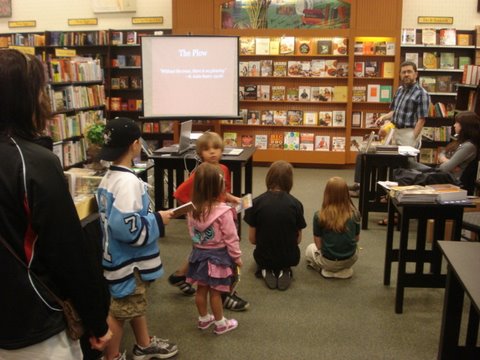
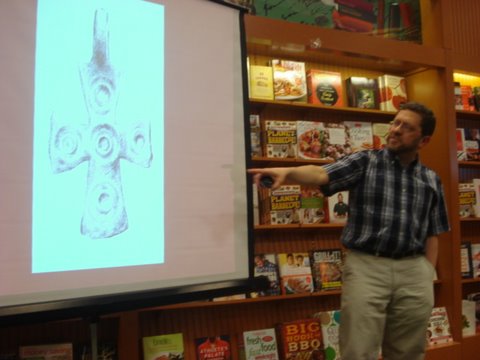
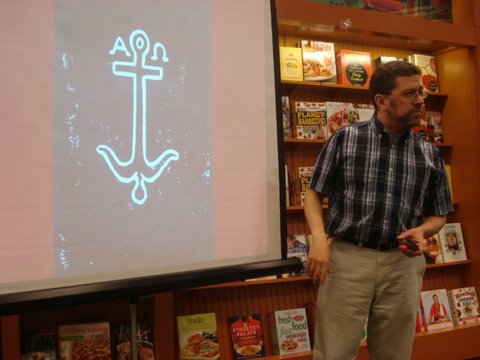
Last night, however, I snuck out with my dear daughter Mary Agnes and gave a presentation at a local Barnes & Noble on my book Signs and Mysteries: Revealing Ancient Christian Symbols. It was challenging — probably the youngest audience I’ve ever pitched patristics to. I’ll guess the average age was 12 or so. But what bright kids. By the end of the show, they were decoding inscriptions from the catacombs in seconds flat.

The event was organized elementary-school teacher Zee Ann Poerio, who is author of the “chapter book” A Griffin In Her Desk (about an elementary-school teacher much like Zee). Zee teaches Latin and history using ancient coins and artifacts. She’s amazing.


Posted on

Oxy Envy

At BMCR, Robert Mazza reviews a book I (thanks to his review) want to own: Greetings in the Lord: Early Christians and the Oxyrhynchus Papyri.

The city of Oxyrhynchus has attracted the attention of scholars in early Christian studies since the first archaeological season of Grenfell and Hunt on the site (1896-1897), which, amongst others, brought into light the Greek original of what came to be known about fifty years later as the Gospel of Thomas (P. Oxy. I, 1). From that moment onwards the ancient rubbish heaps of the city have given to us a wide range not only of Christian literature, but also of documents — such as letters, lists and contracts — relating to the everyday life of Christians and Christian institutions in that city and its neighbourhood.

AnneMarie Luijendijk’s “Greetings in the Lord” is an updated and well-structured presentation of the papyrological material relating to early Christianity from the site. The book, mainly addressed to students and scholars in early Christian studies, is divided into three parts (“Meeting Christians at the Marketplace”; “Papa Sotas, Bishop of Oxyrhynchus”; “Legal matters and Government Dealings”), preceded by a general introduction (“Destination Oxyrhynchus: Historical Detective Work in the Footsteps of Monks and Papyrologists”) and ended by a concluding chapter (“Early Christians in the Oxyrhynchus Papyri: New Voices in Ancient History”).

Read on for more detail.

Posted on

The Beginning of the End of Child Abuse

BMCR reviews a very important work, “Let the Little Children Come to Me”: Childhood and Children in Early Christianity, by Cornelia B. Horn, John W. Martens.

Through an exhaustive analysis of nearly every quote pertaining to children in the canonical New Testament, with some references from early patristic texts and some extracanonical, especially the Infancy Gospel of Thomas, the authors attempt to answer a basic and important question: what “significant differences Christianity made in the lives of children, historically, sociologically, and culturally” in the first few centuries? The answer they posit is that “Christianity made life better for children” … “Christian criticism of practices of abuse, infanticide, abortion, and exposure led to improved lives for numerous children, in significant part because the Roman state embraced the Christian moral code in the course of the fourth and fifth century.”

Also important, on the same topic: When Children Became People: The Birth of Childhood in Early Christianity, by O. M. Bakke.

Posted on

Verse-Case Scenario

Edward G. Mathews, Jr., reviews Christos Simelidis’s Selected Poems of Gregory of Nazianzus in BMCR.

Gregory of Nazianzus is one of the most consistently celebrated of the early Christian writers … However, this sustained popularity was generally due to his theological acumen and his extraordinary rhetorical skills, not to his poetry, which both Jerome and the Suda numbered at 30,000 verses (only about two-thirds of them have actually survived) …

Simelidis’ work is a revised version of his Oxford doctoral dissertation. It offers a lengthy introduction to Gregory’s poetry (pp. 21-102), critical editions of the Greek texts — no translations — of four of Gregory’s poems … This is an extraordinarily detailed and erudite study that ought to lay down the path for any future study of Gregory’s poetry. Gregory stands as a unique transitional point between classical/hellenistic poetry and Byzantine poetry.

Some of Gregory’s poems are available in English translation, in the Popular Patristics series: On God and Man: The Theological Poetry of St. Gregory of Nazianzus.