Posted on

Listen to the Images

Everyone’s favorite banshee, Maureen, is posting audio of one of my favorite texts from the (very end of the) patristic era, St. John Damascene’s On Holy Images. She sees the hand of providence, or at least some sort of Jungian synchronicity, in Scott Hahn’s simultaneous posting of an essay on iconoclasm at Beliefnet. My historical backgrounder on John Damascene and the iconoclast controversy is right here. For those who can’t stop reading, Maureen also links to full text of John in English translation.

Some years back I met a nun named Sister Damascene. When I confessed my admiration for her patronal namesake, she said with a sly smile, “Oh, is that where the name comes from? All this time I thought it was because I drove the car in the novitiate, and Mother Superior always called it ‘that Damn Machine.'”

Posted on

Steel the One

News arrives that our fair city is once again declared the “most livable” in the United States. We’re not surprised, and neither is our esteemed neighbor and co-author at GrailCode.com. Ranking is based on a formula that scores housing affordability (cost of living); transportation; jobs; education; climate; crime; health care; recreation; and ambience (museums, performing arts, restaurants and historical districts). It’s quite accurate, in my estimation. I wasn’t born here, but here’s where I choose to live. It feels like a small town, but has everything I’d want in a city.

Posted on

Which Church Father Are You?

I’m sure you were wondering when we’d get around just such a self-help test. By now you’ve figured out the color of your parachute and the season of your wardrobe. It’s time to figure out your place in the early Church. For each question, choose ONE answer that best describes your position.

When you hear the co-worker in the next cubicle utter heresy, you instinctively…
a. take him aside and carefully demonstrate to him that the orthodox position is really the most reasonable.
b. hit him with a mallet and then question his masculinity.
c. guide him verse-by-verse through the Book of Exodus, observing often that the plot is clearly an allegory of your co-worker’s life.
d. suggest that the current troubles in the Holy Land are his fault.

You celebrate your birthday…
a. always on the date you were born.
b. always on the day you were born (e.g., Tuesday).
c. never, because birthdays (like many other things) make you irritable.
d. by debating a pagan.

Your preferred home is…
a. Athens.
b. Jerusalem.
c. a cave.
d. a symbol of heaven, whose historical and geographical position is of relatively little importance.

Your guilty pleasure:
a. Cicero.
b. self-mutilation.
c. wearing a pallium.
d. intractable liturgical conservatism.

You think marriage…
a. is useful for the propagation of future celibates.
b. is primarily an allegory.
c. should be forbidden to widows.
d. bore the brunt of the consequences of Adam’s Fall.

If you could change anything, it would be…
a. everything.
b. Change? What’s change?
c. the emperor’s mind.
d. Augustine, Ambrose, and Rufinus, for starters.
e. Alexandria and Caesarea

Posted on

The Year in Review

Today marks one year since I started this blog. So it probably marks about fifteen years since my son started bugging me to start blogging. I’m very glad I finally took him up on it. I’ve met so many fascinating people through these pages. I thank you all for visiting, commenting, and sending me notes. I’ve learned much from the give and take that comes with this territory, which was very new to me (and still is). My unpleasant experiences I can count on one hand — and still have fingers left over.

Here’s some trivia from Junior the Webmaster. I have no idea what any of it means.

In its first year, this blog racked up 845,546 hits, 386,086 page views, 164,258 visits, and 74,376 unique visitors.

The most visited posts were:

Youth When the Church Was Young

Roman Cruelty, Christian Purity

My list of Top 20 books on the Fathers

The Time Capsule (on the Didache)

Another bit of trivia: This blog is one of Google’s top hits for several searches. But my absolute favorite is “Christian baby names.” I earned this by posting on some ancient Christians’ choice to name themselves “Stercorius” (literally, Crap). I hope I haven’t started a trend.

The top-selling books through the site are (in order):

The Fathers of the Church (by far!)

The Mass of the Early Christians

The Grail Code: Quest for the Real Presence

and Living the Mysteries: A Guide for Unfinished Christians

The most popular non-Aquilina books are (in order):

Through Their Own Eyes: Liturgy as the Byzantines Saw It by Robert Taft, S.J.

The Spirit of Early Christian Thought: Seeking the Face of God by Robert Louis Wilken

The Christian Catacombs of Rome: History, Decoration, Inscriptions by Fabrizio Bisconti et al.

Four Witnesses: The Early Church in Her Own Words by my friend Rod Bennett

In Procession Before the World: Martyrdom As Public Liturgy in Early Christianity by Robin Darling Young

If all I did in the course of the last year was sell these books I’ve loved by authors I admire, I’d count myself a great success at blogging. I hope you who bought them enjoyed the books half as much as I did. If so, you’re pretty happy campers in this KOA (Kampground of the Ancients).

I can’t thank all of you enough for encouraging me in this work. I address my gratitude to Junior first, but to all of you who have clicked here. When you do that, I know that a tree has fallen in the forest.

Posted on

The Saint in Between

Caught between St. Patrick yesterday and St. Joseph tomorrow is the great St. Cyril of Jerusalem, one of my favorite Church Fathers. Cyril’s catechetical and mystagogical sermons are not only great reads, but packed with precious details about the faith and practice of the Church at mid-fourth century. He gives us one of the most complete and vivid descriptions of the sacramental rites.

Cyril was born about 315; died probably 18 March, 386. His famous “Catecheses” were likely delivered around 347. He must have been as great a teacher in person as he is on paper. A pilgrim from Spain witnessed the mystagogical sermons in his church, and she wrote down what she saw for her friends at home: “While the bishop discusses and sets forth each point, the voices of those who applaud are so loud that they can be heard outside the church. And truly the mysteries are so unfolded that there is no one unmoved at the things that he hears to be so explained.”

So you needn’t hold back the applause while you read. Want to know St. Cyril better? Check out this study.

I spent the morning of the feast with the good doctors of Catholic Medical Association of Pittsburgh. It was an odd experience looking out on an audience of so many people who had poked and prodded and scoped my body down through the years. I spoke not about Cyril, but about St. Pantaleon, physician and martyr, and about The Martyr’s Cup.

Posted on

Perpetua Light

Today’s the memorial of Saints Perpetua and Felicity. I’m on KVSS radio this morning, talking about their “Passion,” which is one of the most remarkable documents of the early Church. Composed by Perpetua herself, it is certainly the most detailed account of a woman’s experience of Christianity during those formative years (she died in North Africa in 203 A.D.). Perpetua’s narrative concerns itself with many experiences we don’t often find in the Fathers — childbirth and breastfeeding, for example. We also glimpse how a woman exercised spiritual leadership in the ancient Church. Perpetua’s Passion is an important early witness for the study of liturgy, sacramental theology, and the doctrine of purgatory. It is one of the key texts discussed in one of my favorite books, Robin Darling Young’s In Procession Before the World: Martyrdom As Public Liturgy in Early Christianity.

You can listen to my interview via the live feed at the station’s website, or pick up the program at the Aquilina page later on. Eventually, Junior will move it to my own audio page.

Posted on

Family Matters

Grace builds on nature. Anyone who’s read my book The Fathers of the Church knows that I trace my love for the Church Fathers back to my love for my dad. It’s the constant teaching of the Fathers that the home is a Church (ecclesia domestica) and the Church is a family (familia Dei).

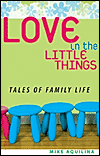
So, in the interest of full theological disclosure, I’ve written a book about the life of my family — my parents and sibs, my wife and my kids. It’s called Love in the Little Things: Tales of Family Life, and it’s been vetted by my wife and my four oldest children. I’m told it’s quite funny. (Patristic nerds will be happy to know that Ambrose, Augustine, and crew make cameo appearances.) If you dare to peek behind the pages of this blog, Love in the Little Things is your keyhole.

But don’t take my word for it — or my kids’ word for it. Here’s what the reviewers have to say:

“I wish I could have read this book when I was a young dad, but I was too busy learning all the lessons alongside Mike Aquilina. No matter what stage of the parenting game you’re at, don’t delay—start reading this book now!”
—Scott Hahn, author, Letter and Spirit: From Written Text to Living Word in the Liturgy

“…a domestic catechism for the domestic church…absolutely delightful and insightful”
Bishop Thomas J. Tobin, Providence, R.I.

“…a book that knows real life smells a little like incense, a little like pasta and a little like a used diaper. As someone who has experienced the gracious vivacity of the Aquilina home firsthand, I can promise that you have a sure and fine guide to finding the Blessed Trinity in the clutter and chaos of the glorious thing known as family.”
Mark P. Shea, author, By What Authority?

“This book is a delight—easy to read and pregnant with insight. It is amazing how little things will change your view about family, faith and life.”
Curtis Martin, president and founder, FOCUS

“Mix lots of laughter and a few tears, add generous helpings of faith and hope, bring it all to a boil with the flame of love—that’s Mike Aquilina’s recipe for a happy, holy family. Love in the Little Things stands out for its good humor and deeply Catholic good sense. A terrific read for married couples of any age and for couples preparing for marriage.”
—Russell Shaw, author, Catholic Laity in the Mission of the Church

“…a charming yet profound blueprint on how to be a devout Christian. People of all ages, of all religions, will delight to read this self-deprecating guide for pursuing holiness in a family milieu with all its humorous idiosyncrasies. Bravo!”
—Rev. T.G. Morrow, author, Christian Courtship in an Oversexed World

Posted on

Intro to Lent II: Fasting

Second in a series of three posts.

“Why do Catholics have to fast?”

The question came from a non-Catholic Boy Scout in my son’s troop. We had spent a long, soggy weekend in the middle of the woods. And now, Sunday morning, the adults announced that breakfast would be delayed so that the Catholics could keep the Communion fast. He was not a happy camper.

His question comes to mind again as Lent begin, because fasting is the most distinguishing practice of the season. On two days in Lent, Ash Wednesday and Good Friday, Catholics limit their eating to one full, meatless meal. On all the Fridays of Lent we abstain from meat.

Why do Catholics fast? Our reasons find firm grounding in the Bible.

When we fast, we follow holy example. Moses and Elijah fasted forty days before going into God’s presence (Ex 34:28, 1 Kgs 19:8). Anna the Prophetess fasted to prepare herself for the coming of the Messiah (Lk 2:37). They all wanted to see God, and they considered fasting a basic prerequisite. We, too, wish to enter God’s presence, so we fast.

Jesus fasted (Mt 4:2). And since He needed no purification, He surely did this only to set an example for us. In fact, He assumed that all Christians would follow His example. “When you fast,” he said, “do not look gloomy like the hypocrites. They neglect their appearance, so that they may appear to others to be fasting” (Mt 6:16). Note that He did not say “IF you fast,” but “when.”

And WHEN is now. In Lent the Church extends the idea of fasting, beyond the minimal skipping of meals, to a more far-reaching program of self-denial. Jesus said: “If any man would come after me, let him deny himself … daily” (Lk 9:23). So we “give up” something that we’d ordinarily enjoy: sweets, soda pop, a favorite TV show, or the snooze alarm.

Fasting has its health benefits, but it’s not the same as dieting. Fasting is something spiritual and far more positive. Fasting is a spiritual feast. It does for the soul what food does for the body.

The Bible spells out specific spiritual benefits of fasting. It produces humility (Ps 69:10). It shows our sorrow for our sins (1 Sam 7:6). It clears a path to God (Dan 9:3). It is a means of discerning God’s will (Ezr 8:21) and a powerful method of prayer (8:23). It’s a mark of true conversion (Jl 2:12).

Fasting helps us to be detached from the things of this world. We fast, not because earthly things are evil, but precisely because they’re good. They’re God’s gifts to us. But they’re so good that we sometimes prefer the gifts to the Giver. We practice self-indulgence rather than self-denial. We tend to eat and drink to the point where we forget God. Such indulgence is really a form of idolatry. It’s what St. Paul meant when he said, “their god is the belly … with minds set on earthly things” (Phi 3:19).

How can we enjoy God’s gifts without forgetting the Giver? Fasting is a good way to start. The body wants more than it needs, so we should give it less than it wants.

St. John of the Cross said that we cannot rise up to God if we are bound to the things of this world. So we give up good things, and gradually we grow less dependent on them, less needy.

All of this is part of our preparation for heaven. For we’re destined to lose our earthly goods anyway. Time, age, illness and “doctor’s orders” can take away our taste for chocolate, our ability to enjoy a cold beer, and even the intimate embrace of a loved one. If we have no discipline over our desires, then these losses will leave us bitter and estranged from God. But if we follow Jesus in self-denial, we’ll find a more habitual consolation in the ultimate good — God Himself.

How is it that some people are able to remain serene and cheeful amid extreme suffering and even when facing imminent death? It’s not just a matter of temperament. They’ve prepared themselves for the moment by giving up the things of this world, one small thing at a time. They’ve grown so accustomed to small sacrifice that the big one isn’t such a stretch.

No one says that fasting is easy. In fact, says Benedictine Father Thomas Acklin, author of The Passion of the Lamb: God’s Love Poured Out in Jesus. “Fasting can seem very hard, and it can seem that if I do not eat I will become weak and will not be able to work, or pray, or do anything.

“Yet there is that marvelous moment,” he adds, “when, after some hours have passed, my stomach has stopped growling and I’ve even forgotten what I’ve given up, when there is a lightness, a freedom, a clarity of the senses and a brightness of attitude and feeling, an incomparable closeness to the Lord.”

Lent is a special season, but God wants these forty days to have a lasting effect on our lives. So, in a sense, fasting is for always. Father Rene Schatteman, an Opus Dei chaplain in Pittsburgh, says that he received this lesson directly from a canonized saint. “I learned from St. Josemaria Escriva, whom I had the privilege of knowing personally, that a person should make some small sacrifice at each meal, always, and not just during Lent.”

Fr. Schatteman emphasizes the importance of little things, and the big effect they can have: “We should all feel the need to help Christ redeem the world by practicing self-denial in everyday, ordinary eating and drinking … to take a bit less, or a bit less of what we like most, to avoid eating between meals, to skip a snack or dessert, etc., without making a big deal of it.”

A Pittsburgh businessman (who asked for anonymity) told me of his longtime practice of fasting on Fridays, “a 12-15 hour fast from food, water-only.” He said, however, that this can be difficult to carry out, not because of the hunger, but because it can disrupt family life. “It’s very hard to sit at the family table and not eat. It’s not so much a question of resisting the temptation of the food. I always felt like I was breaking fellowship. My fasting actually felt selfish, like I was taking something away from our time together as a family.”

He has since modified his fast, “to be broken at the family dinner in the evening.”

Why do Catholics fast? Our anonymous businessman put it well: “It’s medicine for my biggest problem — selfishness and lack of self-control. To force myself to curb my appetites, to not satisfy my desires — even for a short period of time — this is a good thing. To offer up the little sacrifice to God, for my family, for people who are hungry through no choice of their own, this I think is also good.”
Posted on

Intro to Lent I: Prayer

First in a series of three posts.

How do you know it’s Lent?

It’s not so much by the ash mark on your forehead or fish marks on the calendar. Tradition tells us that Lent has three distinguishing marks: prayer, fasting and almsgiving.

This three-part series will examine those practices. Prayer is surely the best place to begin, because it’s the one that unites them all. Fasting and almsgiving are themselves just forms of prayer.

There are two classic definitions of prayer. The one in most catechisms comes from St. John of Damascus (eighth century): “Prayer is the raising of the mind and heart to God.” The other comes from St. Clement of Alexandria (third century). He defined prayer as “conversation with God.”

In prayer we talk to God, and He talks to us. As in any relationship, this conversation takes many forms. Think of all the ways a husband and wife communicate: formal marriage vows, casual chat, winks across a crowded room, affectionate caresses, and phrases they never tire of repeating.

Our communication with God includes a similar range of expressions — set phrases, quiet conversation, gestures such as the Sign of the Cross, and the intimate embrace of the sacraments. Just as a man and woman grow in love by repeating “I love you,” so we Christians grow in love by repeating the Church’s prayers.

Prayer comes in many forms and styles. These are usually divided into “vocal” and “mental” prayer. The categories are helpful, but not watertight. All prayer, after all, should involve our mind; so, in a sense, all prayer is mental prayer. Modern writers sometimes speak of the two types as formal prayer and spontaneous prayer.

Again, such distinctions are useful; we should, however, step beyond them for a moment. When we look at all prayer as conversation, it can change the way we go about it. Thinking of prayer as conversation can help us also to overcome obstacles — such as distractions, dryness, inability to focus — because all these things also come up in human conversation.

Prayer is a conversation that never ends. In the Scriptures, St. Paul says: “Pray at all times” (Eph 6:18); “Pray without ceasing” (1 Thess 5:1); and “be constant in prayer” (Rom 12:12). He saw prayer as endless conversation.

That seems to be asking a lot, but it’s really the best way to think about it. If we are to pray this way, we have to form the habit of prayer. And, like any good habit or skill, prayer requires a sustained effort, over time, with much repetition.

Many people bristle when they hear about discipline in prayer. They think prayer should always be spontaneous. And sometimes prayer does come spontaneously, as when we experience some great joy or great sorrow. But spontaneity is most often the fruit of discipline. It is usually the best-trained musicians who are able to improvise freely. To do anything well takes time, dedication and patient endurance through sometimes-tedious exercises.

The most effective way to discipline our prayer life is by following a program, a schedule of sorts — what the late Cardinal Joseph Bernardin called “a game plan for the Christian.” The best time to set up such a plan is during Lent.

A “plan of life” is a firm but flexible program that schedules our prayer amid the ordinary duties of work, family life and social activity. A daily plan should include some vocal prayers, such as the Rosary or other devotions; plus reading of the Bible and some spiritual book (the writings of the saints are best); attendance at Mass (at least on Sundays and holy days, but more often if possible); and quiet time for more focused conversation with God in mental prayer. The best place for this prayer is in church, before Jesus in the tabernacle.

“Prayer first means God is speaking to us and not the other way around,” says Father Kenneth Myers, a priest of the Diocese of Pittsburgh. “That requires silence — the art of listening carefully to the Lord. And the best place to do that is in the presence of the Blessed Sacrament. Prayer before the Blessed Sacrament requires real effort and commitment, but even when our hearts are dry and it seems fruitless to keep on praying, being before the Eucharistic Lord is like being in the sunlight — even by doing nothing we still absorb those powerful rays of light.”

Our plan should also include weekly or monthly practices, such as confession, fasting, almsgiving and so on.

It helps to set standard times, or to key each practice to other activities, so that we never forget. We can keep our spiritual book by the coffee pot and read while the java is brewing every morning. We can use the beginning of our lunch hour as a reminder to say the Angelus. We can pray the Rosary while waiting for the bus home in the evening. We can listen to ten minutes of the Bible on tape as we drive.

We should plant prayers throughout the day like vines. Put one here, one there — and pretty soon, like ivy on a wall, our prayer will cover our day.

This is how Jesus modeled prayer for us. His own prayer life was rich and varied. Sometimes He offered formal prayers (Mk 12:29, 15:34). He kept holy days, made pilgrimages and attended the rich liturgy of the Jews (Jn 7:10-14). He also prayed spontaneously (Jn 11:41-42). He made time to pray alone in silence (Lk 3:21-22). Yet He also prayed together with His friends (Lk 9:18). He fasted, and He studied the Scriptures.

The first Christians followed their Lord in all these practices, and so do we.

Not that it’s always easy to do. But the formal quality of prayer helps us know what to do when we meet with obstacles. “Never, Never, never, never give up!” says my friend Steve Galvanek. A systems analyst, husband and dad, Steve says his plan sustains him even when he’s tired and preoccupied. “If in my feeble attempts to say a Rosary, I manage just one or two heartfelt Hail Marys, that’s far better than if I hadn’t tried at all”

Even the more unpleasant and difficult things in life can become reminders to pray. The key is to think of them as opportunities rather than obstacles. Another friend of mine, Sarah Scott, admits that it’s hard to find time to pray. She’s a mother of five, owner of a home-based business and volunteer at her children’s Catholic school. “It helps to offer everything up all the little things that you don’t like to do,” she says. “I hate folding laundry. But, instead of getting annoyed about it, I try to offer it up and think about what other people have to deal with. Efforts like this keep me talking with God throughout the day.”

Sounds like a plan.