Someone just alerted me to hours of free audio. EWTN has posted the sound from four of the television series I’ve done with Scott Hahn. Other folks are posting the entire archive of “The Roman Observer,” where I appear every now and then. In both places, you can find my stuff by typing my last name as a keyword: Aquilina.
Year: 2007
Rod and Staff Comforting
Rod Bennett, wisely as always, asks us to go easy on the tomb-touter-thwacking. Meanwhile, Rod gently takes apart the argument advanced for “Jesus’ tomb.”
From Down Under
MercatorNet gives a tidy summary of the tomb nonsense.
UPDATE: The exhaustive roundup is at Singing in the Reign.
UPDATE 2: And a very technical analysis from Richard Bauckham.
Herbal Cures of the Desert Fathers
The monks of St. Catherine’s in Sinai are in the news again. For a reclusive bunch, they sure do make a splash. A few months back, I was aching to see the exhibit of their patristic-era icons. Then they caught my eye with their efforts to record and restore ancient manuscripts.
Now they’re back in the spotlight for their project to catalog ancient medicines and conserve medicinal plants. It’s all to make the world a better place. It seems that pharmaceutical researchers have gained a new appreciation for old folk remedies. Several companies have tried unsuccessfully to patent turmeric — a key ingredient in curries — for fighting cancer and senility. I’m way ahead of them on this; just ask the proprietor of Taj Mahal Indian buffet (McKnight Road in Pittsburgh), the favorite haunt of Yours Truly and David Scott.
What are the monks of Sinai finding in those old manuscripts? “For example, acacia was used to treat coughs and eye complaints in ancient times and is still used for that to this day … Colic was treated with anti-spasmodics, such as hyoscymus, cumin and coriander, still vogue today.” But mostly what they’re dealing with is laxatives. There were apparently many, many brands to choose from.
As Jerome might have grumbled as he passed through Egypt: the more things change, the more they stay the same.
No Lenten Podfast
Maria Lectrix has posted lots of great new patristic audio — Ephrem, Gregory the Great, Irenaeus. It seems almost sinful to have so many great MP3s during Lent. She has also done us a very good turn by coordinating some of her own podcast translations with Father Z’s podcasts of the originals in Latin.
Great Scot
Scotland’s own Adrian Murdoch has posted a PDF of an excellent, short article he wrote on Romulus Augustulus, the last Roman emperor. The article summarizes Adrian’s recent book, The Last Roman: Romulus Augustulus and the Decline of the West. It’s so good it will leave you wanting to read the book. And I hope you do act on the impulse, even if it is Lent. Romulus is the subject of a soon-to-be-released movie, “The Last Legion,” with Ben Kingsley, among others. I’m publishing a longish review of Adrian’s books in an upcoming edition of Touchstone magazine, where I review patristic titles almost every month. Adrian has also been posting much on St. John Chrysostom of late.
Family Matters
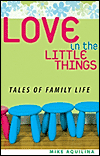
Grace builds on nature. Anyone who’s read my book The Fathers of the Church knows that I trace my love for the Church Fathers back to my love for my dad. It’s the constant teaching of the Fathers that the home is a Church (ecclesia domestica) and the Church is a family (familia Dei).
So, in the interest of full theological disclosure, I’ve written a book about the life of my family — my parents and sibs, my wife and my kids. It’s called Love in the Little Things: Tales of Family Life, and it’s been vetted by my wife and my four oldest children. I’m told it’s quite funny. (Patristic nerds will be happy to know that Ambrose, Augustine, and crew make cameo appearances.) If you dare to peek behind the pages of this blog, Love in the Little Things is your keyhole.
But don’t take my word for it — or my kids’ word for it. Here’s what the reviewers have to say:
“I wish I could have read this book when I was a young dad, but I was too busy learning all the lessons alongside Mike Aquilina. No matter what stage of the parenting game you’re at, don’t delay—start reading this book now!”
—Scott Hahn, author, Letter and Spirit: From Written Text to Living Word in the Liturgy“…a domestic catechism for the domestic church…absolutely delightful and insightful”
—Bishop Thomas J. Tobin, Providence, R.I.“…a book that knows real life smells a little like incense, a little like pasta and a little like a used diaper. As someone who has experienced the gracious vivacity of the Aquilina home firsthand, I can promise that you have a sure and fine guide to finding the Blessed Trinity in the clutter and chaos of the glorious thing known as family.”
—Mark P. Shea, author, By What Authority?“This book is a delight—easy to read and pregnant with insight. It is amazing how little things will change your view about family, faith and life.”
—Curtis Martin, president and founder, FOCUS“Mix lots of laughter and a few tears, add generous helpings of faith and hope, bring it all to a boil with the flame of love—that’s Mike Aquilina’s recipe for a happy, holy family. Love in the Little Things stands out for its good humor and deeply Catholic good sense. A terrific read for married couples of any age and for couples preparing for marriage.”
—Russell Shaw, author, Catholic Laity in the Mission of the Church“…a charming yet profound blueprint on how to be a devout Christian. People of all ages, of all religions, will delight to read this self-deprecating guide for pursuing holiness in a family milieu with all its humorous idiosyncrasies. Bravo!”
—Rev. T.G. Morrow, author, Christian Courtship in an Oversexed World
Tomb with a Crew
My co-author Chris Bailey rocks the tomb at GrailCode.com.
And to Dust Returned
The Quotable Anthony
Anthony’s up at Biblicalia, as Kevin continues his Lenten translation of the sayings of the Desert Fathers.
Grave Consequences
Catholic News Service on the latest media-invented pseudo-history.
Biblical scholars reject filmmakers’ claim about tomb of Jesus
By Judith Sudilovsky
Catholic News ServiceJERUSALEM (CNS) — Catholic biblical scholars and an Israeli archaeologist rejected filmmakers’ claim that a tomb uncovered nearly 30 years ago in Jerusalem is the burial site of Jesus and his family.
Dominican Father Jerome Murphy-O’Connor, a biblical archaeologist and expert in the New Testament at the French Biblical and Archaeological School of Jerusalem who was interviewed for the film two years ago, said he did not believe there was any truth to the claim.
“It is a commercial ploy that all the media is playing into,” he told Catholic News Service Feb. 27.
Amos Kloner, an Israeli archaeologist who wrote the original excavation report on the site for the predecessor of the Israel Antiquities Authority, called the claim “nonsense.”
“In their movie they are billing it as ‘never before reported information,’ but it is not new. I published all the details in the Antiqot journal in 1996, and I didn’t say it was the tomb of Jesus’ family,” said Kloner, now a professor of archaeology at Israel’s Bar-Ilan University.
“I think it is very unserious work. I do scholarly work … based on other studies,” he said.
Toronto filmmaker Simcha Jacobovici and Oscar-winning Canadian director James Cameron announced at a press conference in New York City Feb. 26 that by using new technology and DNA studies they have determined that among the 10 ossuaries — burial boxes used in biblical times to house the bones of the dead — found in the cave by Kloner in 1980 are those of Jesus, his brothers, Mary, another Mary whom they believe is Mary Magdalene, and “Judah, son of Jesus.”
The documentary film by Jacobovici and Cameron is to be aired on the Discovery Channel March 4 and in Canada March 6 on Vision TV. A book on the topic, written by Jacobovici and Charles Pellegrino and published by HarperCollins, is to go on sale Feb. 27.
Father Murphy-O’Connor said the names found on the ossuaries “are a combination of very common names.”
“Fifty percent of all Jewish women in the first century were called either Mary or Salome. It doesn’t mean much at all,” he said. “You can prove anything with statistics.”
The DNA tests could “only prove that they are human” but “certainly did not prove” any familial connection, he said.
Father Murphy-O’Connor noted that Kloner had written about the findings a decade ago, and though it was all out in the public domain nobody had been interested.
According to press reports, the filmmakers said they had worked on the project with world-renowned scientists, including DNA specialists, archaeologists and statisticians. They said the ossuaries were not identified as belonging to Jesus’ family when they were first discovered because the archaeologists at the time did not have the knowledge and scientific tools that now exist.
But Kloner noted that Jesus’ family was from Galilee and had no ties to Jerusalem, casting serious doubt that they would have had a burial cave in Jerusalem. He added that the names on the ossuaries were common during that time and their discovery in the same cave is purely coincidental.
He said the tomb belonged to a middle- or upper-middle-class Jewish family during the first century and the cave was in use for 70-100 years by the family.
Other books, films and articles about the tomb, including a full-page feature in London’s The Sunday Times, a British Broadcasting Corp. documentary film and a book called “The Jesus Dynasty” by James D. Tabor, have been published and produced on the topic in the years since the tomb’s discovery.
At the New York press conference, Jacobovici said he thought the so-called “James ossuary,” purported by its owner, Oded Golan, to have belonged to James, the brother of Jesus, was also from the tomb, and he cited a forensic technique used to determine this.
He did not mention that in 2003 the Israel Antiquities Authority declared the inscription on the James ossuary a forgery or that Golan is currently on trial for forging part of the inscription.
Basilian Father Thomas Rosica, a biblical scholar and head of Toronto’s Salt and Light Catholic Media Foundation, said this latest film shows that “self-proclaimed experts” have learned nothing from the James ossuary incident.
“One would think that we learned some powerful lessons from the media hype surrounding the James ossuary several years ago, and how important public institutions like the ROM (Royal Ontario Museum of Toronto) were duped in their hosting such fraudulent works,” he said.
Father Rosica said: “Why did the so-called archaeologists of this latest scoop wait 27 years before doing anything about the discovery? James Cameron is far better off making movies about the Titanic rather than dabbling in areas of religious history of which he knows nothing.”
A spokeswoman for the Israel Antiquities Authority said two of the ossuaries had been loaned to the filmmakers for their press conference as is customary for such requests for exhibiting antiquities as long as certain conditions are met. The loan was made in the name of freedom of expression and creativity, she said, and did not mean the authority supported their claims.
She said one of the Mary ossuaries has been on display for many years at Jerusalem’s Israel Museum; the Judah ossuary is on display in Fort Lauderdale, Fla.; two ossuaries are currently with the filmmakers; and the other six are in the authority’s warehouse just outside Jerusalem.
Benedict’s Lent: Happy Happy Joy Joy
During this season every year, I return to the work of a patrologist I much admire, Father Kurt Belsole, O.S.B. His book is called Joy in Lent, and it’s a study of St. Benedict’s winsome approach to the Church’s season of penance. Father Kurt shows that Benedict’s emphasis on joy in Lent is an original contribution in the history of monastic spirituality. Here’s Benedict himself in chapter 49 of his Rule. The passage is titled “On the Keeping of Lent”:
The life of a monk ought always to be a Lenten observance. However, since such virtue is that of few, we advise that during these days of Lent he guard his life with all purity and at the same time wash away during these holy days all the shortcomings of other times. This will then be worthily done, if we restrain ourselves from all vices. Let us devote ourselves to tearful prayers, to reading and compunction of heart, and to abstinence.
During these days, therefore, let us add something to the usual amount of our service, special prayers, abstinence from food and drink, that each one offer to God “with the joy of the Holy Ghost” (1 Thes 1:6), of his own accord, something above his prescribed measure; namely, let him withdraw from his body somewhat of food, drink, sleep, speech, merriment, and with the joy of spiritual desire await holy Easter.
Father Kurt unpacks that passage as only a good scholar — and good son of St. Benedict — can. Joy in Lent is available, as far as I know, only from the monks of St. Vincent Archabbey. If you don’t own a copy of Benedict’s Rule, consider buying this one, which is quite beautiful and comes with helpful annotation, historical background, and commentary.
Titanic Stupidity
I leave the office for just a couple of days, and what happens? The guy who steered the silver-screen Titanic to its watery grave now takes his show onto land and digs up the mausoleum of the Christ Family. Or something like that.
Did he follow clues gleaned from between the lines of the Gospel of Judas? Or did the Louvre’s curator carve directional signs around his navel as he lay dying?
Can credulity be strained any more? Or is the elastic gone by now?
While I’m trying to catch up with the phone and email messages that piled up while I was away, please visit Mark Goodacre for good posts and links to even more good posts.
ALSO WHILE I WAS OUT: I got to spend a fleeting moment in Fort Wayne with my old blogging friend Michael Dubruiel. Mike too has posted on the aforementioned pseudo-archeology. You should own Mike’s books, by the way, especially this one: The How-To Book of the Mass: Everything You Need to Know but No One Ever Taught You.
Fess Up
Lent, for the Fathers and for us, should be a time of repentance, of turning away from sin and turning toward the Lord. For the Fathers (and for us), the season is best begun with a good sacramental confession. If you haven’t made it there yet, don’t let another week pass you by.
What follows is from the catechetical sermons of St. Cyril of Jerusalem (late fourth century). He’s addressing those who wished to be received into the Church on Easter Vigil.
Now [Lent] is the season of confession. Confess what you have done in word or deed, by night or day. Confess in an acceptable time, and in the day of salvation receive the heavenly treasure. . . . Blot out from your mind all earthly care, for you are running for your soul. You are utterly forsaking the things of the world. Small are the things you are forsaking; great what the Lord is giving. Forsake things present, and put your trust in things to come.
Have you run so many circles of the years bustling vainly about the world, and have you not forty days to be free for prayer for your own soul’s sake? “Be still, and know that I am God,” says the Scripture (Ps 46:10). Excuse yourself from speaking many idle words. Neither backbite, nor lend a willing ear to backbiters; but rather be prompt to prayer. Show in ascetic exercise that your heart is strengthened. Cleanse your vessel, that you may receive grace more abundantly. For though remission of sins is given equally to all, the communion of the Holy Ghost is bestowed in proportion to each man’s faith. If you have labored little, you receive little; but if you have worked much, the reward is great. You are running for yourself; see to your own interest.
If you have anything against any man, forgive it. You come here to receive forgiveness of sins, and you, too, must forgive him who has sinned against you. Or how will you say to the Lord, “Forgive me my many sins,” if you have not yourself forgiven your fellowservant even his little sins.
Attend diligently the Church assemblies; not only now when diligent attendance is required of you by the clergy, but also after you have received the grace. For if, before you have received it, the practice is good, is it not also good after it is given? If before you are grafted in, it is a safe course to be watered and tended, is it not far better after the planting?
There’s more of Cyril in my books The Fathers of the Church, The Mass of the Early Christians, and Living the Mysteries. My favorite examination of the patristic record on sacramental confession is chapter 3 of Scott Hahn’s Lord, Have Mercy: The Healing Power of Confession.
An archbishop who’s following after the model of Cyril is Jose Gomez of San Antonio, who just issued his own rousing pastoral call to repentance and peace.
Call for Volunteers
I don’t know why I never (till now) bothered to look at the Wikipedia entry on Patristics. There’s not much of an article there — just a “stub,” as they say. But it’s got some great links to online texts of the Fathers, in the original languages and in translation.
Who will rise to the occasion and turn that stub into a worthwhile article? It should be enough to mine the best stuff in the out-of-copyright manuals from the early 20th century.
It would be interesting to find out the copyright status of Schmid, Bardenhewer, Cayre, Tixeront, Cross, Dirksen, and Altaner. I suppose those last two are too recent to be in the public domain. What about the others?