Posted on

The Other Ignatius

Take 5: On the Job Meditations With St. Ignatius

Our Sunday Visitor has just released Take 5: On the Job Meditations With St. Ignatius, co-authored by Yours Truly and my friend Father Kris Stubna. We’re working with St. Ignatius Loyola, the sixteenth-century spiritual master and founder of the Society of Jesus (the Jesuits).

I’m way beyond the first millennium with this one; but my co-author is thoroughly Jesuit-trained (licentiate and doctoral degrees from Rome’s Pontifical Gregorian University).

Last week, by the way, I was a near neighbor to St. Ignatius’s relics, staying at a hotel just blocks from the Gesu in Rome.

Posted on

Pope on Pope

Pope Benedict spoke on Pope St. Leo the Great last week. This is the only one of the audiences I actually got to see in person. I was surprised by how much he added extemporaneously, especially when he spoke in Italian and German. He seemed to be especially fond of Leo — maybe because Leo successfully persuaded the Germanic tribes to leave Rome, whereas Benedict’s predecessor succeeded at keeping his German friend within the walls. Blogger Gashwin Gomes, who sat next to me at the audience, posted video of the English portion of the program. And Teresa Benedetta, as ever, translated:

Dear brothers and sisters,

Continuing our journey with the Fathers of the Church – true stars who shine from afar – today we come to a Pope who was proclaimed a Doctor of the Church by Benedict XIV in 1754.

We will speak of St. Leo the Great. As indicated by the appellative which was quickly granted him by tradition, he was truly one of the greatest Pontiffs who ever honored the Seat of Roman, contibuting a great deal to reinforce its authority and prestige.

The first Bishop of Rome to carry the name Leo, which was later taken by 12 other Supreme Pontiffs, he is also the first Pope whose preaching to the people who gathered around him during liturgical celebrations has come down to us.

One thinks spontaneously of him in the context of the present Wednesday general audiences, an appointment which has become for the Bishop of Rome, in the past few decades, a customary form of encounter with the faithful and so many visitors coming from every part of the world.

Leo was a native of Tuscia [historic Italian region that was under the Etruscans – now corresponds to the province of Viterbo, but included Tsucany and parts of Lazio]. He became a deacon in the Church of Rome around 430, and with time, achieved a high profile in that function.

His outstanding performance led Galla Palcidia, who ruled the Wetsern Empire at the time, to send him to Gaul in 440 to repair a difficult situation.

But in the summer of that year, Pope Sixtus III – whose name is linked to the magnificent mosaics at Santa Maria Maggiore – died, and Leo was elected to succeed him, receiving the news while he was on his mission in Gaul.

Returning to Rome, the new Pope was consecrated on September 29, 440. Thus started a Pontificate which lasted more than 21 years and which is undoubtedly one of the most important in the history of the Church.

Upon his death on November 10, 461, the Pope was buried near the tomb of St. Peter. His relics are kept today in one of the altars of the Vatican Basilica.

Pope Leo lived in very difficult times. Repeated barbarian invasions, the progressive weakening of imperial authority in the Western empire, and a long social crisis had imposed on the Bishop of Rome – as it would with even greater effect one and a half centuries later during the pontificate of Gregory the Great – the need to assume a role that was relevant even in civil and political affairs. Obviously, this did not fail to increaase the importance and prestige of the Roman See.

A famous episode in Leo’s life took place in 452, when the Pope, together with a Roman delegation, met with Attila, leader of the Huns, in Mantua, and persuaded him from continuing with his war of invasion which had already devastated northeastern Italy, thus saving the rest of the peninsula.

img110.imageshack.us/img110/7992/leoattilaraphael2dc32d…
Raphael’s The Meeting between Leo the Great and Attila depicts Leo,
escorted by Saint Peter and Saint Paul, meeting with the Hun king outside Rome

This important event quickly became memorable and continues to be an emblematic sign of the peace activities carried out by the Papacy.

Unfortunately, a similar success was not the outcome of another papal initiative three years later, which is nevertheless the sign of a courage which still amazes us. In the spring of 455, Leo could not, in fact, prevent the Vandals of Genseric, who had reached the gates of Rome, from invading the defenseless city which was sacked for two weeks.

Nevertheless, the Pope’s gesture – helpless and surrounded by his priests, he went forth to meet the invader and asked him to stop – at least prevented the burning of Rome and resulted in saving the Basilica’s of St. Peter, St. Paul and St. John Lateran, in which part of the terrorized population had sought refuge.

We know Pope Leo’s activities quite well, thanks to his beautiful sermons, of which almost a hundred have been preserved, in splendid and clear Latin – and thanks to his letters, almost 150.

In these texts, the Pope appears in all his greatness, in the service of truth in charity, through an assiduous exercise of the word which showed him to be both theologian and pastor at the same time.

Leo the Great, whose attention was constantly solicited by the faithful and the people of Rome, but also by the communion among the different churches and their needs, was a tireless promoter and supporter of the Roman primacy, presenting the Pope as the authentic heir of the Apostle Peter. The bishops, many of them Oriental, who gathered together in the Council of Chalcedon, showed themselves to be well aware of this.

Held in 451, with 350 bishops taking part, this Council was the most important assembly ever celebrated in the history of the Church till then. Chalcedon represented the secure harbor of the Christology established in the three preceding ecumenical councils: Nicaea in 325, Constantinople in 381, and Ephesus in 431.

Already in the 6th century, these four Councils, which synthesized the faith of the early Church, came to be likened to the four Gospels, as Gregory the Great stated in a famous letter (I,24), affirming ‘to accept and venerate, like the four books of the Holy Gospel, the four Councils” because, he explains further, on them “the structure of the holy faith arises as on a keystone.”

The Council of Chalcedon, in denouncing the heresy of Eutiche, who denied the true human nature of the Son of God – affirmed the union, within the one Person of Christ, of the human and divine natures, without confusion and without separation.

This faith in Jesus Christ as true God and true man was affirmed by Pope Leo in an important doctrinal text addressed to tbe Bishop of Constantinople, the so-called ‘Tome to Flavianus’, which, when read at Chalecedon, was received by the bishops present with eloquent acclamation – recorded in the acts of the Council in these words: “Peter has spoken through the mouth of Leo” – breaking into unanimous applause.

From this intervention above all, but also in others carried out during the Christological controversy of those years, it is evident that the Pope felt the particularly urgent responsibility of the Successor of Peter, whose role is unique in the Church, because “only to one Apostle was entrusted what was communicated to all the apostles”, as Leo said in one of his sermons for the feast of Saints Peter and Paul (83,2).

And the Pope knew how to exercise this responsibility in the West as well as in the East, intervening in different circumstances with prudence, firmness and clarity through his writings and through his legates.

He showed in this way how the exercise of Roman primacy was necessary then, as it is today, in order to effectively serve the communion that is charatceristic of the only Church of Christ.

Conscious of the historical moment in which he lived and the transition that it was undergoing – in a period of profound crisis – from pagan Rome to Christian Rome, Leo the Great knew how to be close to the people and the faithful with his pastoral activity and his preaching.

He inspired charity in a Rome that was tried by famine, a refugee influx, injustices and poverty. He opposed pagan superstitions and the activities of Manichaean groups. He linked liturgy to the daily life of Christians by uniting, for example, the practice of fasting to charity and almsgiving, especially during the Four ‘tempora’ which marked the seasonal changes during the year.

In particular, Leo the Great taught the faithful – and even today, his words are valid for us – that Christian liturgy is not a remembrance of past events but the actualization of invisiblle realities that work in the life of every person.

He underscored this in a sermon (64,1-2) on Easter, which, he said, must be celebrated everry day of the year “not as something from the past, but rather as an event of the present”.

All this was part of a precise plan, the Holy Pontiff pointed out: Just as the Creator animated with his breath of rational life the man he had fashioned out of the mud of the earth, so too, after original sin, he sent his Son to the world to restore lost dignity to man and to destroy the power of the devil through a new life in grace.

This is the Christologic mystery to which St. Leo the Great, with his letter to the Council of Chalcedon, gave an effective and essential contribution, confirming for all times, through the Council, what St. Peter said at Caesarea.

With Peter and like Peter, he professed: “You are the Christ, the Son of the living God” – thus, God and man together, ‘not alien to the human species, but alien to sin’ (cfr Serm. 64).

With the strength of this Christologic faith, Leo the Great was a great bearer of peace and love. He thus shows us the way: in faith, we learn charity. Let us learn with St. Leo the Great to believe in Christ, true God and true man, and to realize this faith everyday in actions for peace and in love for our neighbor.

Posted on

Friends, Romans, Countrymen

I just got back from a full week in the Eternal City, where I was traveling with my St. Paul Center colleagues Scott Hahn and Rob Corzine. We enjoyed a week packed with meetings in an exhausting number of Vatican dicasteries and pontifical universities and colleges. The conversations were exhilarating and encouraging.

Between meetings we found ourselves in the company of bloggers Gashwin Gomes and Joan in Rome. We even got to attend an inspired talk by Joan at Christendom College’s thirtieth anniversary bash. Among her rapt listeners were Cardinals Arinze and Law, former papal spokesman Joaquin Navarro-Valls, U.S. ambassador to the Vatican Mary Ann Glendon, Zenit’s Liz Lev, and blogger-TV personality Father John Wauck.

The Fathers were with us everywhere. On our way from meeting to meeting, we dropped in to visit the relics of St. Clement, St. Ignatius, St. Monica, St. Gregory, plus the Apostles, of course, and the popes. We passed these archeological digs quite often. Rob and I ran through the Forum Romanum — apparently among the last visitors to pass through free of charge! Big news on Italian TV was the exhuming of the body of Padre Pio.

Gashwin blogged (several posts) on our travels together and even added YouTube video of the papal audience on St. Leo the Great. If you listen closely at the end, you can hear us croaking the Our Father in Latin. Gashwin also attended a lecture by the Ecumenical Patriarch, Bartholomew, who was in town to visit his alma mater, the Pontifical Oriental Institute.

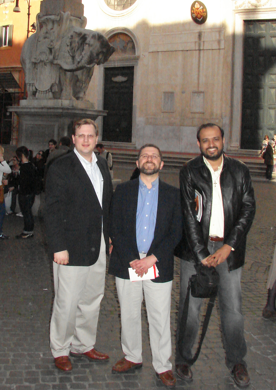
Gashwin is delightful company. Our conversations ranged from St. Catherine of Siena to the Bhagavad Gita, from gelato to Brownson and Hecker. Here’s Rob, me, and Gashwin at Santa Maria Sopra Minerva. (I don’t know the elephant’s name.)

picture-3.png

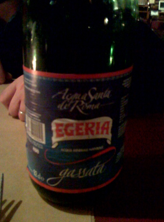
And just to show you how hard it is to avoid the ancients in Rome … They’re even on the label of your water bottle.
picture-1.png

Posted on

Occult Classic

Jim Davila points us to an unusual new title, The Occult Sciences in Byzantium, edited by Paul Magdalino and Maria Mavroudi. Its primary focus seems to be alchemy and astrology, as precursors to modern sciences.

This volume represents the first attempt to examine occult sciences as a distinct category of Byzantine intellectual culture. It is concerned with both the reality and the image of the occult sciences in Byzantium, and seeks, above all, to represent them in their social and cultural context as a historical phenomenon. The eleven essays demonstrate that Byzantium was not marginal to the scientific culture of the Middle Ages, and that the occult sciences were not marginal to the learned culture of the medieval Byzantine world.

Posted on

Syriously Marian

Interesting lecture at Fordham, on St. Ephrem’s Marian poetry:

Women’s Choirs in Late Antiquity Offered More Than Just Hymns, Scholar Says

Though the voices of biblical women were rarely heard, they were prominent and significant, and used as a vehicle of teaching by the Church in late antique Syriac homilies and hymns, according to a scholar at the Orthodoxy in America lecture at Fordham University on Feb. 26.

“The hymns assigned to the women’s choirs in the middle of the fourth century were explicitly liturgical,” Susan Ashbrook Harvey, Ph.D., a professor of religious studies at Brown University. “The church spoke through these women’s choirs.”

In a lecture titled, “Women’s Voices Bearing Witness: Biblical Memories in Ancient Orthodox Liturgy,” Ashbrook Harvey said Syriac writers, such as Ephrem Syrus, gave women, such as the Virgin Mary and Sarah, a rhetorical voice in the lyrics of Madrashes, stanzaic poems of different meters that dealt with doctrinal matters.

“These voices were often lacking in biblical narratives,” Ashbrook Harvey said. “Ephrem’s Mary embraces her social sufferings as a form of power. She was a figure who embodied challenge … and whose voice is a teaching voice.”

Hat tip: PaleoJudaica.

Read more on the Syriac Fathers:

Syriac Fathers on Prayer and the Spiritual Life

Ephrem the Syrian: Select Poems
Symbols of Church and Kingdom: A Study in Early Syriac Tradition

Posted on

More on Athens and Jerusalem

First published in 1981, Andrew Louth’s The Origins of the Christian Mystical Tradition: From Plato to Denys has never gone out of print. The author, an Orthodox priest and patristics scholar at the University of Durham, traces certain intellectual currents — purification, illumination, union, etc. — as they develop through the works of Plato, Philo, Plotinus, Origen, Augustine, and others. Though a pagan, Plato emphasized man’s spiritual nature and forged a philosophical vocabulary that the early Fathers would later appropriate for Christian theology. Nevertheless, Louth clearly demonstrates that patristic theology is not baptized Platonism (as some historians of religion assert). Plato, for example, held the soul to be divine by nature, and the mystical ascent to be a return or homecoming. For Christians, the soul is divinized by grace. Man is made in God’s image, but there remains an ontological gulf between creature and creator.

Later chapters examine the works of John of the Cross (16th century) in light of his patristic forebears. While some Eastern Orthodox critics judge John to be deviant from the tradition of the Fathers, Louth sees John’s doctrine as differing in “perspective rather than anything fundamental.” Indeed, Louth concludes that “these different styles [Eastern and Western] draw out different areas of mystical experience … [T]his is but evidence of a tension within a deeper unity, and suggests that East and West have much to learn from one another here.”

The final chapter considers the qualities that make Christian mysticism distinctive, particularly “The Mystical Life” lived within “the Mystical Body.” Louth argues that “Christian mystical theology is ecclesial; it is the fruit of participation in the mystery of Christ, which is inseparable from the mystery of the Church. Within the Platonic tradition the mystic is an individual, or at best the member of an intellectual elite.”

In an important new afterword, the author goes so far as to argue — against some comparative religionists, and against a position he himself had formerly held — that the phenomenon of mysticism is, in truth, something distinctively Christian.

Posted on

Another Patristic-Era Cemetery Found

This one in Ireland:

Three ringforts were also found at Camblin. One of them included a small cemetery dating to the 6th to 7th Century. Archaeologists say the cemetery would have been in use before the Bishops of Roscrea had formalised human burial into consecrated churchyards.

‘Burials were all in the Christian manner, although some of the bodies seem to have been more casually interred, such as one where the legs were bent to fit into a small grave The burials included people of all ages and it is likely the site was used for several hundred years,’ according to the archaeological report on the motorway route commissioned by the National Roads Authority.

The report said the concentration of ancient sites discovered near the present N62 Templemore Road at Camblin reflected the location of the ancient Roscrea to Cashel routeway.

Posted on

Games People Played

Many of the early martyrs died as props in public spectacles. They went unarmed against gladiators. Or they were sewn up in animal skins and sent out against wild beasts. Christians today know the scenes from religious images that impose a certain solemnity on the occasion.

But a recently discovered mosaic in Tunisia gives us a sense of the showbiz of it all — a carnival barker calling us to carnage.

I think it makes books like this one all the more poignant.

Posted on

Patristic Pulpit Pack

Pope Benedict just last week concluded his five-part series of addresses on the life and work of St. Augustine. I’m sure it made you want to learn more about this undisputed giant of intellectual history. But where to begin?

Maybe start with the sermons. Augustine is one of history’s greatest preachers — at once warm and winsome in his delivery and profound and sophisticated in his exposition. His 559 surviving sermons fill eleven imposing volumes in the most recent English edition.

I know: That’s not much help if you’re trying to find something manageable for starters.

But now comes a book that gathers a more manageable seventy-six “essential” sermons for a modern reader’s study (or a modern preacher’s imitation). It’s aptly titled Saint Augustine: Essential Sermons. Topics range from dogma to morals, from liturgy to lives of the saints, from Mariology to celibacy.

The styles range from polemic to pleading, all rendered in the colloquial English that has been the hallmark of the New City Press Works of Saint Augustine series: “That’s what the Church of God is like; in some of the saints it works miracles, in other saints it proclaims the truth, in other saints it preserves virginity, in other saints it preserves married chastity; in some this, in others that. All doing their own thing, but living the same life together.”

The volume is well suited for devotional or spiritual reading. The scholarly notes have been stripped out, to keep the size down, and the index is minimal. The introduction, however, is immensely helpful, analyzing Augustine’s rhetorical techniques in a way that’s accessible to nonspecialists, and teasing out, from Augustine’s casual asides, the great preacher’s homiletic methods and habits of preparation.

Posted on

Father Benedict Groeschel

Father Benedict Groeschel is a prolific author and television preacher, but he never wastes a word. In a new book, Praying with the Creed, he gives brief meditations on the articles of the ancient creeds. Each chapter is structured for a group prayer meeting, but it would serve just as well for private prayer. The author supplements his own reflections with passages from the writings of the saints as well as modern theologians such as Matthias Scheeben and Romano Guardini. Each chapter ends with questions for meditation and a closing prayer. The book is the first of four projected volumes that correspond to the four major divisions of the Catechism of the Catholic Church: creed, worship, morals, and prayer.