Posted on

Mass of the Early Christians, Take 2

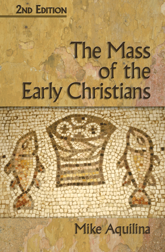
I’m holding in my hands the new edition of The Mass of Early Christians. It’s in the warehouse. It’s even on Amazon.
t419_cover_rgb.jpg
What’s new in this expanded edition? Lots. The book’s a good deal bigger. There are at least six new chapters — on Clement of Rome, Cornelius, Firmilian, the Anaphora of St. Mark, Eusebius, and the Council of Nicea. I added several more apocryphal texts, and included a discussion of the recently discovered Gospel of Judas. I also added more texts by Irenaeus, Cyprian, Origen, Clement of Alexandria, and others. Still other chapters were extensively rewritten based on more recent scholarship.

In case you missed the reviews the first time around, here’s a sampling:

“This is an excellent and exciting work. I wish that The Mass of the Early Christians was compulsory reading for all ordinands. Mike Aquilina is to be congratulated.”
Robert Beaken, New Directions (U.K.)

“All Christians from liturgical traditions can read this book with profit and find comfort in the firm historical basis of their own worship. Those who have shunned liturgical worship might after reading this book reconsider their position and wonder what they have been missing.”
Christian Book Reviews

“The Mass we know on Sunday—the Mass you encounter in this book—is where Tradition lives, where Church’s memory reigns ‘in the Spirit.’ Read this book, then, and remember.”
Scott Hahn, professor, Franciscan University

“Aquilina is to be congratulated for making these texts accessible to a new and wide-ranging audience allowing us to echo the cry voiced by the martyrs of North Africa in the third century: ‘we cannot live without the Mass!'”
Fr. Joseph Linck, rector, St. John Fisher Seminary

“Mike Aquilina has performed a needed service in making this heritage accessible to non-specialists.”
Oswald Sobrino, Esq.

Can you tell I’m excited? Hope you like the new edition as much as I do.

Posted on

Sound and Vision

Well, our pilgrims are emerging from their jet-lag and their “while you were out” messages, and they’re beginning to post mementos of our trip to Rome and Assisi. Susie from Omaha posted almost a thousand photos — everything from Rome’s streetcorner Marian shrines to Assisi’s, um, interesting plumbing.

If there were an audio track, you’d recognize the mellifluous voice of Kris McGregor of KVSS Radio. Kris joined us for the pilgrimage, and she managed our live and taped broadcasts from the streets, sites, and truck stops of Italy. KVSS has now posted much of that audio. So you can listen as I struggle to be heard over the roar of Roman crowds and the horns of Roman traffic. Scott and Kimberly Hahn were far more successful — as indeed Kris was — but these people are professionals. (Junior says he’ll post video of some of their presentations as soon as he finds the right cable.)
phone-a-roma
I’m still giddy from the experience. We remembered Clement and Ignatius along the streets they walked themselves. We venerated their relics. We prayed at the tombs of Peter and Paul, Simon and Jude, Philip and James, Francis and Clare. In those days between Ascension and Pentecost, we made an earnest novena to the Holy Spirit. We joined daily for the Holy Eucharist. Our chaplain (joined by four clergy pilgrims) was Father Pablo Gadenz of Trenton, New Jersey, a brilliant young Scripture scholar, and he preached up a storm.

There were some funny moments, like when a bystander berated Scott Hahn for “proselytizing” in his mini-lecture at the Arch of Titus — a lecture addressed, in English, only to our little flock. But the defining moment (for me) came when a Spanish Salesian Brother took one of our pilgrims aside in the Catacombs of Saint Callixtus and observed: “This group is very special. You all have Jesus in your heart.”

Posted on

Justin Time (Well, Not Quite)

I renew my apologies for blogging intermittently over the last couple of weeks. My sojourn in Rome and Assisi (and Newark) was followed immediately by a stay in Chicago for the Religious Book Trade Exhibit, where I was a featured author, the guest of Word Among Us Press. WAU is the publisher of my most recent book, The Resilient Church: The Glory, the Shame, and the Hope for Tomorrow.

None of this should excuse me from missing Justin Martyr’s feast day yesterday (mea MAXIMA culpa) or showing up later for Marcellinus and Peter. In reparation I offer you, from my archives, Justin, more Justin, and Peter and Marcellinus.

I have almost caught up from the weeks away — responded to the accumulated email, deleted the spam, posted the comments that required moderation, and begun my normal work schedule. Early next week I hope to post recaps of Rome, Assisi, and Chicago, with sound and pictures.

Posted on

Memento

I’ve adapted this from last year’s Memorial Day post…

This weekend, in the United States, we mark Memorial Day, an observance that honors the dead, especially those who served and died defending the country in wartime.

How did the ancients keep this holiday? Well, they didn’t, of course, since it’s a nineteenth-century innovation of American origin.

But there’s a sense in which the early Christians kept every day as a “Memorial Day.” They called the Eucharist an anamnesis, a “memorial” of Christ’s death — a God-willed remembrance through which Jesus became really present.

And they marked not only Christ’s death, but also the days of the saints who died in Christ, especially the martyrs. Very early, the Church’s calendar began to teem with feast days honoring the dead, and the living Christians gained some notoriety for their treatment of the deceased.

Cremation had long been the norm in most societies of the pagan Roman Empire. Jews, however, followed the custom of burying their dead. Christians did, too, and looked upon “Christian burial” as an expression of their faith in the resurrection of the body. Such an oddity was this practice that, in many locales, it earned Christians a derogatory nickname: “The Diggers.”

Yet the pagans also honored their dead, often with lavish funeral rites. One common component, in Greek and Roman cultures, was the funeral banquet. The empire had many laws regulating the practice of funerary societies, clubs that would guarantee a decent send-off and a festive memorial for their members. Benign local officials sometimes chose to look upon Christian churches as funerary societies, since they seemed to fulfill the same purpose.

Roman families actually hosted severals banquets to honor their recently deceased: one at the gravesite the day of the funeral; the second at the end of nine days of mourning; others on specified religious holidays; and one major banquet on the birthday of the deceased. (See the excellent discussion of these meals in Dennis E. Smith’s From Symposium to Eucharist: The Banquet in the Early Christian World. It’s a fascinating study, in spite of its very low-church conclusions.)

Christians adapted the ancient rites as their own — or saw no reason to abandon them completely after conversion. Like the former pagans themselves, the pagan customs were thoroughly converted — baptized, as it were, purified and rendered a new creation. One major Christian difference was in giving bodies a decent burial. This is abundantly evident in the recently discovered catacombs in Rome, where hundreds of corpses were found well dressed and placed with reverence.

Christians also kept the custom of funerary banquets. In some places they may have taken the form of an “Agape,” or love-feast, as we find recorded in the New Testament Letter of St. Jude. Another possibility is that the funeral Eucharist was observed as part of a fuller banquet, a practice we find in St. Paul’s First Letter to the Corinthians (chapter 11). In some churches the funeral was certainly marked by a Eucharist at the gravesite. We have a very early record of the graveside practice, from the mid-second century, in the apocryphal Acts of John. These funerary banquets or Masses may also be the meals we find depicted on the walls of the catacombs.

By the fourth century, the gravesite celebrations — sometimes called refrigeria, or “refreshments” — had gained a reputation in some quarters as raucous, drunken affairs. This was especially true of the festivals of popular saints, where the temptation was strong to knock one back for every glass poured out as a libation. When St. Monica moved from North Africa to Italy to be near her son Augustine, the Milanese bishop, St. Ambrose, discouraged her from observing the refrigeria at all — even in a pious way.

The great liturgical scholar Joseph Jungmann noted that the earliest recorded graveside Masses were offered on the third day after the Christian’s burial. The third day — what a stunning symbolic fulfillment of our life in Christ — how beautiful, how poignant, how utterly incarnational and sacramental! Jungmann sees this custom as the ancestor of our current practice of votive Masses for the dead. And he notes times and places where various churches traditionally observed the seventh day, the ninth, the thirtieth, and the fortieth as well.

Some people see the gorgeous farewell passage in Augustine’s Confessions as a turning point in ancient attitudes. There, Monica, who had once avidly marked the refrigerium, now asks her son to remember her in the Mass. It is, they say, at this moment in history that popular sentiment had begun to turn from the rowdy festival to the solemn Mass. That’s a nice thought, but it seems contradicted by later practice, as Christians continued to mark festive banquets at gravesites throughout the era of the Fathers.

Last year, while researching these customs, I had a “Christmas Carol” moment straight out of Dickens. Googling around, I landed on one of the many lovely sites devoted to the Roman catacombs. There I learned that, in the area called St. Miltiades in the Catacombs of St. Callixtus, there is a “Crypt of Refrigerium.” It is very near, the website told me, to the so-called “Cubicle of Aquilina,” which bears the inscription “Aquilina dormit in pace” (Aquilina sleeps in peace). Last week I saw that inscription with my own eyes.

May that inscription one day be true of me, and may it this day be true of my ancestors, whom I remember, as the holiday requires.
Posted on

Reno on the Fathers

Last time I posted on R.R. Reno’s essay, “The Return of the Fathers,” it wasn’t available online. It is now, at First Things. It’s filled with good news about the world we live in.

One of the most important new facts about Christian theology in North America is the sudden popularity of the theologians and pastors, monks and bishops, martyrs and missionaries, who first fashioned a Christian culture nearly two thousand years ago. The Church Fathers are returning as agents of renewal, guiding us toward the biblical source of a truly Christian culture.

We see the return of the Fathers in unexpected places. The Ancient Christian Commentary on Scripture, edited by Thomas Oden and published by InterVarsity, has been remarkably successful. Across twenty-eight projected volumes (eighteen or so are now out), the series presents a selection of patristic interpretations, organized around the verses of the Bible. The result is a grand catena, a style of commentary in which the Bible is illuminated by a selection of short passages from such ancient interpreters as Augustine, Origen, Chrysostom, and Basil.

Popular in the centuries following the debates that culminated in the great ecumenical councils and creeds of the fourth and fifth centuries, catenae were used to reinforce and pass on the authoritative interpretations from the age of the Church Fathers. In this way, the imaginations of biblical readers were socialized into the patristic consensus about God, Christ, salvation, the Church, and sacraments. That a twenty-first-century evangelical press has gone forward with a project committed to this mode of retrospective, consensus-building biblical commentary—and that the project has met with striking success—says something important about our time.

The Ancient Christian Commentary on Scripture is not unique. Robert Louis Wilken’s account of the great patristic intellectual synthesis, The Spirit of Early Christian Thought, is widely read. In The Beauty of the Infinite, David Hart argues for the superiority of patristic metaphysics over the latest postmodern fashions. Graduate students at universities such as Notre Dame, who thirty years ago would have written dissertations on Karl Rahner and transcendental philosophy, are now more likely to focus on the speculative system of Origen or the Christian Platonism of the Cappadocians.

If you haven’t read Reno’s book Sanctified Vision: An Introduction to Early Christian Interpretation of the Bible, then get right on it!

Posted on

I Have Come Not to Be Serb, But to Serbia

Here’s a great story.

Archaeologists unearth 4th century church in Serbia

BELGRADE — Archaeologists have discovered a 4th century Christian church in southern Serbia, the Blic newspaper reported Tuesday.

“It’s an exceptional discovery,” Gordana Jeremic, the lead archaeologist at the Mediana site near the city of Nis, was quoted as saying.

The ruins were located only several meters (feet) from another church that was discovered in 2000, the paper reported.

The excavation also unearthed more than 600 objects including coins, jewels, utensils, and frescos.

“The discovery of a bronze ring decorated with a cross is particularly important because it proves that Christians lived here,” Jeremic said.

Mediana, once a Roman vacation resort, is located on the outskirts of Nis, the birthplace of Roman emperor Constantine The Great, which at the time was known as Niassus.

Posted on

Last Rows of Sommer

My conversation continues with Carl Sommer, author of We Look for a Kingdom: The Everyday Lives of the Early Christians.

You give the Roman world a fair hearing and you recognize nobility in the pagans. Who is your favorite figure from pagan antiquity?

My favorite figure from pagan antiquity is the historian Livy, who understood his world so well, and wrote, “We can endure neither our vices nor the remedies needed to cure them.”

Who is your favorite figure from Christian antiquity, and why?

My favorite figure from Christian antiquity is Justin Martyr. I enjoy the thought of him living in Rome in rented rooms, over a pagan bath, quietly teaching anyone who would come to him, but also able to engage the leading pagan intellectuals of his age on equal footing.

What are the most significant similarities between the Fathers’ world and ours?

The most significant similarities between the pagan world and ours are in the prevailing sexual mores and in the fascination with violent entertainment, which shocks and numbs the soul, and requires increasingly large doses to satisfy the addiction.

What are the most significant differences?

There are more differences than similarities between the Roman world and ours. There are so many variables that no historical era can present more than a rough facsimile of another. We have defeated some evils, like slavery, and horrific forms of capital punishment such as crucifixion. But evil continues to exist, and our technological marvels present new temptations and new pitfalls to avoid. So I think one would be forced to conclude that despite our progress, we haven’t come very far after all.
 
On a philosophical plane, the biggest difference between our world and the Roman world is that the ancients, whether pagan, Jew, or Christian, saw the world as full of spirits, some good, and some malign.  They believed that what we would call “a miracle” could happen at any time. We, of course, understand the scientific laws that govern the behavior of objects in this world. We have no need of spiritual explanations for things. We accept the existence of God, for the most part, but we don’t think we have to do something specific to convince Him to cause the sun to rise tomorrow. In some ways, this change in attitude is good. God is benevolent, and He did create an orderly universe. But we’ve also lost something of poetic wonder. We can’t look at the natural world with quite the same sense of awe.

What book from ancient Christianity has rocked you more than any other, and why?

I would have to say that Eusebius of Caesarea’s Ecclesiastical History has rocked me more than any other work, for a variety of reasons. First, we learn more about the persecutions from him than from any other source. But as a historian, reading his brief quotes of lengthy documents that no longer exist has convinced me that we know only a tenth of what we could know about the first few centuries of Christianity. What would we find in, for example, Papias’s lost five volumes, above and beyond what we can learn from the brief passages that have been preserved?

How does living with the Fathers affect the way you live your life?

Living with the Fathers has taught me humility.  I have had every advantage, compared to them, and yet they attained a level of spiritual and intellectual grandeur at which I can only marvel.

How has the teaching of the Fathers — the nearness of the Fathers — influenced the way you pray?

I’m a typical modern American. I grew up assuming that spontaneity was better than repetition, that “creative chaos” was better than order, and that independence was better than submission to authority.  The years have taught me that all these assumptions were mistaken. The Fathers have given me some better assumptions to take their place. Morning and Evening Prayer are beautiful because they sanctify time. The liturgy in itself, without any trappings, is beautiful because Christ Himself is beautiful. And the apostolic authority of the bishops is a great good because it allows all these beauties to pass unchanged from generation to generation. And that is the greatest beauty of all.

Posted on

Sommer Begins

I mentioned a few weeks back that I’ve been enjoying Carl Sommer’s We Look for a Kingdom: The Everyday Lives of the Early Christians. It’s a new book, just out from Ignatius Press, and it does for the patristic era what classics like Henri Daniel-Rops’ Daily Life in the Time of Jesus did for the New Testament era.

Carl and I have been going back and forth by email. I asked him if I might interview him for the blog, and he kindly consented. I’ll post our Q&A over the next few days.

So … now perhaps we begin.

Your book is different from other books on Christian antiquity. It’s not a history of theology, nor is it a social history. Nor is it really a work of apologetics. How would you describe your method, and what made you choose it?

There are many books, better than anything I could write, about the developments in theology or the Sacraments in the early Church.  New Testament studies are also quite thick on the ground.  There is nothing wrong with any of these books, but I wanted to try to do something a little bit different.  I wanted to see if I could reconstruct the daily lives of everyday Christians in the first three centuries.  My methodology was fairly simple.  I ransacked the Ante-Nicene fathers and the archaeological records, not for developments in Trinitarian thought, but for references to marital and childrearing practices, daily prayer, care for the poor and sick, life in the military, and other aspects of daily life.

What do you think modern Christians gain by entering imaginatively into the ancient world? Why, for example, should we care about the practice of Roman medicine or the methods of ancient mail carriers?

It’s hard to pinpoint any immediate, practical benefits.  I think, though, that general knowledge about the Roman world can enhance our understanding of the New Testament, and certainly, an appreciation of the difficulties Christians faced during the age of martyrs can inspire us to be better Christians today.  I remember how I felt when I walked out at the end of Mel Gibson’s “Passion of the Christ.”  The secularists were afraid people would come out wanting to beat up Jews, but the movie had the opposite effect on me.  I came out wanting to be a better person.  I think reading about the daily lives of the early Christians could have the same effect on people.
 
Of course, the specific examples you gave have specific uses.  Understanding the inadequacies of the public postal system helps students of the early Church to understand one aspect of communications between communities, and the importance of personal oral testimony.  Those who carried the letters were more than just mailmen.  They were trusted emissaries who passed their most important messages by mouth, not by letter.  Nineteenth and twentieth century  scholars, members of literate societies that highly prized the written word, have often made the assumption that in the first century, as in the twentieth, anything important would be most likely communicated in writing.  In fact, in the first century, the opposite was true.  The most important messages were transmitted orally first, and by the written word only as a way of confirmation.  Thus, the Catholic notion of an oral tradition is borne out by the actual facts on the ground.  And in fact we find that Papias and others who made inquiries into the origins of Christianity trusted oral tradition over the written word:  “I imagined that what was to be got from books was not so profitable to me as what came from the living and abiding voice”  (Papias of Hierapolis, Fragments, I).
 
Regarding medical practices, too, many inferences can be drawn. In We Look for a Kingdom, for instance, I have suggested that some of the condemnations of sorcery in the New Testament might actually be condemnations of abortion.  The argument is complicated, but has primarily to do with the meaning of the Greek word pharmakeia.  See We Look for a Kingdom, pp. 312-315, for the entire argument.

In your opinion, what are the most common misconceptions about early Christianity?

The most common misconceptions about the early Christians are that they were egalitarian, and that they were anti or non-liturgical in their worship.  The notion of egalitarianism is easy to dispel.  If one honestly looks at the New Testament data, one quickly realizes that the Twelve had more authority than the body of believers, and that they routinely passed a share of their authority on to others.  That the apostles exercised discipline over the churches is also easy to confirm in Scripture, when one considers passages like this one: “I warned those who sinned before and all the others, and I warn them now while absent, as I did when present on my second visit, that if I come again I will not spare them…”  (2 Corinthians 13:2).
 
It is, admittedly, harder to demonstrate the liturgical nature of early Christian worship, because there is no direct description of the Liturgy in the New Testament, but shortly afterward, in the Didache and in Justin Martyr’s First Apology, we find descriptions of Liturgies that look a lot like what we do today.  We can’t simply assume that the first century Church worshipped as Justin did, but it seems reasonable to suppose that very early on, the Christians took existing Synagogue rituals and modified them for Christian usage, all the while with Jesus’ command, “Do this in remembrance of me” foremost in their minds.

Even mistaken ideas have consequences. What are the ill effects of these misconceptions?

The ill effects of the first misconception are many.  First and foremost, Christ willed that His body should be one (or so I believe a fair reading of John 17:20 would lead one to conclude), but the belief that individual interpretation of Scripture should somehow override the authoritative teachings of the Bishops has resulted in an almost unbelievable fragmentation of the Body of Christ.  We have paid bitterly for this disunity. 
 
The anti-liturgical bias, which manifests itself outside Catholicism in the more charismatic forms of worship, and within Catholicism in the spirit of experimentation that has prevailed in the past thirty years, has had a more subtle, but nonetheless real, effect.  The assumption that the words of Scripture that we read in the Liturgy of the Word, and the salvific act of Christ that we memorialize in the Liturgy of the Eucharist need somehow to be packaged and marketed have led to a trivialization of the Gospel message itself.  I recently heard Donald Trump assert on TV that “Nothing sells itself.”  That may be true of the products of this world, about which Mr. Trump knows more than I.  But the Gospel can and does sell itself every day.  We need to get out of the way, and let the ancient Liturgy speak for itself.

Stay tuned. I’ll post more from the conversation tomorrow.

If you’d like to read the intro to Carl’s book, see the introduction online. And there’s another interview with Carl at Insight Scoop. If you’re ready to buy the book, go directly to order.