Posted on

Nestorius Back in Print

Roger Pearse has posted an English translation of the Bazaar of the heresiarch Nestorius (writing under a pseudonym). Nestorius is a tough read, as even his ancient critics liked to point out. But the manuscript history of the Bazaar is a fast-paced international thriller that takes us through rough patches of geopolitics of the last century. Some of the few copies vanished in massacres in Kurdistan. Another was destroyed in World War I.

A man of the Antiochene school, Nestorius tried to articulate a christology that would oppose two other heresies, Arianism and Apollinarianism. In doing so, he over-corrected, and his rationalism drove him to conclude that Christ existed as two distinct persons, the man Jesus and the divine Son of God. A further consequence was his denial of the title “Mother of God” to the Virgin Mary. He claimed she was mother only to Christ’s human nature.

St. Cyril of Alexandria argued forcefully for the hypostatic union — a single “I” in Jesus Christ. Cyril also pointed out that a mother gives birth to a person, not a nature. The Council of Ephesus rejected Nestorius’s doctrine in 431. (More on the controversy here.)

Posted on

Will Iraq’s Christian History Be “History”?

Now comes more unsettling news on the fate of the material patrimony of Christians in the Middle East. I’m posting this Times story, Archaeologists Worry That Iraq Will Erase Its Pre-Islamic History, as a follow-up to my previous posts here and here. Many of the “pre-Islamic” sites the authors mention are the monasteries and churches where Syriac Christianity emerged.

BEIRUT, Lebanon — There is mounting concern among scholars that the appointment of religiously conservative Shiite Muslims throughout Iraq’s traditionally secular archaeological institutions could threaten the preservation of the country’s pre-Islamic history.

Dr. Donny George’s recent departure as chairman of the State Board of Antiquities and Heritage, and his flight to Syria with his family, is among the latest results of a transformation that began in December when a Shiite-dominated government was elected in Baghdad. The radical Shiite cleric Muqtada al-Sadr, who commands his own militia, emerged with enough seats in Parliament to take control of four ministries and to create a Ministry of Tourism and Antiquities.

The State Board of Antiquities and Heritage, traditionally under the Ministry of Culture, now reports to this new ministry as well.

“The Ministry of Tourism and Antiquities wants to control Iraq’s archaeological heritage by demolishing this institution, one of the oldest institutions in Iraq,” George said from Damascus. “This will be a disaster for this field, and for the cultural heritage of the country.”

Although the Ministry of Tourism and Antiquities has begun operating, the law creating it has not yet been approved by Parliament, said Abudul Zahra al-Talaqani, a spokesman for the new ministry.

The proposed law would divide the State Board of Antiquities and Heritage into four administrative departments: museums, excavations, manuscripts and heritage. The present departments of restoration and research would be eliminated, suggesting that preservation and scholarship would no longer be the institution’s focus.

The long history of secular scholarship in Iraq has covered all periods, including excavations at the Islamic site of Samarra and the restoration of Ukhaidir, an Islamic fortress near Karbala. Earlier sites include ruins from the Sumerian, Akkadian, Babylonian, Parthian and Sassanian civilizations.

The State Board of Antiquities and Heritage was created in 1923, when Gertrude Bell, the British explorer and administrator, founded the Iraqi National Museum. “It was the best in the whole Middle East,” said Dr. McGuire Gibson, a professor of Mesopotamian archaeology at the University of Chicago. “At one point there were 13 Iraqi Ph.D.’s working there.”

Liwa Sumaysim, the new minister of tourism and antiquities, is a dentist whose wife, a member of Parliament, is related to al-Sadr. The new ministry has already replaced employees of the State Board of Antiquities and Heritage at the national and local level.

Burhan Shakur, an archaeologist who was director of excavations at the Iraqi Museum, was fired in the spring, then given the option to retire; he has left for Germany. Abdul-Amir Hamdani, the inspector for antiquities in the Dhi Qar province, an area rich in pre-Islamic sites, was jailed in April on charges of corruption. After three months he was released, and the charges were dropped. But his job was then filled by a man with ties to Al Fadilah, an Islamist party aligned with the Sadr movement.

With the looting of archaeological sites in southern Iraq still thriving, control of the antiquities department is a significant prize. Most of the archaeological sites in the southern Dhi Qar province are pre-Islamic, dating roughly from 3200 B. C. to A. D. 500. A link between Islamic militants and looting at pre-Islamic archaeological sites has long been suspected, but is difficult to prove. The Nasiriyah Museum was burned and looted in 2004 by militants affiliated with al-Sadr. The museum’s guards reported that the militants promised to do to the antiquities there exactly “what the Taliban did.”

The center for Iraq’s illicit antiquities trade, Fajr, in the heart of the Sumerian plain, is also a stronghold for militants loyal to al-Sadr. And anti-Western graffiti has appeared at looted archaeological sites.

“It is hard to say yes or no if these gangs have a relation with the Sadr movement,” cautioned Mufeed al-Jazairi, Iraq’s first minister of culture after the Coalition Provisional Authority disbanded, noting that looters were active in Saddam Hussein’s time as well. “But it is not surprising to imagine that one of these gangs will announce that they are allies with Sadr, hoping to gain a political shield in case they are being followed by authorities.”

“If the destruction of sites continues, it is not just the death of archaeology,” Gibson of the University of Chicago said. “Antiquities are key to Iraq’s economy; at some point the oil will run out. Iraqi tourism will be built on archaeology.”

Yet Gibson warned that putting an archaeological department under a tourism office tends to have negative consequences because sites may become mothballed, and research possibilities lost.

The Sadrist leadership in the new ministry has made its views known in other ways. Recently two pre-Islamic statues it returned to the Iraqi Museum were accompanied by a note describing them as “idols.” Dr. Elizabeth Stone, an archaeologist and professor of anthropology who has excavated in southern Iraq, said that officials of the Ministry of Tourism and Antiquities had also visited the museum before the departure of George, who is Christian, and asked, “Do you want to be governed by a crusader?”
Posted on

Train Your Monocle on the Noncanonical

But back to Jim Davila for a moment. Jim, who blogs at PaleoJudaica, was in Ottawa this weekend to present a paper titled More Christian Apocrypha. The paper’s worth your perusal. He’s cataloging the efforts by scholars around the world to translate the noncanonical ancient texts attributed to the apostles, prophets, and other biblical characters. These texts are not inspired, of course, not inerrant, and not what we call “Scripture,” but they tell us much about the early Church, its concerns and, sometimes, its lunatic fringes. With all the current scholarly activity Jim describes, we have a lot of fascinating reading to look forward to.

(But what would Jerome say?)

Posted on

Doctor Cantankerous

It’s not officially St. Jerome’s feast day until you’ve read this poem aloud to someone you love.

St. Jerome is one of my favorite characters from all of history. Everything you read in that poem is true. Jerome quarreled with or complained about (or at least growled at) an amazing array of his fellow Fathers: Ambrose, Augustine, Chrysostom, Rufinus, and, of course, Origen (to name just a few).

If you want the proof — and all the gory details — read J.N.D. Kelly’s Jerome: His Life, Writings, and Controversies. It’s a treat. A historian I much admire admitted to me that Kelly’s Jerome is one of the very few books he wishes he had written himself.

Junior posted audio of my KVSS interview, for your listening pleasure. (Scroll to the bottom of the page.)

One of the stops on our May 2007 Rome pilgrimage is the Basilica of St. Mary Major, where Jerome’s relics repose. Consider joining us for the trip!

Posted on

Angels in the Scrolls

Kevin at Biblicalia is doing great work for the Republic. Today he posted two beautiful translations from the Hebrew. Kevin’s Eastern Orthodox; but to help his Western friends celebrate the feast of the archangels, he translated one of the Songs of Sabbath Sacrifice from the Dead Sea Scrolls. It’s a liturgy of angelic worship and earthly worship, perfect for the day. He also posted a Grace After Meals found in the Qumran library. This prayer is significant because of its similarity to one of the eucharistic prayers of the Didache. Kevin’s discussion of the Didache’s Jewish resonances is illuminating. Don’t miss these posts. And don’t forget to thank Kevin for making these translations. He’s promised us something good from the Greek, coming up soon.

If you’re interested in the ritual fragments found in the Dead Sea Scrolls, see the book Liturgical Works in Eerdmans’ series of Commentaries on the Dead Sea Scrolls. The author is James Davila, whose blog PaleoJudaica you should know by now.

Posted on

The Fathers and the Angels

Today is the feast of the Archangels Michael, Gabriel, and Raphael — the three we know from Scripture. If you’re really zealous for the doctrine of the Fathers, you’ll want to spend the day cloistered somewhere pondering the ancient Church’s great work of angelology, The Celestial Hierarchy, attributed to St. Dionysius the Areopagite. That text exercised a profound influence on the later Fathers (like St. Maximus Confessor and St. Gregory the Great) as well as the greatest of the Schoolmen (St. Thomas Aquinas and St. Bonaventure). If you manage to read it prayerfully in the course of the feast day, you’ll probably need to make a retreat for the rest of the weekend, if only to adjust to the heightened intensity of your awareness of angelic help and presence.

Those of you who demand paper copy should invest a pittance in the book: The Celestial Hierarchy or, better, The Complete Works of Pseudo-Dionysius (the latter volume has a fine introduction by Jaroslav Pelikan). For Amazon’s prices, you can buy the books new, shred them, line your hamster cage with the confetti, and still get your money’s worth. But imagine getting a glimpse of heaven, too — Aquinas’s favorite view of heaven, at that!

If all you have is a couple of minutes to spend on angelology, do drop by Dymphna’s Well, to get a quick and useful doctrinal-devotional summary.

And, in your kindness, remember me to the celestial hierarchy today. It’s my name day, and I do take St. Michael’s patronage very seriously. One of my quirks is my habit of celebrating his feast twice every year. I’m as Latin as can be, but his feast falls on my birthday in the Byzantine calendar. So how can I resist?

Scott Hahn and I will be visiting the world’s most famous site of a St. Michael apparition during our Rome pilgrimage in May 2007. That’s Castel Sant’Angelo, where he appeared to Pope Gregory the Great. I hope you’ll join us.

Posted on

Jerome Rides the Airwaves

Saturday’s the feast of St. Jerome, the great name-caller, but Friday I’ll be talking about him with Bruce and Kris McGregor at Spirit Radio. You can tune in 7:20 to 8 a.m. (Central Time) at KVSS’s website. Just click the “listen live” button. I hope to have the interview posted on the blog in time for Jerome’s big day.

Posted on

Jerusalem’s Buried Treasure?

Rogue Classicism tells us that yesterday was (by one way of reckoning) the anniversary of the day the Roman armies breached the walls of the upper city of Jerusalem in 70 A.D. Now Jim Davila at PaleoJudaica tells us of Sean Kingsley, a British archeologist who believes he has traced the whereabouts of the treasures of the Jerusalem Temple. Their route takes several twists and turns through the patristic era, as they move from Jerusalem to Rome to Constantinople to North Africa before settling back in Judea. Kingsley believes the treasures, including the sacred Menorah, are buried beneath an ancient monastery in the wilderness. You can piece the story together by reading this and this.

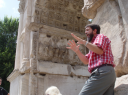
One of my favorite photos from last year’s St. Paul Center pilgrimage to Rome is of Scott Hahn telling the sad story of Jerusalem’s fall, while all the pilgrims gazed upon the Arch of Titus. The Arch’s sculptured walls vividly illustrate Jerusalem’s tragedy in terms of the pagan Romans’ triumph.

We’ll be back to tell the tale in May of 2007, God willing. Please consider joining us!

Picture 1.png

Posted on

Meet You at the Bridge

In our May 2007 pilgrimage to Rome, we’ll be staying fairly close to the Milvian Bridge. I hope you’ll be able to join us, because great things happen there.

A little background … In the early years of the fourth century, Maximin, the ruler of the Eastern regions of the empire, had renewed the persecution against the Christians with bloody enthusiasm. He was as superstitious as Maxentius, who ruled the west, but superstitious on a more regular plan. He squandered the public treasury building new temples, restoring old ones, and setting up a regular state-supported system of pagan priests. Every fake and charlatan who could produce an authentic-looking pagan miracle was promoted to a high-paying government job. Maximin was also a raving drunk, and in his ravings he often issued lunatic orders that he could hardly remember the next day.

Eventually, Maxentius found himself facing just one contender in the West — the young Constantine — and popular feeling was on Constantine’s side. But Maxentius still held Rome and the Italian peninsula. The battle lines were drawn, and Italy prepared for another of those destructive but ultimately meaningless battles between rival emperors that litter the history of the Empire. But this time something different happened. On the eve of the battle, Constantine made a decision that changed the Empire forever.

On October 28, 312, the battle lines were drawn, when suddenly Constantine had a vision. Eusebius, who heard it from the lips of Constantine himself, tells it this way: “About midday, when the sun was beginning to decline, he saw with his own eyes the trophy of a cross of light in the heavens, above the sun, and bearing the inscription CONQUER BY THIS. He himself was struck with amazement, and his whole army also.”

Did Constantine really see that vision? Some modern historians doubt it; they think Constantine made up the story to justify his decision. Really, they said, he saw which way the wind was blowing, and realized that Christians were by far the largest religious group in the Empire. If he had their support, he had an advantage that none of the other Augusti had. And it’s interesting that Eusebius doesn’t mention the vision at all in his History of the Church, written shortly after Constantine’s victory. Only years later, when he was writing his Life of Constantine, did Eusebius tell that famous story.

But it’s quite possible that Constantine did see that vision. Certainly most of the Church has believed the story for most of history. Either way, his decision to fight under the sign of Christ changed the history of the world. Constantine won the battle of the Milvian Bridge, and freed Rome from the tyrannical grip of the madman Maxentius.

In fact, Constantine had approached the problem of religion like a pagan Roman. He had invested in the god he thought might do him the most good, and his investment paid big dividends. But he at least lived up to his agreement with God, and he began to show special favor to the Christians right away. He immediately had a statue of himself with the cross set up in the center of Rome, where everyone would see it, and this inscription was written under it in large letters: “By this saving sign, the true proof of courage, I saved your city from the yoke of the tyrant and set her free; furthermore I freed the Senate and People of Rome and restored them to their ancient renown and splendor.”

When Constantine met Licinius at Milan in 313, the two Augusti issued an edict proclaiming freedom of religion for everyone. For the first time in human history, absolute freedom of religion was the official policy of a great world power. The Edict of Milan was something truly new in the world, and it was really Constantine’s idea—Licinius just went along with it because it seemed best to do what Constantine said.

The drunken pagan Maximin still ruled part of the East, but he was afraid enough of the combined power of Constantine and Licinius that he grudgingly accepted the decree. Anyway, it wasn’t long before Licinius had eliminated him; and when Licinius (who never really liked Christians) found an excuse to begin persecuting the Christians in the East in 320, Constantine eliminated him in turn. By 324 Constantine was sole Emperor of the whole Roman Empire, and the Christian Church was free everywhere to come out into the open.

Posted on

Just an Old-Fashioned Love Song

David Solomon, editor of the Gregory of Nyssa Homepage, has posted A Comparative Study of the Commentaries on the Song of Songs by three great men: Origen of Alexandria, Gregory of Nyssa, and Bernard of Clairvaux. You won’t find better company for reading the Bible’s most lovely and loverly book.

If you’d rather read Origen’s commentary in its entirety (and on paper), you’ll find it in the Ancient Christian Writers series. A tantalizing recent study is Origen on the Song of Songs As the Spirit of Scripture: The Bridegroom’s Perfect Marriage-Song.

An excellent companion volume to Gregory’s portion is From Glory to Glory: Texts from Gregory of Nyssa’s Mystical Writings by Jean Danielou and Herbert Musurillo.

Hat tip: St. Paul Center for Biblical Theology.

Posted on

Belatedly Cyprian

Last week, while I was in the woods, the Church marked the memorial of Saints Cyprian and Cornelius. Even from my sylvan outpost, though, I managed to do a KVSS interview on the great third-century African bishop, and I herewith direct you to the audio file (scroll way down the page). Cyprian is important for many reasons — you’ll learn all that from the interview — but not least for the fact that he wrote a great treatise on the Eucharist, the earliest that has survived to our day. Blogger Maria Lectrix has posted audio of St. Cyprian’s treatise On the Lapsed, along with some wonderful background material. I may have missed the feast day, but Cyprian’s work is a feast always in season.

Cyprian’s Letters are available in three volumes in the excellent Ancient Christian Writers series. His little treatise on the Lord’s Prayer is included in this volume in St. Vladimir’s Seminary’s Popular Patristics Series.