Posted on

Easter Basket Case


Easter Sunday, from 9 to 11 p.m. (Eastern Time), I’ll be on KDKA Radio to discuss the new edition of my book The Companion Guide to Pope Benedict’s the Fathers. That’s 1020 on your AM dial if you’re in the Pittsburgh area, KDKAradio.com if you’re streaming. It’s a call-in show, so you’re welcome to join the conversation. 

I’ll be speaking with the renowned Father Ronald Lengwin, who has been hosting his show, Amplify, since 1975.

Speaking of patristics: you may be aware that KDKA was the world’s first commercial radio station.

Posted on

The Fathers and Fish: It Wasn’t Just for Friday

This (from the London Times) is just too cool.

In Ancient Rome lions ate Christians, so we are told. But what did early Christians eat? A lot of fish, according to recent research on bones from the Roman catacombs.

“The eating habits of Rome’s early Christians are more complex than has traditionally been assumed,” say Leonard Rutgers and his colleagues in The Journal of Archaeological Science. Their work was based on analysis of 22 skeletons found in the Catacombs of St Callixtus on the Appian Way, an area utilised in the 3rd to 5th centuries AD (although some of the skeletons were radiocarbon-dated to the 2nd century).

Posted on

Louth and Found


Kind reader Matthew M. did a bit of Web archeology and found the lost Louth lectures:

Your question about the Louth lectures picqued my curiosity. I found the originals Dan Greeson had posted here, on the website of the lecture location:http://stgeorgecathedral.net/sermons.html (in Windows Media format). On that page are a number of other interesting lectures.

Since the wma format is inconvenient, I converted them to MP3 files here:

The Relevance of the Church Fathers today
Maximus the Confessor and Modern Science

Posted on

Free Patristic Audio

Commenter Stephan drives a truck and is looking for good patristic audio to keep him company in the cab. 

The goldmine, of course, is the site of Maria Lectrix, which has a whole section dedicated to the Fathers in English translation. (And more linked here.)

iTunes U is offering good stuff from the Augustinian Institute, including lectures by  John Cavadini, John Kenney, Lewis Ayres, and others. I don’t know if it’s possible to link to these, but if you have iTunes you know how to get the files. While you’re at iTunes, search on “early Christianity” and you’ll also find lectures by Thomas Oden (editor of the Ancient Christian Commentary series) and Darrell Bock, whose book The Missing Gospels I reviewed here).

Not too long ago, Sister Macrina posted links to some patristic audio.

I’ve posted some radio interviews and stuff.

A couple years back, a young Orthodox seminarian posted files of lectures by Father Andrew Louth, and I linked from here — but his blog has vanished. Anyone know where the files went?

Anyone know other sources of free patristic audio?

Posted on

Season Your Psalter

The new book is in!

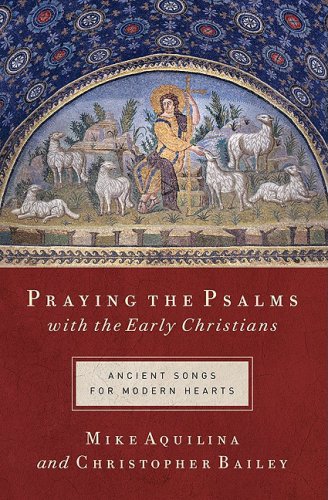
Praying the Psalms with the Early Christians, co-authored with Chris Bailey, with whom I wrote The Grail Code.

What a joy to read the Psalms as they were read in the early Church. For us, as for the first Christians, the Psalms are a treasury of counsel for ordinary living, insight into the power of the sacraments, praise for God’s glory and mercy, and love for his kingdom, which is the Catholic Church. The Fathers call King David to witness as they preach fidelity in marriage, kindness in speech, and even the mercies of purgatory. As we pray this book, we recognize that ancient Church as our own, and we raise our prayer in unision — no, in communion — with the saints of long ago, who are living still.

— Scott Hahn
Professor of Scripture and Theology
Franciscan University of Steubenville

This June, Chris and I will be helping to host a pilgrimage with Happy Catholic.

Posted on

The Annual Feast of Fools (Like Me)

It’s April Fool’s Day, and the blog is three years old. This is post number 1,800. Of the 150 million or so blogs tracked by Technorati, this one’s ranked 43, 173, with an authority of 104. And I’m a Marauding Marsupial in the TTLB Ecosystem. Three years of doing this, and I still don’t understand what any of that means. I don’t think I even have a working hit counter since my last one went out of business.

I do enjoy the company, though, so thanks for dropping in as often as you do. It makes the nerd’s life a lot less lonely, doesn’t it?

Posted on

Putting Your Duqs Up

Last Friday I attended Duquesne University’s colloquium on the reception history of the Bible. It was a full day. If I were a better note-taker, I’d have much more to blog. But I was too busy listening and absorbing it all.

Both keynote addresses were superb: “The Church Fathers and New Testament Exegesis” by Dr. Dale Allison of Pittsburgh Theological Seminary, and “Christ, the Church, and the Shape of Scripture: What We Can Learn from Patristic Exegesis” by Fr. Brian Daley, S.J., of Notre Dame. 

Dr. Allison gave five examples of plausible interpretations proposed (or, rather, commonly held) by the Fathers that are nowhere found in critical commentaries of the last two centuries (including his own!). He emphasized that his examples were representative, not exhaustive, that he was not a patrologist, and that a specialist might come up with many more. His bottom line: “Study of the Fathers should be part and parcel of … modern historical-critical exegesis.” He tagged Tertullian and Eusebius as two of history’s four great “intertextual” interpreters of Scripture (the others being Albert the Great and Grotius). T and E excelled at this, he said, because they were keen to disprove the Marcionites who sought to jettison the Old Testament with its God.

Father Daley looked at the “christological hermeneutics” of four ancient interpreters: Irenaeus, Origen, Athanasius, and Augustine. He directed us to the works where each shows his cards, hermeneutically speaking, laying out principles of interpretation. I hope to track these down for you in the near future and collect them in a single post.

In the afternoon I attended “Blessed is the Glory of God from His Place”: Notes on the Jewish and Christian Reception History of Ezek 3:12, by Fr. Alexander Golitzin, host of the excellent online interdisciplinary seminar, Jewish Roots of Eastern Christian Mysticism. He was every bit as entertaining and illuminating as I expected him to be. I also enjoyed “The Reproduction of Gen 1:26-27 in Y. Berakhot 12d and Early Syriac Sources” by Dr. Silviu Bunta (University of Dayton) and “Reception History within the Canon Itself: A Case Study on Leviticus 25 and the Year of the Jubilee” by my friend Dr. John Bergsma (Franciscan University of Steubenville).

A highlight for me was carpooling over to the conference with David Mills, David Scott and Rob Grano, whose Amazon book links I have not yet learned to incorporate, using the most recent version of WordPress.
Posted on

Jewish Scholars on Christian Fathers on Jewish Matters

The New Republic reviewed Paula Fredriksen’s Augustine and the Jews: A Christian Defense of Jews and Judaism.

The Economist reviewed Miri Rubin’s Mother of God: A History of the Virgin Mary. I haven’t read this one. Her Corpus Christi: The Eucharist in Late Medieval Culture was very useful to me as I was writing The Grail Code: Quest for the Real Presence. Her thesis, in a nutshell, was that the realist doctrine of Transubstantiation made possible many of the great things in Christendom: the hospitals, hostels, and hospices, the orders dedicated to charitable works, etc. She was great on the medieval, but she didn’t quite get the Fathers’ doctrine of the Eucharist. In fact, she acted as if eucharistic realism arose in the Middle Ages, and she showed no evidence of having read Cyril of Jerusalem, Gregory of Nyssa, or more than a bit of Chrysostom on the subject. I fear the same thing might happen in this book — but, again, I can’t say because I haven’t read it.