Posted on

Pittsburgh’s Known for Catch-Up

It’s not quite fifty-seven varieties, but here’s my backlog of recent links. Sorry for the delays!

Maureen picks up a Cyprian allusion in a recent papal document.

Roger Pearse points us to a list of CSEL volumes with links to Google books, and an interesting bit on the Fathers and inerrancy.

Sister Macrina catalogs patristic audio available free online.

Phil has posted a patristic carnival.

Ben C. Smith has concluded his series on the New Testament canons of the patristic era. Feel free to applaud. This is a great achievement.

Roger’s also posting lively translations of the letters of Isidore of Pelusium: “It is necessary, my dear chap, to persuade your listeners by facts that the kingdom of heaven exists, and then to get those who listen to want it. However listeners let themselves be persuaded when they see their teacher acting in a way worthy of the kingdom. But if he philosophizes on the kingdom, while acting in a manner which deserves punishment, as you have done, how can he persuade his listeners? He acts like a man trying to persuade people to desire something which he has previously persuaded them does not exist!”
Adrian Murdoch has posted a ton of good material on archeology. I haven’t been keeping up with my links. Do go and read through his recent archives.
Posted on

A Surprising Patrologist

The biography of Meg More that came out in the U.K. last year is now shipping from the U.S. So I’m re-running my little notice. This is a lovely book for fathers of daughters. It’s a lovely book for lovers of the Church Fathers, devotees of Thomas More, and folks who are fascinated by the history of the Reformation era.

* * * * * * *

I just finished reading John Guy’s A Daughter’s Love: Thomas and Margaret More. It’s a sketch of the relationship between the sainted Lord Chancellor and his firstborn child, his “dearest Meg.”

I was first drawn to the book because I, like Tevye in Fiddler on the Roof, have five daughters — and what father doesn’t see hints of his young daughters’ great virtue in Meg’s character in A Man for All Seasons?

I did not know, however, that Meg was quite a patrologist. Like her father and the Mores’ friend Erasmus, she was a great reader of Eusebius, Cyprian, Jerome, and Augustine. She even corrected mistakes in Erasmus’s scholarship on the Fathers. John Guy thinks she should have been the obvious candidate to translate the Bible into English — except that it never would have occurred to anyone to ask a woman. Meg’s daughter Mary would one day translate Eusebius’s Ecclesiastical History out of the Greek.

I do recommend A Daughter’s Love: Thomas and Margaret More, and not just for dads with lovely daughters, but for everyone. It’s not a devotional book, or even a “Catholic” book (I got no hint that Guy was a co-religionist of mine). It’s a book for all folks, all seasons.

Posted on

Anybody Going to This?

There’s a big patristics deal going on at Duquesne University in Pittsburgh next week. It’s actually a colloquium on the reception history of the Bible, and it takes place March 27, 9 a.m. to 5 p.m. It’s free and open to the public. How’s this for a lineup?


KEYNOTE ADDRESSES:

“The Church Fathers and New Testament Exegesis” — Dr. Dale C. Allison (Pittsburgh Theological Seminary)

“Christ, the Church, and the Shape of Scripture: What We Can Learn from Patristic Exegesis” — Fr. Brian E. Daley, S.J. (University of Notre Dame)

PRESENTATIONS:

“Blessed is the Glory of God from His Place”: Notes on the Jewish and Christian Reception History of Ezek 3:12 — Fr. Alexander Golitzin (Marquette University)

“Scandal and Expectation: The Function of the Allegory/Typology Distinction in Contemporary Scholarship” — Dr. Peter Martens (Yale University)

“The Reproduction of Gen 1:26-27 in Y. Berakhot 12d and Early Syriac Sources” — Dr. Silviu Bunta (University of Dayton)

“Inspired Word and Spiritual Worship: How Byzantine Hymnography Interprets Sacred Scripture” — Fr. John Custer (Byzantine Catholic Seminary of Ss. Cyril and Methodius)

“Ancient Interpretation of John 8” — Dr. Susan Hylen (Vanderbilt University)

“Reception History within the Canon Itself: A Case Study on Leviticus 25 and the Year of the Jubilee” — Dr. John Bergsma (Franciscan University of Steubenville)

CLOSING REMARKS:

“My Journey with Mark” — Fr. Sean P. Kealy, C.S.Sp. (Duquesne University)

I’m hoping to be there — if the work gets done between now and then. Let me know if you’re planning to go.

Posted on

Angels Have Landed

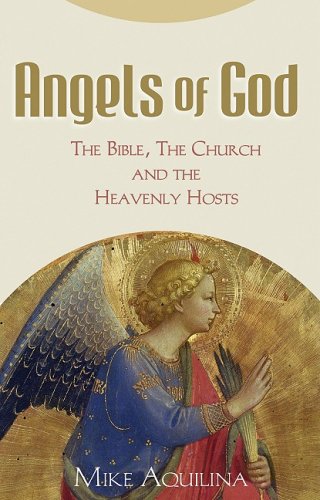
My new book has arrived — Angels of God: The Bible, the Church and the Heavenly Hosts.

Inside, you’ll encounter many of the usual suspects — Dionysius the Areopagite, John Chrysostom, Gregory the Great, and Augustine. Plus Michael, Gabriel, Raphael and a countless host of others.

.

What they’re saying about it:

RUSSELL SHAW: “Angels of God is a learned, readable and ultimately inspiring account — based on Scripture, the teaching and worship of the Church, and the real-life experience of many individuals — of the role played by these heavenly friends of ours in God’s providential plan and in our lives. If you want to get to know your guardian angel, start here.”

MARCUS GRODI: “… by far one of the most thorough and helpful books I’ve ever read about angels. Michael’s book remains safely within the boundaries of Sacred Tradition and gives readers a clearer understanding of ourselves, in relation to God and his heavenly realm.”

FATHER T.G. MORROW: Everything you ever wanted to know about angels and never asked. Another big hit for Mike Aquilina.”

As the catalog says: forget the sweet-faced cherubs of popular culture, and brace yourself for a far more potent reality: powerful heavenly beings who play a significant role in the drama of your daily life. Our fellowship with the angels (says Aquilina) is “not an ornament on our religion; it’s a life skill.”
Posted on

Martyr, She Wrote

Last year I did some consulting work for a new series titled Catholic Heroes of the Faith. I just received the good news that their first two video offerings are available for order: the animated Saint Perpetua Story and the documentary Saint Perpetua: Martyr of the Faith. (I’m talking, on camera and off, through a good bit of the latter.) The website’s very cool. They’ve posted the full text of The Martyrdom of Perpetua and Felicity. They have all sorts of downloadable goodies, like coloring pages and posters. There are also video snippets everywhere. This stuff’s ideal for Catholic-school religion, CCD, or homeschool use.

Posted on

Best of Show

This Friday evening my family and I attended a great event: the opening of an exhibit of the artwork of Lea Marie Ravotti. Specifically, it was the work she did for our collaboration, Signs and Mysteries: Revealing Ancient Christian Symbols. The show is in the vast new parish center of St. Thomas More Church in Bethel Park, Pa. (a suburb of Pittsburgh), and it will continue until March 30. Afterward, Lea hopes to move the show to other venues — churches, libraries, schools, hospitals, colleges and universities. She is also selling prints of selected works from the book. She gave me a tee-shirt with a third-century sarcophagus banquet scene. Now how cool is that?

Hope you can stop by and see the exhibit. If you can’t get to Pittsburgh, don’t fret: you can still buy the book.

Lea is a well-known and well-shown artist in her native Prague. She was raised an atheist in communist Czechoslovakia, came to the States for work when the walls fell, and here she questioned her way to Christian faith. Take a few minutes to read OSV’s interview with the artist about her art and her conversion.

lea's exhibit

Posted on

Confessions, The Sequel

Msgr. Stephen DiGiovanni is getting a lot of buzz since the New York Times talked up his success in promoting the sacrament of penance. When he arrived at his assignment, the confessionals had fallen into use and had been re-purposed. In a (probably unintentionally) allegorical line, the Times reporter noted that “The confessional in the front, nearer the altar, was filled with air-conditioning equipment.” Now, he and his assistants at St. John the Evangelist in Stamford, Connecticut hear an average of 450 confessions a week. Msgr. DiGiovanni has even gained the supreme confirmation that he is doing good in this world: the expressed horror of Father Dick McBrien.

Readers of this blog expected no less from the pastor. Msgr. DiGiovanni is the founder of the Saint Monica Institute for Patristic Studies, which encourages serious study of the Fathers among Catholic lay people. Check out the Institute’s many discussion groups and programs.

Posted on

Lent: Turn Up the Joy

During this season every year, I return to the work of a patrologist I much admire, Father Kurt Belsole, O.S.B. His book is called Joy in Lent, and it’s a study of St. Benedict’s winsome approach to the Church’s season of penance. Father Kurt shows that Benedict’s emphasis on joy in Lent is an original contribution in the history of monastic spirituality. Here’s Benedict himself in chapter 49 of his Rule. The passage is titled “On the Keeping of Lent”:

The life of a monk ought always to be a Lenten observance. However, since such virtue is that of few, we advise that during these days of Lent he guard his life with all purity and at the same time wash away during these holy days all the shortcomings of other times. This will then be worthily done, if we restrain ourselves from all vices. Let us devote ourselves to tearful prayers, to reading and compunction of heart, and to abstinence.

During these days, therefore, let us add something to the usual amount of our service, special prayers, abstinence from food and drink, that each one offer to God “with the joy of the Holy Ghost” (1 Thes 1:6), of his own accord, something above his prescribed measure; namely, let him withdraw from his body somewhat of food, drink, sleep, speech, merriment, and with the joy of spiritual desire await holy Easter.

Father Kurt unpacks that passage as only a good scholar — and good son of St. Benedict — can. Joy in Lent is available, as far as I know, only from the monks of St. Vincent Archabbey. If you don’t own a copy of Benedict’s Rule, consider buying this one, which is quite beautiful and comes with helpful annotation, historical background, and commentary.

Posted on

Fit from a King

PhDiva gives us detail on the recent Davidic discoveries in Israel — descriptions, background, photos, and even a patristic angle:

Some three years ago the impressive remains of a monastery from this period were excavated that together with the remains of the current excavation confirm the identification of the place as “Metofa”, which is mentioned in the writings of the church fathers in the Byzantine period. The name of the Arab village, “Umm Tuba” is therefore a derivation of Byzantine “Metofa”, which is Biblical “Netofa” and is mentioned as the place from which two of David’s heroes originated (2 Samuel 23:28-29).

Posted on

Sigh

I was interviewed twice by the author of this story. I talked about the roots of indulgences in the Old Testament and the New. We discussed the ancient rabbis’ doctrine of the “treasury of merit” and how it applies to the biblical stories. I told her our approach to indulgences is better understood in terms of family life than of civil law or accounting. None of that made it into print, and I’m not really surprised. From the outset, the story seemed to be “Those Crazy Catholics and the Things They Do” (place emoticon with rolling eyes here). So that’s what she wrote. She quoted me once, an inane bit about how many times I do these rain dances and rub the rabbit’s foot in a given year. In the second interview I even clarified for her that the question doesn’t really make sense. It’s like asking how many times I kiss my wife. I told her that since I go to weekly confession and daily Communion, I usually fulfill the requirements, but I tend to do it more deliberately if my business, for example, takes me near a pilgrimage site. But none of that fit the story, which is, please remember: “Those Crazy Catholics and the Things They Do.”

And they wonder why print media are dying. And they talk about how their fact-checking makes their product so much more reliable than what you’ll find on blogs and partisan websites. Uh, yeah, right.

Posted on

Drawing a Bede

Pope Benedict has ventured into the British Isles with his Wednesday Audience talk on the man known to readers of 1066 And All That as the Venomous Bead, and known to other Christians as the Venerable Bede. The full text is not up yet in English, but here’s the summary.

In our catechesis on the early Christian writers of East and West, we now turn to Saint Bede the Venerable. A monk of the monastery of Wearmouth in England, Bede became one of the most learned men of the early Middle Ages and a prolific author, while also gaining a reputation for great holiness and wisdom. His scriptural commentaries highlight the unity of the Old and New Testaments, centred on the mystery of Christ and the Church. Bede is best known, however, for his historical writings, in which he traced the history of the Church from the Acts of the Apostles, through the age of the Fathers and Councils, and down to his own times. His Ecclesiastical History recounts the Church’s missionary expansion and growth among the English people. Bede’s rich ecclesial, liturgical and historical vision enable his writings to serve as a guide for the Church’s teachers, pastors and religious in living out their vocations in the service of the Church’s mission. His great learning and the sanctity of his life, earned Bede the title of “Venerable”, while the rapid spread of his writings made him a highly influential figure in the building of a Christian Europe.

Posted on

Hope for Europe?

Father John Saward ponders the worrisome state of Europe and speaks, with hope, of Europe’s Return to the Fathers. “The faith that comes to us from the apostles passes perpetually, as St Athanasius says, ‘from fathers to fathers’. Now, among our past fathers-in-God, the saintly and orthodox doctors of the early Church (most of whom were bishops) have a special status and authority. Every succeeding generation in the Church refreshes itself at the fount of their teaching and measures itself by the standard of their lives. The fatherhood of the Church Fathers radiates the light of the Gospel unfailingly.”

The Fathers of the Church are the Fathers of Europe. In the first millennium, they gave our continent its Christian birth; at the dawn of the third Millennium, they can aid its re-birth. They ‘inculturated’ the faith, in Greco-Roman antiquity; they can guide us in re-evangelizing the Europe of post-modernity. They are of special encouragement to those who, with Pope John Paul II, seek new bonds of Christian solidarity between East and West, for in the Patristic age the Church still breathed fully with her two lungs. We cannot pretend that there were not, even then, many cases of cultural incomprehension and in the end an apparently unstoppable drift towards estrangement. But equally we must not obscure, we should take heart from, the innumerable examples of lived Catholic communion. Let me cite one. In the second century, St Irenaeus, a Greek from Smyrna, ministered as priest and bishop in Lyons, among the Celts of Gaul. In the far West he heard preached, and himself preached, the same apostolic creed he had received from Polycarp in the East. The one Church of Christ, says Irenaeus, ‘even though dispersed throughout the whole world’, holds in all the places one and the same faith, ‘as though having only one soul and one heart’. And what is the visible principle of this unity and orthodoxy? The succession of bishops from the apostles and the accord of the local Churches with ‘the very great and very ancient Church, known to all, which the two most glorious apostles Peter and Paul founded and established at Rome’.